



Let’s face it, medical expenses can have a major impact on your budget, especially as you get older.
If you’ve heard about a Health Savings Account or maybe your work offers one, then it just may make sense to give it some serious consideration – and, in my opinion, it typically makes a lot of sense.
Interested in learning more?
Everything you need to know about Health Savings Accounts, and how to determine if one is right for you, is here for you.
Table of Contents
What Is an HSA?
A Health Savings Account, also referred to as an HSA, provides an opportunity for you to use pre-tax money from your income to pay for certain medical expenses.
It also allows you to use the money for other qualifying expenses such as medical equipment, prescribed medicine, and copays.
You Can Specifically Use Funds From the HSA on:
- Dental Treatment
- Hospital Services
- Contact Lenses
- Chiropractic Care, And
- Crutches, Among Others
All in all, you can use the money from your HSA to pay for just about any type of medical expense.
Best of all though, the money you use to pay for these expenses comes out 100% tax-free.
The most amazing thing about an HSA is that it offers triple tax savings.
There is no other account available that offers this type of benefit.
Your contributions are pre-taxed, the growth of the funds within your account is tax-free, and when you withdraw money from your account to pay for qualifying medical expenses, the money comes out tax-free.
The amount of money you could save in taxes over your lifetime by contributing to an HSA could easily amount to tens or even hundreds of thousands of dollars.
How Do I Open an HSA?
To open a health savings account, you must be enrolled in a high-deductible health plan (HDHP) through your work or individually.
As long as you have an HDHP, you have the option to open and contribute to an HSA.
And opening your HSA is also a pretty simple step. There are a number of banks and other financial institutions where you can open an HSA.
There could be fees associated, so be sure to do some homework.
Once opened, you can contribute up to a maximum amount to your HSA on an annual basis. For 2024, the maximum contribution is $4,150 for an individual plan and $8,300 for a family plan.
There’s also a catch-up contribution of an additional $1,000 if you’re 55 or older.
Within the HSA, typically after a certain amount has been accumulated, you can invest these monies within various mutual funds offered by your respective HSA.
Where you open your HSA will determine what investment options you have available.
So, What Is A High-Deductible Health Plan?
Okay, let’s take a step back to define what an HDHP is so I don’t lose you.
For an individual plan, the IRS states that an HDHP must offer a minimum deductible of $1,600 with an out-of-pocket maximum of $8,050 for 2024.
For a family plan, The HDHP must offer a minimum deductible of $3,200 with an out-of-pocket maximum of $16,100 for 2024.
The IRS can update and adjust these figures every year.
Many companies today offer both a standard health insurance option, such as a PPO or HMO, along with an HDHP.
Compared to a standard health insurance plan, an HDHP has a higher annual deductible but lower monthly premiums. High deductible health plans typically possess these characteristics:
- For every family, the HDHP uses one calendar year for the deductible.
- HDHPs still deliver the same quality health insurance.
- After meeting the deductible, an HDHP can cover expenses up to 100%.
- HDHPs can be considered more affordable than other health plans. However, it truly depends on your personal and family medical situation.
With the above being a few advantages of an HDHP, there is one major disadvantage you must understand:
You could face the potential for higher out of pocket expenses since you’re on the hook until you reach the threshold of the deductible.
If you don’t have the money set aside or can’t pay for it out of monthly cash flow, then an HDHP might not be the right policy for you, especially if you and your family are prone to regular doctor and hospital visits.
How Does an HSA Work?
So now that we’ve established you have to be participating in an HDHP before you can open an HSA, let’s dig a little more into how the policy works.
If you are an employee, you can set up your health savings account through a trustee such as a bank. However, most employers who offer an HSA will most likely already have a relationship established with an institution where you will open your account.
Once your account is opened, it then comes down to determining how much you want to contribute out of your paycheck. And, if you’re lucky, your employer might even be willing to make contributions to your HSA as well.
If your employer makes a contribution, it is not included as income; however, it does count toward your maximum annual contribution.
How Much Should I Contribute to the HSA?
When it comes to determining how much you should contribute, it truly depends on your own personal situation.
With all things being equal though, I always recommend contributing as much as you possibly can up to the maximum.
For 2024, the maximum contributions will be $4,150 for individuals, and $8,300 for families.
And, if at all possible, I recommend not touching the money in your HSA and letting it grow so you can use it for health care expenses in retirement. Try to pay for current health care expenses out of your cash flow or other savings.
Granted, I know this isn’t possible for everyone, but the longer you can take advantage of the tax-free growth of the HSA without tapping into it, the more money you will have to withdraw 100% tax-free for medical expenses in retirement.
Does an HSA Expire?
Your health savings account does not expire. You can keep your account for as long as you want regardless of if you decide to change your insurance plan or change jobs.
Also, if you have an Archer MSA, you can place that money into your HSA.
Don’t confuse an HSA with an Archer MSA or flexible spending account (FSA) in terms of carryover policies and contribution limits, even though all three accounts can be used for medical and healthcare costs.
Unlike an FSA, the HSA doesn’t have the use-it-or-lose-it restrictions. An HSA will carry over year after year.
Pros and Cons
Advantages of an HSA
Here are the notable benefits of an HSA and why so many people have chosen to set one up:
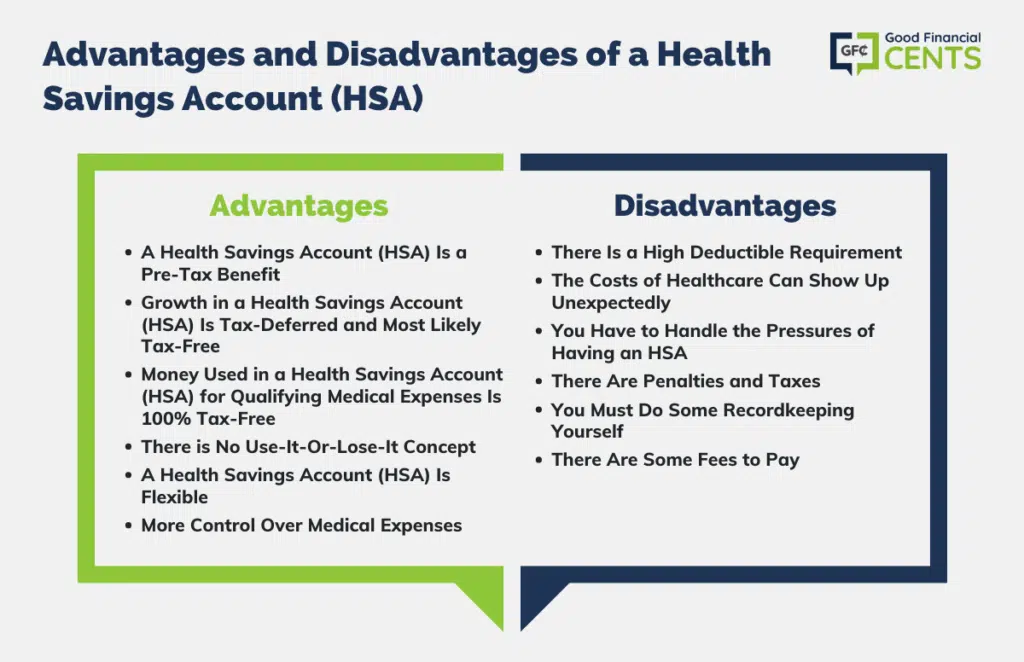
- HSA Is a Pre-tax Benefit. Contributions into the account are made before being taxed. This is extremely beneficial as it can lower the amount you pay in taxes.
- Growth in an HSA Is Tax-Deferred and Most Likely Tax-Free. The growth of your investments within your account is tax-deferred and most likely will be tax-free as long as they are used for qualifying medical expenses.
- Money Used in an HSA for Qualifying Medical Expenses Is 100% Tax-Free. Thus the power of triple tax savings. Contributions go in pre-tax. Once invested, they grow tax-deferred, and when your money is withdrawn for qualifying medical expenses, it comes out 100% tax-free. There’s no other account in the United States that offers triple tax savings.
- There Is No Use-It-Or-Lose-It Concept. The funds in your account are always yours. The only way they go away is if you spend them.
- An HSA Is Flexible. The money in your account has a wide range of uses including most medical expenses, prescription medications, office visits, eyewear, etc. Another benefit of an HSA is that you may use it for the health expenses of your dependents as well.
- More Control Over Medical Expenses. Basically, you’re trading reduced monthly premiums for the possibility of higher out-of-pocket expenses.
- Health and Doctor Visits Don’t Occur That Often Throughout the Year. An HSA could allow substantial savings.
Disadvantages of an HSA
- There Is a High Deductible Requirement. You may find it hard to come up with the required amount of money to meet a high deductible for your out-of-pocket expenses. This can be the case even though you have lower premiums every month.
- The Costs of Healthcare Can Show Up Unexpectedly. You cannot predict the future, and your health expenses may suddenly go beyond what you expected. When this happens, you may find yourself lacking the money needed to pay for medical expenses.
- You Have to Handle the Pressures of Having an HSA. You may choose not to seek medical care even when you need it because you do not want to touch your HSA funds or pay for them out-of-pocket.
- There Are Penalties and Taxes. While the HSA is tax-free for medical expenses, that’s not the case if you have to withdraw it for other reasons. When you withdraw money before you turn 65 and it’s for a non-qualified expense, you will be taxed and receive a 20% penalty. However, if you withdraw money for non-qualified expenses you will still pay taxes, but the 20% penalty is waived.
- You Must Do Some Recordkeeping Yourself. It is important to keep a record of all your withdrawals, healthcare expenses, and the receipts that come with them. They will be your proof that you used them for eligible healthcare expenses.
- There Are Some Fees to Pay. While it may vary by institution, your health savings account may require you to pay a fee per transaction or for monthly maintenance. However, these fees are typically pretty reasonable, and the institution may waive those fees if you keep and maintain a minimum balance.
How to Set up an HSA
Setting up an HSA is simple. If one is provided through your employer, then it’s just a matter of signing when you are hired or during open enrollment.
If you’re self-employed though, you’ll have to find a bank or financial institution in which to open your account.
In general, you do not need a certain amount of money or a minimum balance in the account to qualify for an HSA. But, some administrators may be willing to waive fees in the event you maintain a minimum balance.
Of course, when you are just starting out with your health savings account, an institution that offers a lower minimum balance can save you some money in fees.
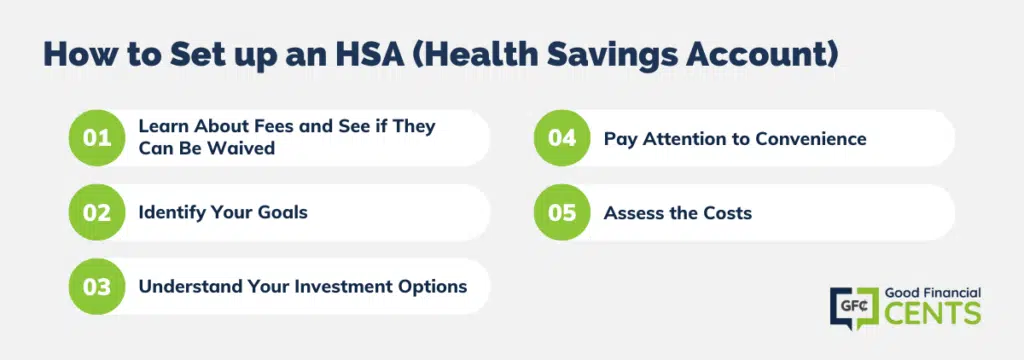
1. Learn About Fees and See if They Can Be Waived
When looking for the most suitable place to open your health savings account, fees and investment options should be priorities. Ultimately, you can make a comparison of several providers and pick the right one for you.
2. Identify Your Goals
The main purpose of setting up an HSA is to have some assistance in covering your medical expenses either now or in the future. Any money left over in your account, as long as it is invested, can grow and earn interest.
With that being the case, you need to determine whether you’re going to use your HSA for current medical expenses or let the account grow over time to use in retirement for the inevitable expenses that won’t be covered by Medicare.
It doesn’t necessarily have to be one or the other, but having a plan in place can help you identify if and when you want to withdraw money from your account.
3. Understand Your Investment Options
It is essential to assess what investment options are available in a specific health savings plan. You will know it’s the best plan if the HSA provides a wide variety of options with low expense ratios.
4. Pay Attention to Convenience
Convenience is a vital factor regardless of if you pick an HSA at a major institution or a small bank. An ideal HSA will allow you to withdraw funds and contributions easily. For instance, an HSA will give you a debit card that you can use at a doctor’s visit or a pharmacy.
You can find HSA custodians that have ATMs and several branches across the country. There are also smaller institutions that communicate with their customers via a website, telephone, or mail.
5. Assess the Costs
The monthly and annual fees vary among banks. Your account balance and your funds also determine the fees you will have for your HSA. Some providers will require you to have a minimum balance first. Make sure to know what a bundled fee covers as well as the schedule of fees.
Alternatives to Using a Health Savings Account
The information above states the rules on how you can qualify for a health savings account such as enrolling in an HDHP.
But, what if you do not qualify? What are your alternatives?
Other Health Plans Sponsored By Employers
- Stand-Alone Health Reimbursement Accounts (HRAs): HRAs are used by small businesses to reimburse their employees for health insurance and out-of-pocket medical expenses.
- Flexible Savings Account (FSA): FSAs are plans established by employers that allow for reimbursement of eligible medical expenses, tax-free. However, you cannot use them on health insurance premiums.
- Healthcare Reimbursement Plans (HRPs): HRPs are plans funded by employers to be used for the individual reimbursement of their health insurance premiums, tax-free. HRPs do not have a maximum annual contribution.
PPO Health Insurance Plans
A PPO plan is a program in which an insurance company and healthcare providers have an agreement to provide discounted fees to their members.
Joining a PPO will enable you to acquire some discounts on healthcare expenses such as a doctor’s visit, an emergency procedure, or a prescription drug purchase.
IRA Accounts
An IRA is a kind of investment that is set up at a financial institution or a brokerage firm.
Over time, you add money to your account, and you may use the money to acquire investments like bonds, mutual funds, and individual stocks.
You may also withdraw the money at a later date and use it as an income during retirement.
Final Words – Health Savings Account
While there are some alternatives to a Health Savings Account, it is essential to make sure that you qualify for it to reap its benefits. The good thing about an HSA is that you have full control of the money in your account.
Consult your bank about their health savings plans and talk to a broker or a financial advisor to help you review your options.
This is a post from Clint Haynes, a Certified Financial Planner and Financial Advisor in Kansas City, Missouri. He is also the founder and owner of NextGen Wealth. You can learn more about Clint at his website NextGen Wealth.