



A business checking account helps small business owners keep their business funds separate from personal funds.
No matter the type of business you’re in, you need a checking account in order to stay on top of bills and invoices. You also need an account in order to accept and deposit payments from customers or clients, and you probably need a debit card that lets you pay for business-related expenses directly.
Get started with our top pick: Chase Business Checking
The best business checking accounts make it easy to create a “home base” for your business finances — one where you can accept payments, stay on top of payroll, and access important banking benefits. Some of the best business checking accounts even offer initial cash bonuses you can earn if you sign up and set up qualifying direct deposits or meet minimum balance requirements. Most importantly, many of the top business checking accounts available today function mostly online, meaning you can open an account virtually and without ever leaving your home.
Table of Contents
Best Business Checking Accounts of 2026
As a business owner, you have a lot of issues to worry about. Your business checking account shouldn’t be one of them. We compared all the top business checking accounts available today to find the ones with the best features and benefits with the lowest fees (or even no fees).
If you need a new checking account for your business, you should start your search here:
- – $300 cash bonus available when opening an account with qualifying activities
- – Monthly variable fee waived with a minimum qualifying balance or qualifying activities
- – Access 16,000 ATMs and nearly 4,900 branches
- – Unlimited electronic deposits

- -No account fees or hidden fees
- -Earn 1.0% APY on up to $100,000 in your account
- -FDIC-insured for at least $250,000
- -Unlimited transactions
- -Live customer support
- -Make transfers to other accounts with ease
- -No account fees or hidden fees
- -No minimum balance requirements
- -Manage money, initiate transfers, and pay bills on the go with the mobile app
- -Get all your ATM fees reimbursed
- -FDIC-insured

- -No monthly maintenance fees or minimum balance requirements
- -Access over 3,100 ATMs and 1,100 bank branches nationwide
- -Free 200 transactions each month

- -Earn .80% APY on deposits when you meet minimum daily balance requirement
- -Unlimited domestic ATM fee reimbursements
- -$100 minimum deposit required to get started
- -Get up to 50 free transactions per month

- -Access over 43,000 ATMs nationwide without a fee
- -Most transactions are unlimited
- -No monthly service charges or account minimums
- -Mobile deposit available

- -Broad ATM network with more than 39,000 available nationwide
- $35 monthly fee, waived with an average daily balance of $25,000 or more
- -Unlimited transactions each month
- -Free online bill pay and business debit cards

- -Qualify for 150 free transactions per statement cycle ($.50 per transaction thereafter)
- -25 free cash deposits per statement cycle
- -Access over 3,000 branches
- -Access U.S. Bank, MoneyPass, and participating 7-Eleven store ATMs.
Best Business Checking Reviews
The best business checking accounts offer a ton of perks and features for small businesses without any burdensome fees. The following reviews go over the highlights of each account including checking features each offers, monthly fees (and how to avoid them), and any bonus offers available.
Chase Business Checking
Chase Business Checking is popular with consumers thanks to its many user-friendly features and its initial bonus offer. Currently, you can get $300 as a new Chase business checking customer, when you open a Chase Business Checking® account with qualifying activities. If you read the fine print, the requirements for the cash bonus are very reasonable. All you have to do is open an account, deposit at least $2,000 in new money within 20 days, and complete five debits or direct deposits within 60 days. Once you complete the qualifying activities and maintain the balance for at least 60 days, the bonus is yours.
Other perks you can expect with Chase Business Checking include convenient access to 16,000 ATMs and almost 4,900 bank branches nationwide, unlimited electronic deposits at no charge, access to online banking and bill pay, and 24/7 customer service. Chase Business Checking does charge a variable fee on business checking accounts. The requirements to waive the fee vary by product.
Get $300 Cash Bonus with Chase Today!
Highlights:
- Get $300 as a New Chase Business Checking Customer, When You Open a Chase Business Checking® Account With Qualifying Activities
- Monthly Variable Fee Waived With a Minimum Qualifying Balance or Qualifying Activities.
- Access 16,000 ATMs and Almost 4,900 Bank Branches Nationwide
- Unlimited Electronic Deposits
BlueVine
BlueVine is well known for its small business loans, yet this company also offers a very lucrative business checking offer. Customers can get unlimited transactions and access to live support, and there are no account management fees or hidden fees.
Money kept in a BlueVine business checking earns 1.0% APY, although this rate only accrues on the first $100,000 you have on deposit. You get two free checkbooks with this account, so you can use it to pay bills that aren’t easily paid online. You can also get fee-free access to your money at more than 38,000 MoneyPass ATMs nationwide, and your deposits are FDIC-insured up to $250,000.
Highlights:
- No Account Fees or Hidden Fees
- Fdic-Insured for at Least $250,000
- Earn 1.0% APY on up to $100,000 in Your Account
- Unlimited Transactions and Live Customer Support
- Make Transfers to Other Accounts With Ease
Novo
Novo offers small-business checking that is geared to business owners as well as freelancers and entrepreneurs. Its business checking account comes with no account fees and no hidden fees, and there are no minimum balance requirements to get started or maintain your account.
Novo will reimburse your ATM fees at any ATM nationwide, so you don’t have to worry about driving around town trying to find an in-network ATM. The mobile app Novo provides helps you manage your money on the go, but also to pay bills and transfer money.
You can also get free ACH transfers, mailed checks, and incoming wires. Opening an account takes only a matter of minutes, and rest assured that your small-business checking accounts from Novo are also FDIC-insured.
Highlights:
- No Minimum Balance Requirements
- No Account Fees, Monthly Fees, or Hidden Fees
- Mobile App Lets You Manage Money, Initiate Transfers, and Pay Bills on the Go
- Get All Your ATM Fees Reimbursed
- FDIC-Insured
Citizens Bank Clearly Better Business Checking
If you live in an area where Citizens Bank has a presence, you should also check out Citizens Bank Clearly Better Business Checking. This account comes with no monthly maintenance fee and no minimum balance requirement. You also get your first 200 transactions for free each month, which is more than enough for most small businesses.
For the most part, this business checking account is best for someone who lives near qualifying ATMs, posts less than 200 transactions each month, and doesn’t want to pay any fees for a business checking account.
Highlights:
- No Monthly Maintenance Fees or Minimum Balance Requirements
- Access Over 3,100 ATMs and 1,100 Bank Branches Nationwide
- Free 200 Transactions Each Month
Axos Bank Business Interest Checking
Most business checking accounts don’t offer interest on deposits, but Axos Bank Business Interest Checking is one of the few that does. With this account, you’ll earn .80% APY on your balance without a monthly maintenance fee provided you maintain an average daily balance of $5,000. You can also access online and mobile banking, including bill pay and the option for remote deposits.
Other benefits of Axos Bank Business Interest Checking include the fact you get unlimited domestic ATM fee reimbursements and your first set of 50 checks for free. You also get up to 50 free transactions per month ($.50 each thereafter) and up to 60 remote deposits per month. Finally, you only need an initial deposit of $100 to get started with this account.
Highlights:
- Earn .80% APYon Deposits When You Meet Minimum Daily Balance Requirement
- Unlimited Domestic ATM Fee Reimbursements
- $100 Minimum Deposit Required to Get Started
- Get Up to 50 Free Transactions per Month
BBVA USA Business Connect Checking
BBVA USA Business Connect Checking makes business banking easy thanks to its online and mobile access and broad ATM access. There are no monthly service charges associated with this account, and there are no minimum balance requirements, either. You can access all BBVA Compass, Allpoint, and participating 7-Eleven ATMs as well, so you should have easy access to your money no matter where you live.
Mobile deposit is available, and you can qualify for a debit card that works in conjunction with your checking account at no additional charge. Most transactions are unlimited each month but do get only five in-branch withdrawals or process checks combined per month for free. You only need $100 to open this account as well, so it’s easy to get started.
Highlights:
- Access Over 43,000 ATMs Nationwide Without a Fee
- Most Transactions Are Unlimited
- No Monthly Service Charges or Account Minimums
- Mobile Deposit Available
Capital One Spark Business Checking
While Capital One is known for its popular personal and business credit cards and its Capital One 360 checking account, this bank also offers an extremely popular checking account for small businesses. Capital One Spark Business Checking, as it is called, promises to “unlimit your business” with free unlimited transactions each month. Your first five domestic wires are also free each month, and you can access your money faster with next day availability.
A rather steep monthly service fee of $35 applies with this account, but you can have your fee waived if your 30 to 90-day average balance is $25,000 or more. You also get free online bill pay and free debit cards for your account, and you’ll have access to over 39,000 Capital one and Allpoint ATMs nationwide.
Highlights:
- Broad ATM Network With More Than 39,000 Available Nationwide
- $35 Monthly Fee, Waived With an Average Daily Balance of $25,000 or More
- Unlimited Transactions Each Month
- Free Online Bill Pay and Business Debit Cards
U.S. Bank Silver Business Checking
Silver Business Checking from U.S. Bank is another account that can make sense for small businesses in nearly any field. This account comes with 150 free transactions per statement cycle, 25 free cash deposits per statement cycle, and the option for remote check deposit.
This account also comes with online and mobile bill pay, and there are no monthly maintenance fees. Also, note that U.S. Bank has over 3,000 branches that are mostly on the East Coast, so you could do some of your banking in-person if you live near one.
Highlights:
- Qualify for 150 Free Transactions per Statement Cycle ($.50 per Transaction Thereafter)
- 25 Free Cash Deposits per Statement Cycle
- Access Over 3,000 Branches
- Access U.S. Bank, Moneypass, and Participating 7-Eleven Store Atms.
How We Chose the Best Business Checking Accounts
The business checking accounts listed above are some of the absolute best available today, but we didn’t come up with this list out of thin air. After considering more than 30 business checking accounts in existence, we formulated our list of top picks based on the following factors:
Low or No Fees
It’s not uncommon for checking accounts to come with monthly maintenance fees, but we still think these fees should be avoided when possible. As a result, we only considered business checking accounts that don’t charge any monthly fees or have fees you can avoid with qualifying activity. We also made sure the qualifying activity was “reasonable” and realistic for most small businesses to achieve.
Broad ATM Network
Since most business owners need an easy way to access cash in their accounts, we gave preference to the business checking accounts with broad ATM networks. We also considered banks that offer free debit cards for account holders since this lets them access their funds and make purchases directly from their accounts.
Online and Mobile Access
In today’s modern world, you really need to work with a bank that lets you manage your accounts, pay bills, and keep up with transactions on the go. We only considered banks with a strong online and mobile presence for this list, although some banks with brick and mortar branches also made the cut.
Reasonable Limits on Transactions
We also kept our eye out for unreasonable limits on transactions, which is why the banks on our list are so specific. While some of the banks that made our list do limit transactions, we found their limits reasonable for most businesses.
Choosing the Best Business Checking Account — Factors to Help You Decide
All the business checking accounts that made our list are good ones, but it’s likely a few of them would suit your needs better than the rest. Here are the factors you should consider and compare before you sign up.
Local ATM Access
If you want to be able to access your funds with a debit card, you’ll want to make sure your bank offers ATMs close to where you live or work. Many banks have extremely broad networks, but that doesn’t mean they have ATMs in your area. The best way to find out is to head to each bank’s business page or ATM search page to check. If you don’t make sure you’ll have access to local ATMs, you could wind up paying a lot more in foreign ATM fees than you want.
Access to Brick and Mortar Bank Branches
Do you bank online, or do you like to have access to a physical branch? This is a good question to ask yourself as you compare banks and all they have to offer. Some of the banks in our ranking have brick and mortar locations you could visit to make deposits and ask questions. However, others mostly operate online.
Features and Functions
Make sure you consider banks that offer the functionality you need the most, whether that’s access to a mobile app, remote deposits, or online bill pay features. The banks on our list tend to offer the standard features available today, but you should still double-check to make sure your new business checking account will let you bank the way you want.
Maintenance Fees
If a monthly maintenance fee is charged on accounts you’re considering, you should be able to have it waived with a minimum account balance requirement or minimum activity like direct deposits. Monthly maintenance fees are very common among business checking accounts, so they shouldn’t be a deal-breaker. Just make sure you are either comfortable with the fee or able to have it waived without too much effort on your part.
Transaction Limits
Finally, transaction limits are a real sticking point with many business checking accounts. This is especially true for businesses that have a ton of small transactions each month since even small transaction fees of $.50 each can add up fast.
If your business only has a handful of transactions each month, this detail may not matter a lot to you. Still, you should check your current business checking account to get an average of how many deposits and debits your business requires each month. From there, you’ll be able to choose a business checking account that offers enough free transactions to get you through each month.
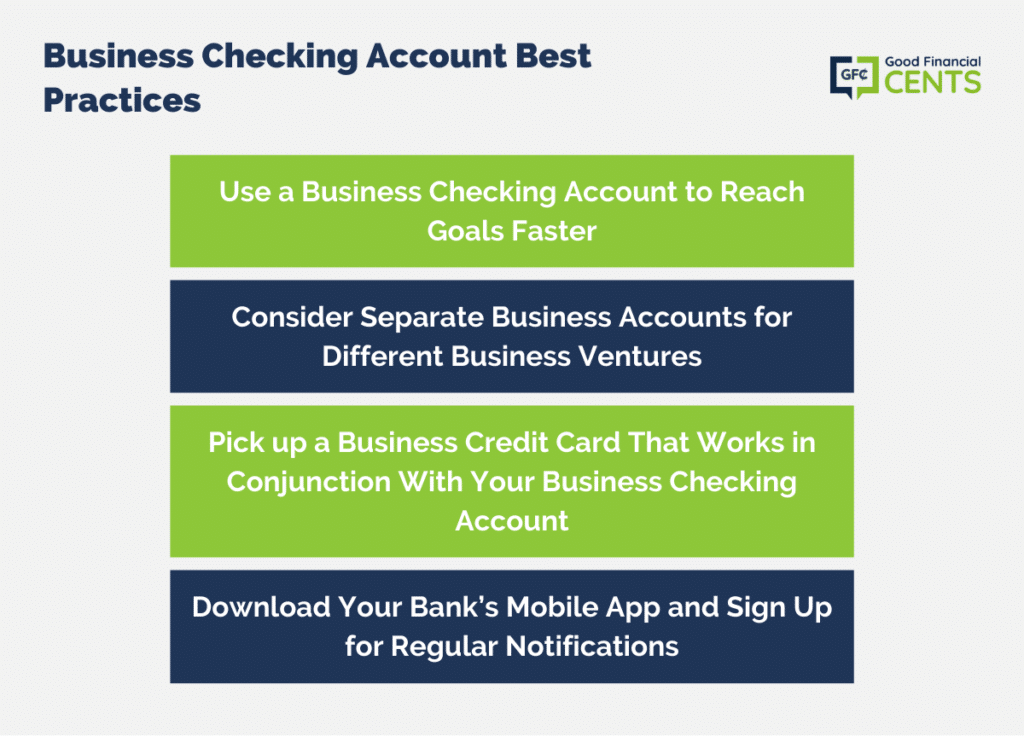
Business Checking Account Best Practices
If you’re in the market for a new business checking account, that’s usually a good sign you’re on the right track. Having a separate account to manage your business income and payments to vendors can help you stay organized and avoid mixing personal and business funds, but it can also help you access powerful tools that can help you take your business to the next level.
Consider these tips as you select a business checking account and start using your account to help your business grow:
1. Use a Business Checking Account to Reach Goals Faster.
No matter the goals you have for your start-up or small business, a business checking account can help you get there faster. Not only can you save time by organizing your business finances under the umbrella of a new checking and savings account, but you can earn interest on your deposits and grow business wealth faster.
2. Consider Separate Business Accounts for Different Business Ventures.
Also, consider whether it makes sense to open additional business accounts if you come up with a secondary business idea and want to avoid intermixing funds. Since many business checking accounts don’t come with any fees, you can easily manage your accounts without having to pay extra for the privilege.
3. Pick up a Business Credit Card That Works in Conjunction With Your Business Checking Account.
Also check whether the bank you’re considering offers a business credit card, as many of the larger banks do. Chase, for example, offers popular business bank accounts but also travel and rewards cards for businesses that help people rack up cash back or flexible travel rewards for each dollar they spend.
4. Download Your Bank’s Mobile App and Sign Up for Regular Notifications.
Finally, consider downloading your bank’s mobile app if they have one. Not only will this help you check in with your balance and upcoming bills while you’re on the go, but you can sign up for notifications that will alert you when a deposit is made or your account balance is low.
In Summary: The Best Business Checking Accounts
Whatever your business goals may be, a good business checking account can help you organize and reach those goals even faster.
These responses are not provided or commissioned by the bank advertiser. Responses have not been reviewed, approved or otherwise endorsed by the bank advertiser. It is not the bank advertiser’s responsibility to ensure all posts and/or questions are answered.