



Are you a self-employed business owner who is looking for a cost-effective way to lower your taxes and help you save for retirement?
If that fits your profile then opening a SEP (Simplified Employee Pension) IRA might be a good retirement account to start for your business.
When I was researching what would be the best retirement plan to set up for myself when I first became self-employed, I narrowed it down between the SEP IRA and the Solo 401(k).
Both allowed very favorable contribution limits, but the administrative costs and ease of setting up made the SEP IRA the easy answer.
If you are considering opening a SEP IRA for your business, here’s what you need to know about the SEP IRA rules and contribution limits and how easy it is to open one.
Table of Contents
- What Is a SEP IRA?
- SEP IRAs Have Tax-Deferred Compounding
- SEP IRA Contributions Are Discretionary
- How Much Can You Contribute to a SEP IRA?
- What Makes Employees Eligible for a SEP IRA?
- Setting Up a SEP IRA and Maintaining Filing Requirements
- What’s the Difference Between a SEP-IRA vs. a Simple IRA?
- Three Reasons You Should You Open a SEP IRA
- Where Can I Open a SEP IRA?
- The Bottom Line – Opening a SEP IRA
- FAQs on SEP IRA Rules
What Is a SEP IRA?
A SEP IRA (Simplified Employee Pension) is a type of employer-sponsored retirement plan that allows business owners and self-employed individuals to make contributions to traditional IRA accounts for themselves and their employees.
The contributions are tax-deductible and the money in the account grows tax-deferred until it is withdrawn in retirement. SEP IRA plans are designed to be simple and easy to set up and maintain.
Employers can establish a SEP IRA plan with minimal paperwork and low administrative costs, and contributions can be made for all eligible employees regardless of whether they choose to contribute to the plan or not.
SEP IRAs Have Tax-Deferred Compounding
Just as a traditional IRA or 401(k), your contributions are pre-tax and can significantly lower your taxable income.
You contribute pre-tax dollars to a SEP IRA, and that has the effect of lowering your tax bill. The money in the IRA grows tax-deferred, and your business doesn’t pay any taxes on the IRA earnings. The assets can be invested in many ways.
The traditional IRA rules apply. When you take the money out of a SEP IRA for retirement, you pay ordinary income taxes on it. (Should you withdraw SEP IRA assets before age 59½, you’ll likely be assessed a 10% penalty, with some exceptions.)
SEP IRA Contributions Are Discretionary
One huge bonus for business owners is that you are not required to contribute to a SEP IRA each year. In addition, there is not a set amount that you have to put in. This flexibility is priceless for a business owner who has a fluctuating net income year after year.
Also, you are not subject to the typical IRA deadline to contribute: April 15th. If you file a tax extension, you can wait until then to make the contribution.
How Much Can You Contribute to a SEP IRA?
In 2024, you can contribute up to 25% of an eligible employee’s compensation, up to a limit of $69,000. That amount is increased by $5,000 from 2022. While that increase may seem minimal, over time it will have a sizable impact on your retirement.
Catch-up contributions are permitted for older employees, increasing the total contribution by $6,500 to $69,000. Based on the 25% rule the income threshold should be $264,000, but it’s not quite that simple. The actual maximum qualifying income for 2024 is $330,000.
Now I just said that you can contribute 25% of your income, up to a total income of $330,000. But $330,000 at 25% would be $82,250, which isn’t right. And that’s where the maximum contribution gets a little bit more complicated.
Under the IRS’s convoluted calculations, in order to come up with the 25% contribution amount, you must first deduct the amount of the contribution from your income. Got that?
For those of you who follow the math, it works out to be – effectively – 20%. That’s how you get the maximum contribution of $66,000 on a $330,000 income.
By deducting $66,000 from $330,000, you get $264,000. And if you multiply 25% times $264,000, you arrive at the maximum contribution of $66,000. I said the calculation was convoluted, and this is what I mean. But for our purposes, you should assume that you can contribute 20% of your income to a SEP IRA. (If you want to do a deep dive into how this works, check out the IRS formula for calculating the contribution.)
| YEAR | MAXIMUM ANNUAL CONTRIBUTION | MAXIMUM CONSIDERED COMPENSATION |
|---|---|---|
| 2024 | $69,000 | $345,000 |
| 2023 | $66,000 | $330,000 |
| 2022 | $58,000 | $290,000 |
| 2020 | $57,000 | $285,000 |
| 2019 | $56,000 | $280,000 |
| 2018 | $55,000 | $275,000 |
| 2017 | $54,000 | $270,000 |
| 2016 | $54,000 | $270,000 |
| 2015 | $53,000 | $265,000 |
| 2014 | $52,000 | $260,000 |
| 2013 | $51,000 | $255,000 |
| 2012 | $50,000 | $250,000 |
| 2011 | $49,000 | $245,000 |
| 2010 | $49,000 | $245,000 |
| 2009 | $49,000 | $245,000 |
What Makes Employees Eligible for a SEP IRA?
If you have employees, then provided they pass a series of tests, you will have to contribute the same percentage to them – just based on their salary- not yours. Generally, employees of a small business are eligible for a SEP IRA if they:
- Are older than 21;
- Have worked for the business in at least three of the five years preceding the year in which the IRA contribution is made; and
- Have received $750 or more in compensation from the business in 2024 (this can rise with COLA adjustments in future years). However, the IRS states that an employer “may use less restrictive requirements to determine an eligible employee.”
However, the IRS states that an employer …
“may use less restrictive requirements to determine an eligible employee.”
Employees covered by a union contract may be excluded from a SEP, as well as non-resident aliens who have not earned income from your business.
All eligible employees must participate in the SEP, including part-time and seasonal workers and employees who die, quit, or get laid off or fired during the year.
Setting Up a SEP IRA and Maintaining Filing Requirements
In order to set up a SEP IRA you first need to choose the trustee for the plan. That can be a bank, a mutual fund family, a diversified investment brokerage, or a managed investment account.
That must be followed by three additional steps:
- Execute a written agreement to provide benefits to all eligible employees.
- Give employees certain information about the agreement.
- Set up an IRA account for each employee.
The plan trustee can help you with all of the set-up steps. The written agreement must include the name of the employer as well as the requirements to enable employee participation. It must also include an allocation formula, and be signed by you or another responsible official in your business.
The IRS even provides Form 5305-SEP (Simplified Employee Pension-Individual Retirement Accounts Contribution Agreement) for this purpose, though the form does not need to be filed with the IRS.
If you don’t want to use the 5305, the trustee that you select to administer the plan almost certainly has their own document format for you.
Once the trustee and the written agreement have been established, you must provide any employees with the following:
- Notice that you have adopted the SEP;
- Any requirements for receiving the allocation; and
- The basis on which the employer contribution will be allocated.
Important: You must also provide your employees with a copy of the completed Form 5305-SEP, or other written agreement used, as well as instructions for the form. It is not considered adopted until each employee is provided with the following information:
- A statement that IRAs other than the one the employer contributes to may provide different rates of return and contain different terms.
- A statement that the administrator of the SEP will provide a copy of any amendments within 30 days of the effective date along with a written explanation of its effects.
- The administrator will give written notification to the participant of any employer contributions made to a participant’s IRA by January 31 of the following year.
You and each of your employees will get a statement from the plan trustee at the time you make your first contribution, and at least annually thereafter. The trustee must also provide a plain language explanation of any fees or commissions that it will charge on funds withdrawn from the plan.
The plan can be set up as late as the due date of your business income tax return for the year in which you want to establish the plan, including filing extensions if necessary.
What’s the Difference Between a SEP-IRA vs. a Simple IRA?
The SEP-IRA and Simple IRA (Savings Incentive Match Plan for Employees) are both types of employer-sponsored retirement savings plans, but they have some important differences:
- Eligibility: SEP IRA plans are open to employers of any size, including self-employed individuals, while Simple IRA plans are only available to employers with 100 or fewer employees.
- Employee contributions: Employee contributions are not allowed in a SEP IRA plan, while employees can make contributions to a Simple IRA plan.
- Employer contributions: Employers are required to make contributions to a Simple IRA plan, either by matching employee contributions dollar-for-dollar up to 3% of compensation or making a non-elective contribution of 2% of compensation for all eligible employees. In contrast, there are no employer-matching contributions required for a SEP IRA plan, but employers are required to make contributions to the plan.
- Contribution limits: The contribution limits for a Simple IRA are lower than for a SEP IRA. For the year 2024, the contribution limit for a Simple IRA is $16,000 for individuals under age 50 and $19,500 for those 50 and older, while for SEP IRA is the lesser of 25% of the employee’s compensation or $69,000.
- Penalties for early withdrawals: Both SEP IRA and Simple IRA plans have penalties for withdrawing funds before reaching age 59.5.
Three Reasons You Should You Open a SEP IRA
If you’re in a position to open up a SEP IRA then you definitely should. It’s one of the very best self-employed retirement plans available.
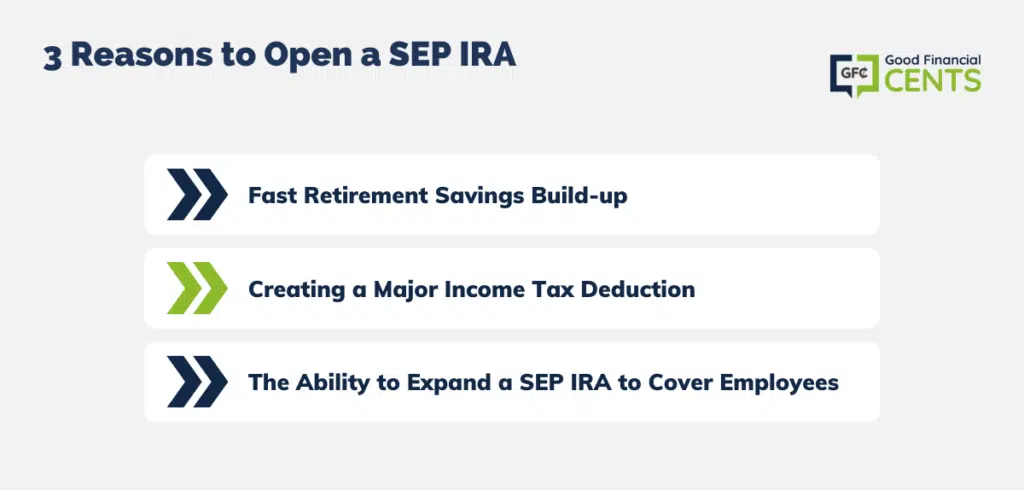
Here are three reasons why this plan stands out above every other:
1. Fast Retirement Savings Build-up
At $$69,000, or $76,500 if you are 50 or older, the SEP IRA offers one of the highest contribution limits possible. This is far higher than what you can get with a traditional or Roth IRA, or a SIMPLE IRA. Think about how quickly you could accumulate a seven-figure retirement portfolio by making that kind of contribution each year.
By contributing $69,000 per year, with an investment return of 7% per year, your plan could pass $1.1 million in just 12 years. That means that if you start a SEP IRA at age 30, you will be a millionaire by the time you’re 42, just on your retirement plan alone.
Let’s take it a step further. If you continue the same contribution pattern until the age of 50, you will have nearly $2.3 million after just 20 years of making contributions. That looks like a recipe for early retirement, don’t you think?
2. Creating a Major Income Tax Deduction
But moving past the rapid portfolio build-up, let’s consider another major advantage of the SEP IRA – tax deductibility. $69,000 is a massive reduction in your taxable income. Assuming that you’re in the 22% tax bracket for federal income taxes, and 6% for state income tax, you would save $16,240 in income taxes each year.
3. The Ability to Expand a SEP IRA to Cover Employees
If you have employees in your business, or you plan to have them going forward, a SEP IRA can easily accommodate them. But there is one quirk in adding employees to a SEP IRA. Since it is an IRA, as in an individual retirement account, you can sponsor the plan, but each employee within the plan will have to open up his or her own account.
That’s a minor inconvenience, but one that will enable you to easily transition from sole practitioner status to having employees with a retirement benefit. In today’s job market, offering a generous retirement plan is a virtual requirement for attracting the best talent to your business.
And believe it or not, there’s actually a secondary benefit for the separate accounts. Since each employee will have an account in his or her own name, they will be responsible for investment choices made within their accounts. That will relieve you as the employer from having any responsibility to choose and manage investments in each individual plan.
If you’re looking to open up a retirement plan for your business, you owe it to yourself to thoroughly check this plan out.
Where Can I Open a SEP IRA?
Opening a SEP IRA is just as easy as opening a regular investment account. You can open up one of these plans with the help of almost any financial advisor or financial institution. Some of my favorite providers include:
Betterment
Betterment rebalances for you and gets you out of investments that are underperforming. For anyone who wants a hands-off approach to their SEP IRA, Betterment offers a great solution with very low costs.
M1 Finance
M1 Finance is an innovative robo-advisor that lets you play a hand in your retirement investments. If you’re a self-employed individual or small business owner and you want the convenience of a robo-advisor with the control of a self-managed account, M1 could be an excellent choice for your SEP IRA. You can contribute up to age 73, at which time there are required distributions.
With zero advisory fees, expert advice, and automated account management, M1 Finance makes investing for retirement a breeze. While there is no deposit required to open an M1 account, there is a $500 initial requirement to begin investing in a SEP IRA.
M1 investments, referred to as pies, are composed of up to 100 ETFs and stocks. M1 has crafted 60 pies for targeted investment goals, but you can also build your own.

Ally Invest
Ally Invest is an excellent investment platform for SEP IRA accounts on at least two fronts.
The first is cost. Ally Invest has no annual fee and commissions are $0 per trade, which is rock bottom for the industry. The second is the investment platform itself. It has all the tools and resources you need if you want to use your account for active trading. There are virtually unlimited investment options, including and especially options trading. They also offer extended hours trading, enabling you to place trades up to 1 ½ hours before the market opens, and up to one hour after it closes.
Ally Invest is a perfect investment platform for the do-it-yourself investor, and particularly if you are an active trader. But they also offer several managed account options at very reasonable fees. That means that you can have part of your money professionally managed, while you go the DIY route with the rest of your account.
TD Ameritrade
TD Ameritrade is on this list for one reason and that is ETFs. While their process for starting your account is just as easy as any other online brokerage, they offer one feature that sets them apart; FREE ETF TRADES. TD Ameritrade offers more than 100 exchange-traded funds that you can trade for free. This is the most generous offer of any of the online brokerages. If you want an inexpensive way to invest your SEP IRA investments then TD Ameritrade offers you a hands-on approach with no fees.
E*TRADE
E*TRADE is an excellent investment platform for long-term investors – which is really what you want to have for a retirement plan. And since they offer virtually every type of investment plan and retirement plan available, you can have several accounts with the same broker.
Their trading fees are $0 and they offer 2,700 no-load, no transaction fee mutual funds. They’re also one of the better platforms when it comes to service levels. You can get as much or as little broker assistance with your account and trading activities as you choose. If you want a fully managed account, can get that through E*TRADE Capital Management.
You can even have other retirement plans at your business in addition to SEP IRAs, and you can set up a SEP IRA for your small business even if you are already participating in another retirement plan at another company.
Sole proprietors, partnerships, and corporations can all create SEPs. In fact, they may qualify for annual tax credits of up to $500 during the plan’s first three years, which can be applied toward the plan’s start-up costs.
So if you have a small business or work on your own and you want a retirement plan that works for your future without a lot of hassles, a SEP IRA may be right for you.
The Bottom Line – Opening a SEP IRA
In conclusion, a SEP IRA is a great retirement savings option for small business owners and self-employed individuals, as it allows them to make tax-deductible contributions on behalf of themselves and their employees. The contribution limits for a SEP IRA are high and flexible, making it an attractive option for those looking to save for retirement.
However, it’s worth noting that employees are not allowed to make contributions to their own SEP-IRA account. As with any retirement savings plan, it’s important to consider the fees, investment options, and other features of the plan, as well as the income limits, before making a decision.
It’s always best to consult a financial advisor and your tax professional to ensure that a SEP IRA is the best option for you and your employees.
FAQs on SEP IRA Rules
Employers, including self-employed individuals, are eligible to establish a SEP IRA plan and make contributions on behalf of their employees. However, the employees are not allowed to make contributions to their own SEP-IRA account.
No, there are no employer-matching contributions required for a SEP IRA. Employers are only required to make contributions to the SEP-IRA on behalf of their employees.
Yes, there are penalties for withdrawing funds from a SEP IRA before reaching age 59.5. These withdrawals are subject to a 10% early withdrawal penalty in addition to any applicable income taxes.
Employers can increase their SEP IRA contributions by adjusting the amount they are contributing to the plan. Keep in mind that the contribution limit must be followed.










I just started a business this year with a part time employee. Can I start a SEP IRA with the following eligibilities – salaried or 3 in 5 year for hourly employees? That is, I will be the only qualified employee for first 3 years.
This comment: “Catch-up contributions are permitted for older employees, increasing the total contribution by $6,000 to $61,000”
SEP-IRA plans do not permit a catch-up contribution as they are not salary deduction plans.so your example is incorrect.
If age 50 or older and you are depositing your annual IRA contribution into your SEP-IRA account (to minimize the number of accounts you have or to get better economies of scale) you can put your IRA catch-up into the SEP-IRA account, but that is just $1,000, not the $6,000 you stated,
Hi Jeff
I have SEP IRA, Traditional IRA and Roth. I opened up SEP IRA this year as I became self-employed (I have no employees), and cash is sitting on the SEP account.
I am wondering if I should just roll it over to Traditional IRA/Roth. Are there a rule that the funds have to stay in the SEP account for certain period to avoid tax charges?
Hi Siena – You can do the rollover with no tax consequences (but there will be taxes if you convert the SEP to a Roth). But you may want to keep the SEP since you can get a much larger deduction/contribution.
My husband is a partner in an LLC with one other partner and no employees. Their incomes pass-thru the company to k-1’s and they each file as self employed, (no W-2’s.) Can my husband open a SEP IRA on his own being 60 yrs old, his partner is not interested being younger and not wanting his money tied up.
Hi Wendelin – According to this page from the IRS, the answer is no. But check with a CPA to find out what your options are.
Hi Jeff,
I started a Sep about 3 years ago when I started taking a paycheck. I didn’t do anything with it but let the money sit. I decided to move my money into some funds and found out I needed to start one for my employee at the time I started mine even tho the 3-5 rule wouldnt matter because I started mine sooner as the employer. I’m like 3 years late in funding her’s. I didn’t fund my employee because I had no clue what I was doing or that I needed to. Best way to fix this? My CPA has not been much help so far.
Thank you.
Hi Heather – If your CPA hasn’t been much help you may need a new CPA. You’ve got to fix this, and it will take help from an accountant.
Is revenue from stock sales eligible for the 25% contribution rule?
Hi Chip – Probably not. Retirement contributions are generally based on earned income. But check with your accountant, it may be possible. Also, I would think it would be if stock trading is your business.
I am currently employed and also have a side business. Can I set up a SEP IRA? If yes, how much can I contribute to the SEP IRA?
Thank you
John
Hi John, the most you can contribute to all retirement plans if $55,000 for 2018, and that includes employer contributions. So find out what is going into your company plan from you and your employer, and deduct it from $55,000. Of course that assumes your side business income approaches $275,000.
Hi Jeff,
Can a self-employed non-resident alien (files 1040NR and doesn’t pay self-employment tax) still contribute to a SEP.? The 1040NR has a line item in adjustments to income for a SEP.
Hi Louis – This document from the IRS says only that an employer can exclude you if you have no US source income. But it doesn’t deal with self-employment – which must also be US source income. This is an excellent question for a CPA, especially since there may be other factors in your tax situation that might affect the outcome.
For a SEP IRA for 2017 for a self-employed individual would the SEP IRA needed to be set up by 12/31/17 or do you have until 4/15/18 to set it up; or applicable extensions of the 2017 return?
Hi Bonnie – You have until April 15, or your Oct 15 if you get an extension.
My husband is 65 and self employed. He is also collecting Soc. Sec. Does this disqualify him from being able to open a SEP IRA in order to lower our taxes?
Hi Gloria – It doesn’t. He can open an account as long as he has earned income. Social Security doesn’t disqualify him.
Hello,
I had opened 2 SEP IRA accounts with a bank. One is a CD and the other is a money market. They were opened in 2 different years. I wish to transfer them to SEP IRA brokerage account in another institution. The application asked for the plan effective date. I put in the date that the money market IRA was opened. Can the CD also be transferred into this new SEP IRA even though it was opened on a different date or do I have to open another SEP IRA for it? Thanks
Hi Patel – You should be able to rollover both accounts to the new SEP. Check with the broker and see what the procedure is. I very much doubt you’ll need two separate accounts since it is a rollover.
Hello Jeff,
Thank you. Great website. I am 56 self employed with no pension. Have paid over 30 years into social security, but it will not cover my expenses when I am 67. Is it too late to start a SEP IRA because of my age?considering that I would not be able to make much contributions and there is only 11 years left, would you recommend that I enroll in systematic withdrawal (10 years) rather than life?
Thanks.
First, you have to be self-employed to open a SEP IRA, unless one is provided by your employer. But if you can make contributions, you should. Since you have no retirement savings, just about any plan will be better than nothing. Otherwise open a traditional or Roth IRA. The Roth has the advantage that you can contribute to it even after you turn 70, as long as you have earned income. And yes, if you can set up automatic withdrawals, that’s the way to go.
i I am a 77 year old retired nurse .and i receive both social security and a pension and have a small IRA that with an annual disbursement.I dontt take a salary from my maasage therapy sole proprietor practice.and i would like to do schedule C and the 20 or 25 % SEP IRA ..Is this possible?..I assume i have April 15 or an extention until October .Thanks for the timely info
Hi Brenda – Since you’re over 70.5, you can’t contribute to the plan. But ironically, if you have an employee who is over 70.5, she’d be eligible to make contributions. Doesn’t make sense, but that’s the rule.
Hi but late here but I started a LLC last year and this year I am changing to be tax an a scorp for tax purposes so I can be an employee of the company. Question is I also have employees. Can I start contributing to a sep ira for myself now and use the2-3 year criterion for the standards employees?
Thanks
Hi Jay – That’s a research question, and better directed to a CPA. We try to give a general overview here, but when you’re asking about business conversions, it’s highly specialized, and obscure rules can come into the picture. My GUESS(!) is that the plan won’t be affected by the change in business status, so I’ll say the answer is no. But that’s why you need an expert opinion, one based specifically on your individual circumstances.
am opening a SEP IRA for myself as a sole member of an LLC and file a schedule C. Since I do not take compensation from my company am I still allowed to set up a SEP and contribute 25% of the net profit or loss on my Schedule C?
Hi Angela – you should be okay, since the contribution is based on your net profit from the business, and not necessarily your salary.
I am opening a SEP IRA for myself as a sole member of an LLC. Can I fund it from either my business or my personal checking account? Does it matter?
Hi Ashley – As a sole member of the LLC, I don’t think it matters whether the contribution comes from you or the business. But if you’re making an employer contribution, that should be made by the LLC. Please check with your accountant to make sure that’s right.
Hi: I’m 81 years young and own a small business which I’ve owned for over 10 years.
Q: Is there an age limit which would dis-qualify me to open a SEP account? I have no other retirement account and could reduce my current taxes if I could fund a SEP account.
Thanks for your reply.
Hi Howard – You sure can make contributions to a SEP IRA even though you’re over 70.5. The contributions will be tax deductible. But you will also have to take required minimum distributions (RMDs) from the plan, because you’re over 70.5.
Can I invest my sep Ira funds into a construction company by loaning them money for their construction?
Hi Faye – Please tread very lightly here. The IRS has a list of prohibited transactions in a retirement plan, and lending money to a construction company is skating really, really close. If you have a relationship with the construction company, and especially if “their construction” is really the building of a home or other property for you, it will most definitely be a prohibited transaction, and bad things may happen.
Hi Jeff,
My husband opened a SEP IRA but our tax accountant is suggesting to have 401k set up. We made a mistake and funded it yesterday. Do we have time period to recall the money or there is no choice. We had opened account two days back. please advise.
Thanks.
Hi Tim – That’s a VERY specific tax issue, and since you do have an accountant, you need to discuss your options with him or her. Any opinion I or any other outsider might render could point you in the wrong direction. According to the IRS you can have both a 401k and a SEP IRA, so I don’t know how much of a mistake this could be, unless you’ve exceeded the combined funding limit for all retirement accounts (which is $53,000 for 2016).
My business had operated in 2014, almost two years, with now 15 employees including my husband and I. If I want to open SEP IRA for 2015 tax year do I still have to contribute to all of my employees even though they are not meet eligible requirement that require them to work with me at least three years?
Hi AA – The three year rule isn’t set in stone. You’ll have to go by whatever your SEP establishes as the criteria for making contributions for your employees. If you’re concerned about it, discuss it with a CPA to make sure you’re handling it correctly.
do I have to have opened a SEP before the end of the year, or can you open one at anytime? I would like to be able to contribute for 2015..
Thanks
June
Hi June – No, you can set it up and fund it as late as the last date of filing, which can be either April 15th or October 15 if you file for an extension.
Hi Jeff,
I have a small nutrition consulting business AND I also work part-time as an instructor at a fitness studio. I do not currently have a retirement savings plan to which I actively contribute. If I want to open an IRA to put aside some retirement savings, which is the best option for me…SEP? Simple? Roth?
Thanks for your help!
Thanks for the information. I will be setting up a solo 401K or SEP next year and I am gathering as much information as possible. Right now, I’m leaning in this direction.
hi Jeff say im disabled an on ssn im about to rap up my workers com case an im going to take a settlement can i open up a sep ira even though i cant work any more an have not worked cents 2008. Brad
@ Brad Unless you are a business owner that has current self-employment income you won’t be able to open a SEP IRA.
I am interested in purchasing a small $40,000 investment property. Is it possible to use the money from my SEP IRA without going the traditional bank loan. Instead useing my money(sep ira) and paying back my money(sep ira) with interest? Thanks, Scott
No, IRAs can’t be used as collateral and no loans can be made from them. In addition, purchasing investment property is not an allowed exception for penalty on early withdrawal assessed by the IRS. You could take funds out temporarily, but unless you can re-deposit the amount back to the account within 60 days from withdrawals date, or you are over age 59 1/2 you will have a tax penalty. The amount of the distribution will also be taxed as ordinary income.
Hi Jeff,
Great website. I’m a financial planner myself, and have a situation where I’m putting together a SEP IRA for a doctor friend of mine. With him being self-employed, isn’t it just 20% up to 245,000 for him? If that is the case, can he do 20% for employees or does he have to do 25%???? Again, great info on this site.