



Thinking about converting your retirement account to a Roth IRA? It’s easy to see why the Roth IRA is so incredibly popular.
Contributions to a Roth IRA are made with income that has already been taxed, meaning there’s no initial tax benefit, but the money you have in a Roth grows tax-free over time.
Roth IRAs don’t come with Required Minimum Distributions (RMDs) at age 73 like a traditional IRA either, so you can continue letting your money grow until you’re ready to access it.
When you do decide to take distributions from a Roth IRA, you won’t have to pay income taxes on that money. You already paid income taxes before you contributed, remember?
These are the main benefits of a Roth IRA that set this account apart from a traditional IRA, but there are plenty of others. With all of this in mind, it’s no wonder so many people try to convert their traditional IRA into a Roth IRA at some point during their lives.
But, is a Roth IRA conversion really a good idea? This kind of conversion can certainly be lucrative over time, but you should definitely weigh all the pros and cons before you decide.
Table of Contents
- When Would You Want to Convert to a Roth IRA?
- When Would You Not Want to Convert to a Roth IRA?
- Roth IRA Conversion Rules You Need to Know
- What Is the Backdoor Roth IRA and How Does It Work?
- Modeling IRAs in Your Own Plan
- The Deadline to Convert a Roth IRA
- Steps to Convert an IRA to a Roth IRA
- Converting IRA or 401k to Roth IRA After Age 60
- Roth IRA Conversion Examples
- Summary of Converting a Roth IRA
- FAQs on Roth IRA Conversions
When Would You Want to Convert to a Roth IRA?
Converting an existing traditional IRA or another retirement account to a Roth IRA can make sense in many different situations, but not all the time. At the end of the day, the value of this investing strategy depends on your unique situation, your income, your tax bracket, and the financial goal you’re trying to accomplish in the first place.
The most important detail to understand is that, when you convert another retirement account to a Roth IRA, you will have to pay income taxes on the converted amounts.
It can make sense to pay these taxes now to avoid more taxes later on, but that depends a lot on your tax situation now and what your tax situation may be like later in life.
The main scenarios where converting to a Roth IRA can make sense include:
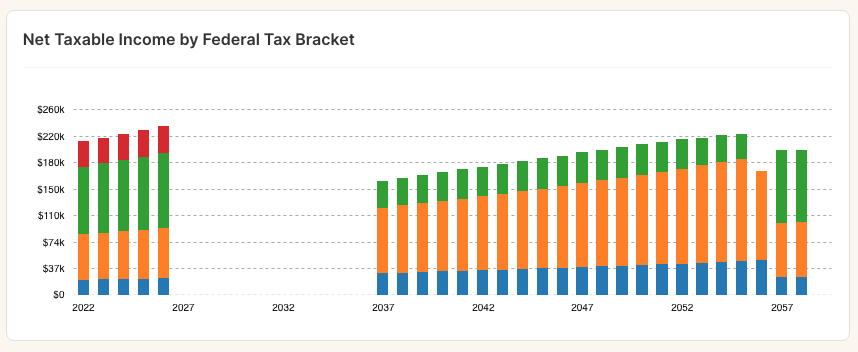
- You will likely be in a higher tax bracket than you are now. If you are finding yourself in an especially low tax bracket this year or simply expect to be in a much higher tax bracket in retirement, then converting a traditional IRA to a Roth IRA can make sense. By paying taxes on the converted funds now — while you’re in a lower tax bracket — you can avoid having to pay income taxes at a higher tax rate once you reach retirement and begin taking distributions from your Roth IRA. (Not sure about your future tax brackets? Use the NewRetirement Planner to approximate your future taxable income, rates, expenses, and more. This comprehensive tool puts the power of planning in your own hands.)
Lifetime tax prior to performing Roth conversions
- You have financial losses that can offset tax liability from the conversion. Converting another retirement account into a Roth IRA will require you to pay income taxes on the converted amounts. With that in mind, it can make sense to work on a Roth IRA conversion in a year when you have specific losses that can be used to offset your new tax liability.
- You don’t want to begin taking distributions at age 73. If you don’t want to be forced to take RMDs from your account at age 73, converting to a Roth IRA can also make sense. This type of account doesn’t require RMDs at any age. (You can use the NewRetirement Planner to help you assess your income needs. See your taxable income for every future year and assess whether you need the income to cover expenses.)
- You’re moving to a state with higher income taxes. Imagine for a moment you’re gearing up to move from Tennessee — a state with no income taxes — to California — a state with income taxes as high as 12.3% In that case, it could make sense to convert other retirement accounts to a Roth IRA before you make the move and begin taking distributions.
- You want to leave a tax-free inheritance to your heirs. If you have extra retirement funds and worry about your heirs facing tax liability on an inheritance, converting to a Roth IRA can make sense. According to Vanguard, “The people who inherit your Roth IRA will have to take annual RMDs, but they won’t have to pay any federal income tax on their withdrawals as long as the account’s been open for at least 5 years.”
These are just some of the instances where it can make sense to convert another retirement account into a Roth IRA, but there may be others. Also note that, before you do anything drastic or begin a conversion, it can be smart to speak with a tax advisor or financial planner with tax expertise.
At the very least, be sure to model the conversion as part of a comprehensive written retirement plan. The NewRetirement Planner enables you to try out specific conversion strategies in the context of your entire financial situation. Assess the conversion on your tax liability, net worth at longevity, and cash flow.
When Would You Not Want to Convert to a Roth IRA?
Considering a Roth IRA conversion comes with immediate tax consequences, there are plenty of scenarios where doing one doesn’t make any sense.
There are also plenty of personal situations where a Roth IRA conversion would likely go against a person’s long-term goals. Here are some of the scenarios where a Roth IRA conversion could be a costly waste of time:
- You’re going to have an extremely low income in retirement. If you have reason to believe you’ll be in a much lower income tax bracket in retirement, then a Roth IRA conversion may not leave you better off. By not converting another retirement account to a Roth IRA, you can avoid paying taxes now at a higher rate for the conversion, and instead pay income taxes on your distributions at a lower rate in retirement.
- You don’t have extra money for the conversion. Because converting another retirement account to a Roth IRA requires you to pay income taxes on those converted funds now, this move is a poor choice in years when you are short on extra money lying around to pay more taxes.
- You may need the money sooner rather than later. Withdrawals on money that was part of a Roth IRA conversion are subject to a five-year holding period. This means you would have to pay a penalty on that money if you chose to take distributions within a five-year period after the conversion.
Again, these are just some of the scenarios where you would want to think long and hard before converting another retirement account to a Roth IRA. There are plenty of other situations where this move wouldn’t make any sense, and you should speak with a tax professional before you move forward either way.
Or, make sure you fully understand your projected income, expenses, and savings situation before doing a conversion. The NewRetirement Planner gives you a detailed insight into all aspects of your financial future.
Roth IRA Conversion Rules You Need to Know
Though there are income limits that apply to contributing to a Roth IRA, these income limits do not apply to Roth IRA conversions. With that in mind, here are some important Roth IRA conversion rules you need to learn and understand:
Which Accounts Can You Convert?
While the most common Roth IRA conversion is one from a traditional IRA, you can convert other accounts to a Roth IRA. Any funds in a QRP that are eligible to be rolled over can be converted to a Roth IRA.
60-Day Rollover Rule
You can take direct delivery of the funds from your traditional IRA (check made payable to you personally), and then roll them over into a Roth IRA account, but you must do so within 60 days of the distribution. If you don’t, the amount of the distribution (less non-deductible contributions) will be taxable in the year received, the conversion will not take place, and the IRS 10% early distribution tax penalty will apply.
Trustee-to-Trustee Transfer Rule
This is not only the easiest way to work the transfer but it also virtually eliminates the possibility that the funds from your traditional IRA account will become taxable. You simply tell your traditional IRA trustee to direct the money to the trustee of your Roth IRA account, and the whole transaction should proceed smoothly.
Same Trustee Transfer
This is even easier than a trustee-to-trustee transfer because the money stays within the same institution. You simply set up a Roth IRA account with the trustee who is holding your traditional IRA, and direct them to move the money from the traditional IRA into your Roth IRA account.
Additional Details to Be Aware Of
Note that, if you don’t follow the rules outlined above and your money doesn’t get deposited into a Roth IRA account within 60 days, you could be subject to a 10% penalty on early distributions as well as income taxes on the converted amounts if you’re under the age of 59 ½.
And, as we already mentioned, you’ll have to pay income taxes on converted amounts regardless of which rule you choose to follow above. You’ll report the conversion to the IRA on Form 8606 when you file your income taxes for the year of the conversion.
What Is the Backdoor Roth IRA and How Does It Work?
If your income is too high to contribute to a Roth IRA outright, the Backdoor Roth IRA offers a potential workaround. This strategy has consumers invest in a traditional IRA first since these accounts don’t come with income limitations in terms of who can contribute. From there, a Roth IRA conversion takes place, letting those high-income investors take advantage of tax-free growth and future distributions without having to pay income taxes later on.
A Backdoor Roth IRA can make sense in the same scenarios any Roth IRA conversion makes sense. This type of investment strategy intends to help you save money on taxes later at the cost of higher taxes now, in the year you make the conversion.
The big disadvantage of a Backdoor Roth IRA is a whopping tax bill, you’re hoping to lower your tax liability in the future. That’s a noble goal but, once again, the Backdoor Roth IRA only makes sense in situations where tax savings can truly be realized.
Modeling IRAs in Your Own Plan
Interested in a Roth IRA, but aren’t sure if it is right for you? Try modeling it in your own plan.
The NewRetirement Planner is the most powerful and comprehensive modeling tool available online. It’s for people who want clarity about their choices today and their financial security tomorrow. It gives people the ability to discover, design, and manage personalized paths to a secure future. Helping you make smart decisions about your money, including whether or not you should do a Roth conversion, is the heart of the tool.
You have two options for how to model conversions in the NewRetirement Planner:
Model Individual Conversions
Once you have set up all aspects of your plan (a really thorough inventory of your current and future income, expenses, and savings), you can try modeling a specific conversion that you think would be advantageous.
- In Money Flows, you can specify the account from which the money will be withdrawn, the amount you wish to convert, the age when you want to do the conversion, and your projected rate of return on the converted money.
- Once saved, you can immediately see if the conversion resulted in a change to your out-of-savings age, estate value, or lifetime tax liability.
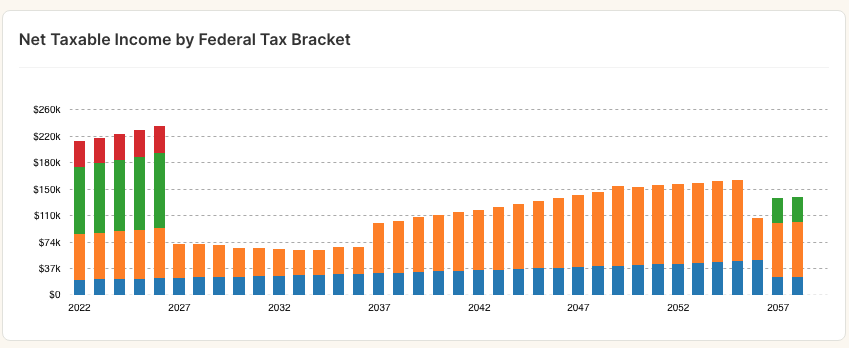
- And, you can review charts to assess your tax liability in the year you do the conversion, the impact on income from RMDs, and more.
Lifetime tax after performing Roth conversions
Use the Roth Conversion Explorer
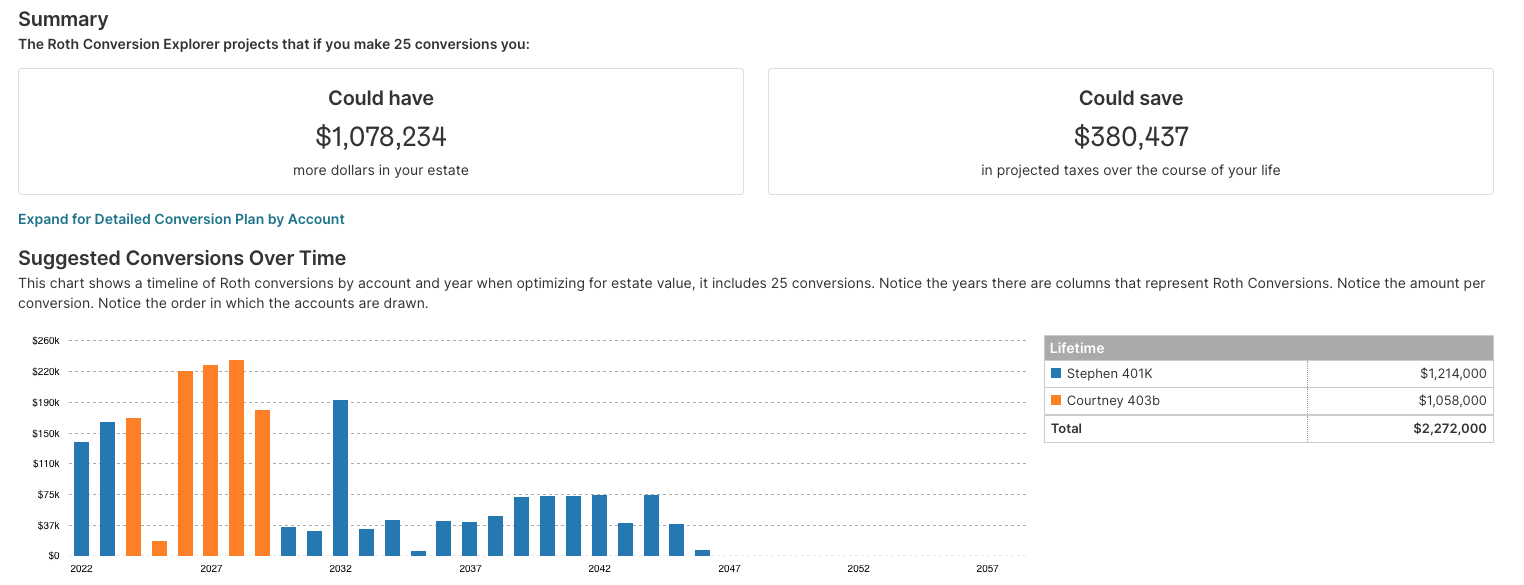
The Roth Conversion Explorer is a modeling tool within the NewRetirement Planner.
If you are not sure when or if you should do a Roth conversion, you might start with this tool. It will analyze all aspects of your plan, running hundreds of scenarios, to generate a conversion strategy that could increase your estate value at your longevity.
The Deadline to Convert a Roth IRA
The deadline for converting funds from a traditional IRA to a Roth IRA is the tax-filing deadline for the year in which the conversion is made. This is typically April 15th of the following year. This means that if you make a conversion in 2022, the deadline for reporting the conversion on your tax return would be April 15, 2023.
As I mentioned earlier, it’s also important to note that there is a deadline for recharacterizing a Roth conversion, which is October 15th of the year following the conversion. This means that if you converted a traditional IRA to a Roth IRA in 2022, you would have until October 15th, 2023 to undo the conversion by recharacterizing it back to a traditional IRA.
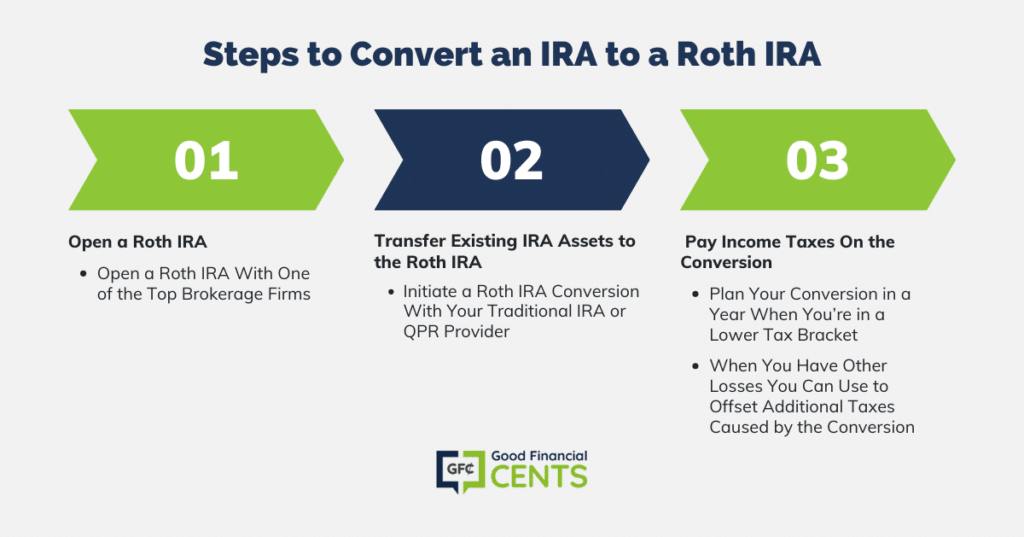
Steps to Convert an IRA to a Roth IRA
If you think a Roth IRA conversion would be a good move on your part, here are the steps you’ll want to take.
1. Open a Roth IRA
First, make sure you open a Roth IRA with one of the top brokerage firms. We think TD Ameritrade is one of the best Roth IRA providers out there due to the fact you pay $0 per trade and $0 per year. However, you should also check out top Roth IRA providers like Betterment, Ally, M1 Finance, and Vanguard.

2. Transfer Existing IRA Assets to the Roth IRA
Next, you’ll want to initiate a Roth IRA conversion with your traditional IRA or QPR provider. Remember that, if you choose to accept the funds with a check, you have 60 days to move the money into your Roth IRA account. You can also have the funds moved via a trustee-to-trustee transfer or even using the same brokerage account, and this is often easier since the move should theoretically be taken care of on your behalf.
3. Pay Income Taxes On the Conversion
The major downside of a Roth conversion is that you will be paying taxes on the amount converted in the current year, and depending on your income tax bracket and the amount you’re converting, the tax bite could be substantial. With that being said, you will hopefully plan your conversion in a year when you’re in a lower tax bracket, or when you have other losses you can use to offset additional taxes caused by the conversion.
Converting IRA or 401k to Roth IRA After Age 60
Converting an IRA to a Roth after age 60 is possible, but it must be done properly in order to avoid tax penalties. The first step is to consult with a tax professional or financial advisor who can help you determine if this conversion makes sense for your specific situation.
Once the decision has been made to proceed, you will need to complete paperwork with your IRA custodian that requests the transfer of funds from your traditional IRA account into your Roth IRA account.
Depending on your age and other factors, you may also need to pay taxes on some or all of the money transferred from the traditional IRA. When the conversion is complete, you’ll have access to tax-free withdrawals from your Roth account once you reach the age of 59 1/2 and have held the account for at least five years.
Roth IRA Conversion Examples
Whenever you’re dealing with numbers, it’s always helpful to demonstrate the concept with examples. Here are two real-life examples that I hope will illustrate how the Roth IRA conversion works in the real world.
Example 1
Parker has a SEP IRA, a Traditional IRA, and a Roth IRA totaling $310,000. Let’s break down the pre-and post-tax contributions of each:
- SEP IRA: Consists entirely of pre-tax contributions. The total value is $80,000 with pre-tax contributions of $12,000.
- Traditional IRA: Consists entirely of after-tax contributions. The total value is $200,000 with after-tax contributions of $40,000.
- Roth IRA: Obviously all after-tax contributions. The total value is $30,000 with total contributions of $7,000.
Parker is wanting to only convert half of the amount in his SEP and Traditional IRA to the Roth IRA. What amount will be added to his taxable income in 2023?
Here’s where the IRS pro-rata rule applies. Based on the numbers above, we have $40,000 in total after-tax contributions to non-Roth IRA. The total non-Roth IRA balance is $280,000. The total amount that is desired to be converted is $140,000.
The amount of the conversion that won’t be subject to income tax is 14.29%; the rest will be. Here’s how that is calculated:
Step 1: Calculate the non-taxable portion of total Non-Roth IRA’s: Total after-tax contributions / Total Non-Roth IRA Balance = Non-Taxable %:
$40,000 / $280,000 = 14.29%
Step 2: Calculate the non-taxable amount by converting the result to Step 1 into dollars:
14.29% x $140,000 = $20,000
Step 3: Calculate the amount that will be added to your taxable income:
$140,000 – $20,000 = $120,000
In this scenario, Parker will owe an ordinary income tax of $120,000. If he is in the 22% income tax bracket, he will owe $26,400 in income taxes or $120,000 x .22.
Example 2
Bentley is over the age of 50 and in the process of changing jobs. Because his employer had been bought out a few times, he has rolled over his previous 401k into two different IRAs.
One IRA totals $115,000 and the other consists of $225,000. Since he’s never had a Roth IRA, he’s considering contributing to a nondeductible IRA for a total of $7,000 and then immediately converting in 2023.
- Rollover IRAs: Consists entirely of pre-tax contributions. Total value is $340,000 with pre-tax contributions of $150,000.
- Old 401k: Also consists entirely of pre-tax contributions. Total value is $140,000 with $80,000 pre-tax contributions.
- Current 401k: Plans out maxing it out for the rest of his working years.
- Non-deductible IRA: Consists entirely of after-tax contributions. The total value will be $7,000 of after-tax contributions and we will assume no growth.
Based on the above information, what will be Bentley’s tax consequence in 2023?
Did you notice the curveball I threw in there? Sorry – I didn’t mean to trick anybody – I just wanted to see if you caught it. When it comes to converting, old 401(k)s and current 401(k)s do not factor into the equation. Remember this if you are planning on converting large IRA balances and have an old 401(k). By leaving it in the 401(k), it will minimize your tax burden.
Using the steps from above, let’s see what Bentley’s taxable consequence will be in 2023:
- Step 1: $7,000/ $346,000 = 2.02%
- Step 2: 2.02 X $7,000 = $141
- Step 3: $7,000 – $141 = $6,859
For 2023, Bentley will have a taxable income of $6,859 of his $7,000 Traditional IRA contribution/Roth IRA conversion, and that’s assuming no investment earnings. As you can see, you have to be careful when initiating the conversion.
If Bentley had gone through with this conversion and didn’t realize the tax liability, he would need to check out the rules on recharacterizing his Roth IRA to get out of those taxes.
Examples are useful, but what is right for you?
Using these examples, it is time to try modeling Roth conversion as part of your own financial future. The NewRetirement Planner enables you to run different scenarios and see the impact on your finances.
Summary of Converting a Roth IRA
If you meet certain criteria and don’t mind facing a larger-than-average tax bill during the conversion year, a Roth IRA conversion could absolutely make sense.
However, you should absolutely weigh the pros and cons of this move before you pull the trigger, and you should definitely set aside the time to speak with a professional who can help you walk through the tax implications.
A Roth IRA conversion can help you avoid taxes later in life when you would really benefit from some tax-free income but don’t jump in blindly. Research everything you can about Roth IRA conversions and alternative ways to save more for retirement, and make sure any decision you make is an informed one.
FAQs on Roth IRA Conversions
The main benefit of converting to a Roth IRA is that the funds in the account can grow tax-free and qualified withdrawals will also be tax-free. Additionally, there are no required minimum distributions for a Roth IRA, which can provide more flexibility in retirement planning.
There are no age restrictions on converting to a Roth IRA, however, the taxes will be due on the conversion
There is no limit to how much you can convert to a Roth IRA, however, you will have to pay income tax on the money you convert.
If you are under 59 1/2 years old and withdraw money from a traditional IRA prior to retirement, you will be charged a 10% penalty. Converting to a Roth IRA does not trigger the penalty.
Yes, you can convert your 401(k) to a Roth IRA, but you’ll have to pay taxes on the amount you convert and certain steps need to be followed.
There is no specific deadline for converting funds from a traditional IRA to a Roth IRA, you can do it at any time. However, you need to report the conversion on your tax return for the year in which you made the conversion. Keep in mind, that regardless of when the conversion is done, the taxes on the conversion will be due for that year.








Enjoyed reading your article. But, felt that you didn’t address the limbo that we are in 2022. If I take a hypothetical example of Traditional IRA having say a$1 million, for a high income person, say making 500k/year, just to get him classified as high income under proposed BBB. If he has after tax contributions of say $200k and the rest is deferred earnings. If he converts the entire Tradfitional IRA to ROTH in 2022, what happens? Will he have an addition to his income of $800k with $200k non-taxable going to ROTH? Isn’t the BBB prohibiting the conversion of the after tax money in Traditional IRA to Roth? If that happens and they make it retroactive to January 1, 2022 as rumored, will he then have to just withdraw before April 15, 2023 the $200k after tax and pay 10% penalty if under 59.5 age and no penalty if over 60 years age? In that case he will lose the tax deferral on future earnings had he left that money in traditional IRA, right? Is there a way for him to avoid that by reversing the $200k roth conversion? Is that allowed? It would be nice if you can cover thse issues for people that want to do the conversion in 2022. I will appreciate it if you directly reply to me by email as well. Thanks.
I have Self Directed Traditional and ROTH Accounts at an SDIRA Custodian. Can I do a ROTH conversion of an Illiquid Asset from the Traditional to ROTH account? The investment I want to convert is a Debt only asset (no Equity component) generating a fixed 8% dividend. It has a fixed FMV from year to year. I know I will pay Tax on the conversion. I am 75 retired.
In your article, you include the following quote from a Vanguard advisor giving advice on inherited IRAs. “According to Vanguard, ‘the people who inherit your Roth IRA will have to take annual RMDs, but they won’t have to pay any federal income tax on their withdrawals as long as the account’s been open for at least 5 years.’”
This quote is out of date in light of the SECURE Act. Except for a limited class of beneficiaries (spouses, disabled, etc.), there are no RMDs for inherited IRAs and all inherited IRAs must be fully distributed within 10 years.
I respectfully suggest that you update your article to account for the SECURE Act.
Jeff… one of the best articles on the subject!
In Jan 2020 I rolled over from my workplace 401K Fidelity Pre-87 and Post-86 the funds to a Fidelity Rollover IRA (pre-tax) and Roth IRA (after-tax), respectively. I also have a non-deductible Traditional IRA with T Rowe Price (TRP) which I would like to convert in its entirety to T Rowe Price Roth IRA. However with the pro-rata rule, my taxable income on the conversion amount would be much higher; if I didn’t have the Fidelity Rollover Account. So my questions relate to allowed workarounds to avoid the pro-rata rule. Possible workaround actions::
1) My workplace 401K does allow for a reverse roll over of my Rollover IRA and Roth IRA. So I can undo what was done in Jan 2020, and then go ahead with the TRP Roth conversion in this year. After the conversion, am I correct that then I can not go ahead and re initiate my previous 401K rollovers in 2020, as the pro-rata rules are calculated on the “end of year” values of all my (non Roth) IRA accounts. I believe I would have to wait until Yr 2021 for the workplace rollover; to avoid the pro-rata rule applying again?
2) If I don’t perform a reverse roll over, but go ahead with the non-deductible Traditional IRA to Roth IRA full conversion (or full distribution) of the fund (earning and after tax contribution). And pay the tax on the tax income. Since at the end of the Yr 2020, I would have a zero balance in my TRP Traditional IRA account and only the Fidelity Rollover IRA. I am correct that since the pro -rata rule applies to the “end of year” values of all my (non Roth) IRA accounts, and since I only will the Fidelity Rollover IRA with value; the the pro-rata rule would not apply.
Appreciate your help with my understanding of the application of the pro-rata rules and potential workarounds.
Shouldn’t this example you provide read “Consists entirely of PRE-tax contributions.” ?? Why are there $40K in “after-tax contributions” in a Traditional (vs ROTH) IRA?
“Traditional IRA: Consists entirely of after-tax contributions. Total value is $200,000 with after-tax contributions of $40,000.”
The case I can think of that he wasnt eligible for a pre-tax IRA contribution and it was before Roth so made a post tax contribution.
The other scenario is if this a work place 401k with mixed Roth and IRA money you could end up in that situation
Hi Jeff,
My husband and I need some advice on a Roth conversion. We need to know how much and when to convert the IRA’s to Roth’s. Perhaps more importantly we need to know if we should do it. We are thinking we should. So my question is who do we go to. We do our taxes on Turbo Tax, and haven’t had a tax accountant for several years. Also about how much should we expect to pay for the service.
Thanks for any advice you can offer. Love your website!
Linda
My husband is 70 years old, career military retiree, and retired from civilian job six years ago.
He has a 250k IRA and received first RMD $8549.
Is opening a Roth IRA an option for investing this RMD?
From what I have gathered, conversion of his current IRA. would eat up a third of the 250k. We have MM Accounts but I have no IRA. So we have to be cautious.
Hi Jeff,
I have been trying to find some info about the simplest way to convert a traditional IRA to a Roth for tax purposes. Our MAGI is above the income limits to contribute directly to a Roth and also above the limits for any tax benefits for a traditional. My plan this tax year is to save up my IRA money in a separate savings account until I have the $6000 and then deposit it all into the Traditional at once, wait till it clears, and then convert all the cash into my Roth. Last year I had complications trying to figure out wha my basis was regarding the conversion, as some of it was in mutual funds. Thanks for your advice.
~Jessi
I started to have IRA monies converted to a Roth IRA in 2018. But I was living in Arizona for the first 8 months then moved to Nevada the last 4 months. For state income tax filing, do I report zero to Arizona or do I report 2/3 of the conversion amount to Arizona? I know the full conversion amount is taxable to my Federal return. I have to file with California already because my old employer decided to pay me severance pay in 2018 even though I had not worked in California since 2017, i assume that should not complicate matters, i assume that zero of my conversion should be reported to California. Thanks.
Hi Jeff,
Thanks for the informative article.
I have a question for you. My old 401k has 120k and about 16k of that in Roth 401k.
I am 50 and not working this year, do you recommend converting that amount into a Roth account at my old 401k if they allow it(or roll it over elsewhere). If yes,then how much should I convert in order to minimize tax that I would need to pay from my savings. I don’t expect to make more than 10k this year if at all.
Thanks a bunch,
Pete
Hi Pete – Since you’re unemployed and have a very low income, this would certainly be the time to do a Roth IRA conversion. But there’s no way I can tell you online how much you should allocate to the conversion, or if you should even do it at all. I recommend sitting down with a tax preparer and coming up with the best number. There’s a lot involved, and the tax liability can be large. It may come down to how much you can afford to pay, especially since the tax will need to be paid outside the converted balance.
Can I contribute the maximum to a Roth IRA and do a conversion from a Traditional IRA to a Roth IRA in the same tax year?
Hi Lafille – You can. The conversion from the traditional IRA to the Roth is a separate event.
It triply makes sense for me to convert some of my Traditional IRA to ROTH because:
1) my income was relatively lower this year,
2) I have a basis, so some of the conversion is non-taxable, and
3) my account value is at a relative low.
I understand the pro-rata rule and how to calculate the non-taxable portion of an IRA conversion, but what date is used for calculating the value of my Traditional IRA? Is it based upon the date the conversion was made, or some other date, such as beginning of year or end of year?
Thank you,
Peter H.
Hi Peter – Should be as of the date of the conversion. That determines the amount converted, not the amount at the beginning of the year, or as of some other date.
I am retired. I converted an IRA to a Roth IRA and paid taxes last year on the amount of the converstion. However, now I am trying to calculate my MAGI for 2019, based on last year’s 2017 tax return. I have been reading that for purposes of calculating the 2019 MAGI, I can subsract from my AGI the amount of the Roth conversion. Where in the IRS Code or Publications can I find this provision? There is a disagreement in the online websites about whether the Roth conversion amount can be substracted from the AGI in computing the MAGI. Help! Thanks.
You’re right Linda, I looked on the IRS website and saw nothing conclusive on that. I recommend asking a CPA.
Can conversions taken out after 5 years be taxed if only the converted amount is taken?
Hi Karen – If I’m understanding your question correctly, yes, you should be able to withdraw the converted amount, since you’ll have paid taxes on that amount at the time of conversion.
Can I move money from my traditional IRA to my wife’s Roth IRA without getting a 10% penalty? I know I will have to pay the taxes but will there be the other 10% penalty because I didn’t put that money in an retirement account in my name before 60 days or does her roth ira count to not get penalized.
Hi Chad – You can’t. A retirement plan is yours only. Even if you’re married filing jointly, you and your wife have totally separate accounts.
I have been retired for many years, I have two traditional IRAs. Can I roll over one of the IRAs to a Roth? I know the tax is paid first. If this is possible, are the funds kept in an account and paid out as requested or can they remain & accrue interest until the funds are needed?
Hi Roselyn – You should be able to do the rollover/conversion from one IRA to a Roth IRA. And yes, you will have the choice to then either set up distributions, or to leave the money in the account to grow.
The following statement in this article is incorrect
Can I really take my money out of my Roth IRA at any time?
Because of the way Roth IRAs were set up and the fact that are contributed to with after-tax dollars, you can take your contributions out of your account at any time without penalty. However, the same cannot be said about your earnings. The amount of money you can take out without penalty is limited to the contributions you have made.
What part of the answer do you believe is wrong Alexander?
Hi,
Great article. Question about timing of rolling a simple IRA to a 401K and then being able to do a Roth IRA conversion (from traditional, after tax contribution). Is there a restriction on when you can do the Roth Conversion once the Simple has been rolled into the 401k? Will there be tax implications if both happen in the same tax year? Same fiscal year?
Thank you,
Patrick
Hi Patrick – There shouldn’t be. The rollover of the Simple IRA to the 401k is non-taxable, and you can do the Roth conversion at any time.
I currently have about 90k in a Roth IRA and 90k in a SEP. The sep balance is a this year’s contribution 50k and a 401k rollover. No profit has been made by the SEP. I hope to maintain at least 360k/year of income by accumulating rentals. Assuming the income scenario works out as planned I don’t see any advantage to keeping the money in the SEP. I think it makes sense to convert the SEP to a ROTH and pay the additional 30k of taxes. Do you see any red flags? Am I missing something?
Hi Brian – Nope. In fact it’s a great strategy. If you’ll have $360k in income in retirement from the rentals you’ll need a source of tax-free income the Roth will provide. But if you’re worried about land mines discuss it with a CPA. A $30k tax liability warrants a consultation fee of a couple hundred dollars.
Thank you very much for the article. I have a situation just like the one in your Example 1. I have 2 questions: 1) If I just convert my SEP IRA rollover account into the Roth IRA (i.e. close the account and move all of the money into my Roth IRA account), will the pro-rata rule still apply? 2) If I close my Traditional IRA account and convert it into the Roth IRA, I understand I have to pay some tax on the portion of after-tax contributions I made according to the pro-rata rule. But does this mean when I withdraw fund from my SEP IRA account in the future, some portion of the fund in it is tax free (tax paid)? Thanks.
Hi Dover – The pro-rata rules will apply to the SEP because it’s still an IRA. But I’m confused on your last comment. If you’re closing out your SEP and converting it to a Roth IRA, what will be left to withdraw from the SEP?
I file taxes as unmarried with no dependents. This year I am a full time employee. In 2 years I will be a full time student and will be in a much lower tax bracket.
I want to open a traditional IRA now and an account with my company’s 401K plan and receive the benefits this gives me this year. Then, in two years, once my tax bracket is lower, I would like to transfer these funds to a Roth IRA and pay the taxes due at the time of the conversion at the lower tax bracket.
Because my traditional IRA account will have been opened for 2 years, will I have to pay a 10% penalty, or only the taxes due? Is the total amount I transfer in 2 years to the Roth IRA subject to the $5,500 limit?
thanks,
Mia
Hi Mia – You’ll only have to pay the tax due on the converted balance based on your income in the year of conversion. There will be no penalty. Also, there is no dollar limit on the amount of the conversion. Good strategy you’re working out!
I am 65 years old. I rolled over 250K out of my company 401K to a Bank CD.
Can I convert this money to a Roth? If so can I use part of the money to pay the taxes owed when I convert? I still don’t understand how the tax amount owed are calculated.
Hi Ella – You can if the CDs are part of a rollover IRA account. If they were, the bank should be able to help you with the Roth conversion, including calculation of the tax you’ll owe for doing so.
Hey Jeff,
Just seeing this video for the first time today. Awesome video!
I had a question for you though. My gross income this year in 2018 will likely be over the $135,000 limit on account on selling an investment property which will net me over $60,000. I’m considering rolling over a previous employers’ 401K comprised of approximately $20,000. I would roll this over to a traditional ira and then immediacy you convert it to the Roth.
I am all for diversification though so my question is am I better off continuing to build this traditional Ira and then convert periodically once or twice per year or should I not bother with the Roth at all and just go with the traditional Ira? Or should I have the Roth, the traditional and possibly even dabble with some index funds as well? I understand the tax benefits of the Roth but I’m just wondering what would be be benefits of all strategies?
Hi Kevin – I’m not going to make investment recommendations, since I don’t know you. But as to the Roth conversion, you might want to hold off doing that this year. The property sale pushes you into a higher tax bracket, and that will raise the tax cost of the Roth conversion. Better to do it next year, or spread it out over future years. For most, a Roth conversion will be a smart strategy, but you’ll have to crunch the numbers to make sure it’s right for you.
I could not read all these comments to see if it came up, and I congratulate you on a good article!
My sticking point is that a myth was inadvertently supported – that is, that the Taxable Income that dictates your tax bracket will affect all of your taxable income (“If he is in the 28% income tax bracket, he will owe $33,600 in income taxes, or $120,000 X .28″).
In our progressive system, only the funds that exceed a given bracket-mark are subject to that rate. Even Billionaires pay the lower taxes in the lower brackets and only pay higher tax amounts on their taxable income in the higher brackets.
The pervasive and incorrect myth of ‘one tax on every dollar” and ‘high tax rates are bad’ is why voters do not understand how they are benefitting the affluent, charging themselves for the shortfall, and without even fathoming that their total income would have to be vastly greater than (say) $250k . . . in order for their taxable income to land them in that bracket. They see (say) $250k annual as reachable in their lifetimes, and think they protect themselves from paying a higher rate on the first and every dollar.
Specific to withdrawals from an IRA or Pension, correctly rolled into a ROTH – – only the part of the withdrawal (as regular income) that gets bumped into the next bracket incurs the higher bracket’s tax rate. This could be quite a small amount, compared to what just-that-chunk’s taxes would have been at the lower bracket rate. Everything under the higher bracket still only incurs that lower bracket’s rate (and funds over the higher bracket-mark *would have* incurred that previous rate, at the very least . . .). In many case, rolling into a ROTH when the withdrawal amount bumps you into the next bracket, is a very small difference.
Hi Jeff,
I am 61 and retires and my wife 57 and works very little. I have a rollover IRA, and a Roth and my wife also have a rollover IRA and a Roth. I intend to take a distribution of $72000/year from my rollover IRA to live on. Should I or my wife convert some $ every year from the rollover account into the Roth within 22/24% bracket. My rollover has larger sum than hers and I will take RMD in 9 years. What do you suggest?
Thanks,
Tam
Hi Tam – From a tax standpoint it really doesn’t matter because the tax liability will be the same either way. But since you’re closer to RMDs, you may want to go with your own accounts first, in case you have to spread the conversion out over several years to minimize the tax liability. You can convert your wife’s account later. But please talk to a CPA about this, since you’re obviously working with a very large amount of money.
Hello,
My wife and I are 66, retired, and in the process of converting traditional IRA money to Roth accounts. We haven’t tapped any of our IRAs yet as we’re living off of our pensions and other non-deferred savings, planning on taking SS when we turn 70.
Does it matter from whose traditional IRA we convert funds to our Roths? It doesn’t look like it but perhaps there’s something I haven’t thought of about it.
Thanks very much!
Richard
Hi Richard – Not really. You’ll be in the same tax bracket whether you convert your accounts or your wife’s. Unless you file separately, then you’ll have to consult with a CPA.
Thank you for this comprehensive article.
My wife has an IRA that has about 150K with about $25k non-deductible contributions. She is planning to open a solo 401K and rollover the pre-tax assets from her IRA to the solo 401K. The IRA will be left with the after tax assets (25K).
If she converts the after tax assets to Roth, does the IRS look at the balance of the IRA in the prior years and apply the pro-rata rule and calculate taxes or once the roll-over is done then the conversion is tax free?
Appreciate your comment.
That’s an outstanding question for a CPA. I’m somehow doubting the IRS will consider the separation without applying the pro-rata rules. It may depend on how the IRA trustee reports the rollovers. If the pretax contribs are one distribution, and the after tax are another – and it’s clearly noted – it may work. But talk to the IRA trustee about how it will be reported, then talk to a CPA about the Roth conversion.
Jeff,
Please don’t forget enrolled agents when talking about tax professionals.
Hi Keith – So true! EA’s aren’t CPA’s but from a tax prep standpoint they’re just as good.
Hi Jeff
I am retired and will be 70 1/2 December, 15, 2018. I have $57,000
in stocks and cash in a Traditional IRA that I am thinking about converting to a ROTH IRA. Can the stocks be moved to a ROTH IRA?
or must I sell them? (I will be paying the taxes from my savings.)
If I convert it before December 2018 must I still take my RMD?
Could you list the Pros an Cons of going through with this conversion?
Thank you, in advance, for any information you may give.
???? Louise
.
Hi Louise – If I understand this interpretation correctly, you’ll have to take an RMD on the traditional IRA, but the balance of the amount transferred can be converted. If so, the RMD portion would not be eligible for the Roth conversion. The tax consequences won’t change, since both the RMD and the conversion balance will be subject to tax. But please check with your tax preparer to make sure.
Does an inheritance IRA inherited from a non-spouse relative count against me in the pro-rata calculation or can I consider myself as having no IRAs if all I have is the inheritance IRA? All the contributions to the IRA prior to my inheriting it were pre-tax.
Thanks. Nice article.
Hi John, that’s an advanced question, and I’d direct you to a tax preparer (preferably a CPA). There are probably special provisions that will affect the outcome one way or another.
I have a healthy 401K. All saved with pre-tax funds. Since I’m over 60 and no longer working I’d like to begin the withdrawal process by moving 20K per year into my Roth. The 20K would be taxed at 12% in 2018. I’d like to max my bracket falling just short of the 22% bracket. is this possible? Can I roll over a partial amount from my 401K into my Roth? I’m looking to minimize my future mandatory withdrawal amount when I turn 70.
That’s an excellent strategy Ed, I’d even say it’s an example of the best example since you’re minimizing the tax bite. Yes, you can do a partial conversion from the 401k. If you’re looking to get just under the 22% bracket, crunch some numbers with your tax preparer and get as close as you can.
I converted all my funds of $20,000 in a traditional IRA to a Roth IRA in January 2018. I no longer own any traditional IRAs. In February 2018 if I make a nondeductible contribution of $6,500 and immediately convert this nondeductible IRA to a Roth IRA, will this trigger the pro rata rule for me from a tax viewpoint in 2018?
Hi Jill – The pro-rata rules have to do with taking early distributions from an IRA. In this case, all of your traditional IRAs have already been converted, and the new contribution is non-deductible. It shouldn’t apply.
Hi Jeff,
I hope this question is easy for you. Assume that my longstanding Traditional IRA contains $450,000, of which $45,000 is after-tax money that has remained the same amount for 12 years or so. I still file Form 8606 just to keep track of the $45,000 and let the IRS keep it in sight each year. If I elected a 100% cash distribution from the Traditional IRA and elect zero withholding, can i present $405,000 back into the same Traditional IRA as a Qualified Rollover within 60 days and deem it as 100% pre-tax money and present $45,000 as a Qualified Rollover into a newly-opened Roth IRA within 60 days and deem it as all after-tax money? . Thank you for your forthcoming answer.
Hi William – That looks like a backdoor attempt to circumvent the pro-rata rules. I can’t say that there’s a specific rule against it, but there is a blanket restriction against circumvention of IRS rules. You should discuss that with a CPA and/or the recipient plan trustee, but my guess is they’ll say no.
Thank you for the article.
What happens if I convert part of my traditional IRA to a Roth IRA and then die in less than five years? (My wife will be my primary beneficiary and my daughter will be my contingent beneficiary.)
Hi Larry – The Roth IRA transfers to your wife. She can move the money into a Roth of her own. She can take tax-free withdrawals after five years, and upon reaching age 59.5. If it then passes to your daughter, she will have to begin taking distributions from the plan based either on a five year payout, or a payout over her expected lifetime. No tax will be due on the amount of your contributions, but tax will be due on the earnings portion, unless at least five years have passed. No early withdrawal penalty either.
Jeff,
Great article and very informative. I just made a partial Roth conversion for 2017. Most of my current income is through investments, however I have a considerable sum between my wife and I in 401K and Traditional IRA. My question is if there is a limit to the number of partial Roth conversions in a 12 month period for both my wife and I? I believe the answer is that there are no limits to partial conversions but I have seen conflicting information. These would be within the same institution (Fidelity).
Thank you
Hi John – The limitation is on rollovers between traditional IRAs – one per year. There is no limit on the number of Roth conversions.
You don’t sleep much do you!!! Thank you for the reply Jeff.
My partial conversion that I mention was to bring my total tax up to the crossover of the AMT “sweet spot” and not a dollar more. So the tax I’m paying on this partial conversion is circa 28% (not great) but better than the top cap gains rate. I’m trying to do these conversions over the next 8 years with Trump’s tax bill as the AMT “sweet spot” looks like it will be increasing during this stretch until possible repeal which would allow me to do larger partial conversions again at circa 28%. Ideally I’d like to do these conversions while in retirement (before RMD’s) at a lower tax rate MAYBE so as to take advantage of Social Security if it’s still around (I’m 50). If the current traditional IRA/401K balances are $1.7M, do you think this is a prudent approach to try to do maybe half in conversions over the next 8 years and then look to see about the other half when my wife stops working at circa 57? I’m not working so she will have 8 more years to contribute in ROTH contributions and I have sufficient capital to pay the tax through my taxable accounts. I’m conflicted on how aggressive to be with the conversions near the AMT “sweet spot” crossover for this timeframe OR wait to see what tax rates will be after 8 years.
Hi John – You’re talking about $1.7 million in conversions, so there’s a lot to consider. I think you’ll need to decide this with an accountant. What’s more, the decision will have to be reviewed each year before proceeding. You’ve got a lot of variables there, including your wife’s income. It may come down to that the tax bite in some years is so high that the conversion isn’t worth doing. There’s too much going on to give a blanket answer. A miscalculation or unexpected event could cost you thousands in extra tax. Just a high altitude guess here, but I’m willing to bet the recommendation will be to wait until retirement, when income is presumably lower. But then you’re betting where tax rates will be. These are the complications.
Jeff,
Am I limited on the number of partial Roth conversions from a traditional IRA in a 12 month period? I am doing a partial conversion on 12/31/17 and looking to do multiple partial conversions throughout the year for BOTH my wife and I. Are there limitations here? Thanks!
Hi John – This point is confusing to a lot of people. The one time per year rule is on rollovers of a traditional IRA to another traditional IRA. Roth conversions don’t have a limit.
Great article. Thank you. Jeff. Also I have a question:
This year (2017), I rolled over (all) my traditional IRA to my company 401K, this was allowed by my company 401K managed by Vanguard. This rollover/transfer was done ~6 months ago between institutions: Edward Jones to Vanguard. I closed all my accounts in Edward Jones. A couple of months ago, I opened a new traditional IRA with Fidelity and made a non-deductible 2017 contribution of $5500. I also have a ROTH IRA with Fidelity. Questions:
1) Can I do an Traditional IRA (Fidelity) to ROTH IRA (Fidelity) conversion in the same year I did a total Traditional IRA (Edward Jones) rollover to 401K (Vanguard)?
2) Can I convert my Traditional IRA amount of $5500 to Roth-IRA (and pay any tax on interest made), if so dose it have to be converted before January 1st 2018, or am I OK to covert it before April 15, 2018 in order for it to be counted for 2017 Tax period? Or it doesn’t matter, as I can convert IRA to Roth for any amount, any time and any number of time regardless of tax year?
3) Would I receive a 1099R from institution making the transfer from IRA to Roth IRA?
4) Also I must fill out a IRS Form 8606 correct?
Thank you in advance for your comments.
Hi Waise – 1) You should be able to do the traditional to Roth coversion, even though you did the employer plan conversion earlier. 2) You must covert by Dec 31. 3) Yes, you should get a 1099R. 4) Yes on the 8606.
Hi,
Very helpful article. I have a 403(b) that I am wanting to convert to a Roth, but I am still employed. My employer does not contribute any to this plan, so I am trying to figure out the exact rules for converting while still employed. I will be 49 at the end of this year. I am stopping my 403(b) contributions in January and opening a separate Roth IRA that will be outside of my employer. I believe that all my contributions to the 403(b) have been pre-tax, so it should all be taxable when I convert if I have to move all at once. What are the requirements for conversion if you are still employed when converting?
Hi Michael – There are no specific rules if you’re still employed, but you have to make sure your employer will permit you to do the conversion to what I presume is an Roth IRA, not an employer 403(b) Roth.
Hi Jeff–
During 2016 I converted $100K from an SEP-IRA to five new Roth IRAs, and paid income tax on the $100K distribution. Even though I have had other Roth IRAs for over 20 years, are these new Roths (from the conversion) subject to the 5 year-rule for distributions? If so, what amounts exactly are subject to penalty or taxation?
Hi Kenneth – They’re not, but they will be subject to tax if you’re under 59.5. Only the investment earnings are subject to tax.
Hi Jeff, awesome article. Very helpful. I’d like to get your feedback…
Here is my scenario..
We file married filed jointly. My wife’s income for 2017 is around $250k and my income is $0. I made $250k in 2016. Now, since I am unemployed, I am trying use this time to convert some of my IRA to Roth. You mentioned that for IRA purposes our incomes are different; however, how will this impact us when we file married jointly. If I move $75k will i be paying 10% up to $18,650 and 15% between $18,651 and $75k – that’s it? In this scenario, I thought we would end up paying taxes on $325 (250k – my wife’s + $75k conversion). Based on the above scenario what would you recommend? Appreciate your response.
Hi Mark – The conversion will be based on your joint income, in this case $250,000, or $325,000 if you do the conversion. It will work out that you’ll pay your highest marginal tax rate on the converted balance. So if that’s 25%, then you’ll pay 25% on the conversion amount.
That’ll hurt, but it will probably be better than it would be if you were both working and had a joint income of $500k plus the conversion.
Hi Jeff,
Thanks so much for the great article. I would like your thoughts on my issue:
a) I have a Traditional IRA of $8,000 (all funded by non-deductible funds in 2016). This IRA resides with Mutual Fund Company A.
b) I opened a 2nd Traditional IRA in Oct. 2017 and fully funded it with $6500 (I am over age 50), also in non deductible funds. This IRA resides with Mutual Fund Company B.
I would like to move the IRA with Mutual Fund Company A over to Company B and immediately convert both funds to a ROTH IRA. My assumption is I can combine the account, and I only owe taxes on the GAINS made since the contributions were non-deductible.
Are my assumptions correct?
Hi Harold – since both IRA accounts were funded with nondeductible contributions, you are correct that only the gains on those accounts will be taxable.
I am planning to convert my Traditional IRAs to Roth IRA and tumble to your website while looking for tax info abouth the conversion. This article does answer some of my questions very well.I still have few questions. I really appreciate if you can give answers or point me the right place to start. My IRA contains both pre-tax and post-tax contributions. There are stocks, mutual funds, CDs and cash in my IRA account. I plans to do partial conversion each year for the next several years to minimize the tax. I have 3 questions:
1. How do I calculate the total Non-Roth IRA balance? Is this based on the values of the stocks, mutual funds and CDs and cash at the actual time of the conversion or at the end of that year?
2. I do have a Roth IRA which is more than 5-year old. Should I do the convert to this Roth IRA or should I open a new Roth IRA account for this conversion?
3. Since I will do the conversion for the next several years. Should I open a new Roth IRA for each year or just use the first converted Roth IRA account?
Thanks in advance.
Hi Chris – On #1, when you say “non-roth IRA balance”, do you mean the post tax contributions? If so, the amount will be the actual dollar amount of the contributions. So if you have $50k in a traditional IRA, and $10,000 of it are post tax contributions, that will be the non-taxable amount of the conversion. There’s no calculation to include investment earnings on those contributions (sorry!).
You can do the conversion into the existing Roth, but each conversion starts its own 5 year rule clock, so you won’t change the outcome, no matter what Roth account you do the conversions into.
As to opening a new Roth for each conversion, do that if it makes the process easier for you to understand. It will help, due to the 5 year rule on distributions.
I’d also recommend that you discuss your specific situation with an accountant since you have good questions.
Hi,
Here’s my question:
I’m preparing to leave my employer within the next month or so and retire. I have a rollover IRA with about $420K. I’m wondering if it would make sense to roll that IRA over into my existing company’s 401K plan (yes, it’s allowed) right now, while still employed, to be able to make future Roth IRA conversions in a more tax advantaged way. I do also have an existing Roth IRA, which would receive any converted monies.
I hope you see this message soon as I know time is of the essence since this option is only available to full time employees at my company and my tenure is very short.
Thank you
Hi Nat – Without knowing the details of your situation, I’m not in a position to say whether or not it would be to your benefit to rollover the IRA to the 401k. But you can do a conversion from the IRA too, unless there’s a specific tax benefit, which only your tax preparer would be able to tell you.
So I have a SEP IRA, a 401k and a roth IRA. Am I allowed to make yearly contributions to a SEP IRA, roll it all over into my employer 401k yearly, and continue to make yearly $5500 conversions to my roth IRA without any penalties?
Stepwise it would look something like this:
1) Max out 401k yearly.
2) Contribute to a SEP IRA.
3) Roll over SEP IRA into 401k
4) Deposit $5500 into a traditional IRA
5) Convert traditional IRA into roth IRA
Is that allowed?
Hi Tim – In theory, yes. But you’ll have to see if your employer plan will accept funds from the SEP IRA. They may not, and if they do, they might not accept them each year.
Let me start by saying that I’m not even remotely financially savvy. (The following will make that clear!) APPARENTLY, in August of 2005 I accidentally rolled over my ROTH IRA into a Rollover IRA (which, for all intents and purposes, as I understand it) is the equivalent of a Traditional IRA .
I needed a small amount of money to include in the down payment of my house, so, as instructed by the investment company holding this Roth IRA (the Trustee?), I liquidated the Roth IRA investments (mutual funds), withdrawing the total amount in August of 2005 and was told by the trustee that if I rolled this money back in within 60 days, that the IRS would not deem this withdrawal as a “distribution” for tax purposes. So – I did as instructed and “rolled over” these funds into a money market account, depositing the original amount, plus an extra couple of thousand less than a week later, thereafter making an immediate withdrawal of that few thousand for the house down payment. I was required to fill out a new application for this rollover, and I was told to check the box that said “Rollover”, which I did.
Apparently, however, there were 2 different boxes with the term “rollover” and I checked them both. What I was supposed to have done (but was not advised of this) was to check off the “rollover” box for the “Contribution Type” (Transaction type), which gave me the option of either: “Direct Rollover”, “Regular”, “Transfer”. But I was NOT, apparently, supposed to check off the “Rollover” box under the heading “Account Type”. “Account Type” gave the following 3 choices: “Traditional”, “Rollover”, “Roth”. Apparently I was supposed to have checked the “Roth” box under the “Account Type” heading.
As a result of my checking off the incorrect box, my post-tax contribution-funded Roth IRA turned into a Rollover (Traditional) IRA ! I just found this out – I was under the impression for the past 12 years that my IRA was still a Roth IRA.
I never made another contribution to this IRA, and since it’s been doing nothing but sitting in a money market account all this time, it only changed in value from August, 2005 to September, 2017 for a total increase in value of about $800 ($650 after annual maintenance fees).
In an effort to try to correct this situation, I want to do a “Roth Conversion” rolling over this “Rollover IRA” into a Roth IRA, paying taxes on the $650 income on my 2017 income tax return (I assume I will file IRS Form 8606).
Am I correct in assuming that I do not have to pay taxes on anything but the 12 years of income (less the annual maintenance fees) since all of the contributions were post-tax (having been contributed to my original Roth IRA and therefore never having been claimed as deductions on any income tax returns)?
Will the trustee send me a statement telling me the exact amount of the income over the past 12 years or do I have to figure this out myself? (It’s no problem as I still have all my statements)?
Will the trustee send me a statement of some kind which assumes that ALL the funds contributed to that “Rollover IRA” in 2005 were pre-tax (which is obviously NOT the case.)?
Am I further correct in assuming that I will not have to pay any penalty because it will be converted into a Roth IRA rather than simply being liquidated and transferred to me directly?
Hi Christine – Let me start by saying that you really need to sit down and discuss this situation with a CPA before proceeding. Here’s my guess as to how this will work:
Since the current IRA shows as a rollover IRA, that’s how the distribution will be reported by the current trustee for the rollover. The trustee is going to have to report this the way it exists, and that probably can’t be changed after 12 years.
But a CPA can file your tax return showing that the Roth contributions to the plan were post-tax. That means that they will not be considered taxable when you do the conversion.
But please discuss this with a CPA before proceeding. This is not an ordinary situation, and it will require special handling. There could be a quirk in the mix that changes the whole outcome either way.
Thanks Jeff. I’m making an appt. with a CPA right now.
Hi,
I am moving from IL to California in end of 2017.
I have a good sized IRA. I am thinking of doing a Roth conversion so I should pay state taxes for IL rather than CA. I also will not need to take RMD
Any thoughts
Hi Maya – It makes sense, as long as your tax rate in Illinois will definitely be lower than it will be in California. People often forget about state income taxes with conversions, but they do matter. You’re thinking right.
Hi,
Thanks for the great article. Love it. I have a question on the conversion tax basis calculation. I have a IRA account #1 (100% after tax contribution). I also have a company 401K & pension (100% pretax contribution). I want to convert all my IRA #1 to Roth at the START of the year. And, then convert my pension/401K to a new IRA account #2 LATER in the same calendar year (i am retired). Do i need to include the basis in new IRA #2 when i estimate my taxable income related to converting IRA #1 to Roth? Any thoughts / guidance are appreciated. Thanks
Peter
Hi Peter – Only the amount actually converted will be subject to income tax, net of the percentage that’s determined for non-deductible contributions. So new IRA will be used in calculating your pro-rata basis in the amount of the conversion, even though the account isn’t part of the conversion. Fortunately, the 401k balances won’t figure into the equation.
Jeff,
Thanks. I just want to make sure i understand your reply. Is the conversion basis calculation based upon the outstanding IRA basis at the time of conversion or at the end of the same tax year? Say it differently, if my Roth conversion is on January 1, do I use the IRA basis on January 1 or on December 31? If the answer is at the time of Roth conversion, then i should not include the basis in IRA #2 as it does not exist on January 1. If the answer is at the end of the tax year (regardless when i convert during the year), then i will have to wait one year before i convert 401K into new IRA # 2 as i don’t want to mix the two basis pools. Again, thanks for your help.
Peter
Hi Peter – According my research, it’s as of year end, not the date of conversion. That makes sense, since you’ll fill out the 8606 as part of your tax return for the year.
As to the 401k conversion, you should wait until the next tax year to do the conversion. If you do both in the same year, the converted balance will apply to the pro-rata calculation as well.
Please discuss this with your CPA before proceeding though. You’ve got a lot going on, and a mistake could be costly.
I have approximately $800,000 in a traditional IRA. I plan on retiring early just before I turn 61 years old. I plan on taking Social Security at age 65 or 66. Therefore I will have about four or five years where I will have a lower income. During those four or five years I will be living off of my rental income which I am still depreciating and therefore the rent doesn’t show up as much income on my taxes. During those four or five years I would like to convert some or all of my traditional IRA to a Roth IRA. The reason being is that I may not need my IRA money to live on and would like to bypass the RMDs and allow the account to grow for a very long time. I am considering converting an amount each year that would keep me under the 25% federal income tax bracket. Does this strategy make sense?
Hi Kent – It sounds like a solid strategy. Roth conversions are usually better done during retirement when your income is low, and that’s where you’ll be. Good luck with it.
Two questions: If converting a regular IRA to a Roth, do you have to convert the entire IRA? My entire IRA is taxable.
Also, I converted an IRA to a Roth somewhere around 2001 and was allowed to spread the taxes over four years. Is that still possible?
Hi Carol – No, you can do a partial conversion (or the whole account if you like). Not sure about the four year spread on paying the tax on the conversion, and think it’s not likely. 2001 was 16 years ago, so the rules may have been changed. Check with an accountant though, there are all kinds of unusual provisions buried in the tax code, so I could be wrong.
Hi,
I’ve recently retired and would like to start rolling funds out of my traditional IRA to a Roth. I understand the mechanics pretty well but I have a tax question. If I move a substantial amount out of the traditional IRA, I will have a corresponding tax liability. In order to avoid an under payment penalty, must I approximate my tax liability and make payment before filing?
Thanks
Greg
Yes Gregory, you should make a tax estimate shortly after doing the conversion in order to avoid a penalty. You’ve probably helped your cause waiting until retirement to do the conversion since your tax rate is probably lower. But discuss it with your tax preparer. Only someone who knows the details of your tax situation can tell you if the conversion will truly be a benefit to you.
I have a question about the pro-rata rule for married couples. I have both a traditional and Roth IRA. My wife has only a Roth IRA.
If she were to contribute to a traditional IRA without any tax deduction (since I have a 401k at work) and then convert it, does the pro-rata rule count my traditional IRA when taking into account how much is taxable?
Hi Jonathan – Your IRA and your wife’s IRA are separate accounts. Her’s doesn’t affect yours.
Thanks for the helpful piece…and of course, I have a follow-up question
When I was at my former firm, I had a Roth 401k that also had an employee match and profit share component. The employee match and profit share component were tax deferred. I rolled over these tax deferred dollars to a self-directed traditional IRA to take advantage of certain unique investment opportunities but don’t plan on expanding this pool of money. I now want to roll over the Roth 401k dollars from my former firm’s plan into an IRA. A few points
1. My AGI is over the maximum contribution limits for a Roth IRA
2. I just set up a solo 401k that has both a Roth and tax deferred component
My question is this: Ideally, I’d like to rollover my Roth 401k dollars from my old firm into a Roth IRA but it seems that because my AGI is above the limits, I could never make a contribution to this account. Is that correct?
If yes, perhaps I can rollover the old Roth 401k dollars to the Roth component on my new Solo 401k? Any insight is appreciated.
Hi Jonathan – You’re getting hung up on a common misunderstanding. Just because you earn too much to do a Roth IRA contribution doesn’t mean you can’t do a Roth IRA conversion. There’s no income limit to do a Roth IRA conversion, so you should be good. Check with your accountant if you’re unsure about anything.
Hello — thanks so much for all the helpful articles on your site!
Here is my question:
My husband and I have Roth IRAs currently in two different companies for more than 10 years each.
We are looking at moving from our current trustees to a new trustee (Vanguard).
Each of us will have two funds which will be the last of us to touch when needed in the far distant future.
Since we already have Roth IRAs and we will be moving them as Roth IRAs to a new trustee company, does the five year rule apply to the new trustee company or is that grandfathered from the old trustee company since they have been established Roths for more than a decade?
Thanks for the conversion math class — very helpful in assessing our situation of should we or should we not convert any of the rest of our funds before the deadline age of 70 1/2, giving us a generous timeline.
Hi Jeanie – The five year “clock” runs with the Roth itself, not with the trustee, so you should be fine.
Hello Jeff,
Currently I have a Traditional IRA Account with Vanguard. I have used it to roll over funds from 401K from my previous employer. In addition, I have I have made some deductible as well as some non deductible contributions to that Traditional IRA. I wanted to start implementing backdoor Roth IRA strategy starting 2018. In order to avoid tax liability, I was thinking I should convert the entire balance from my Traditional IRA account to my current employer’s 401K account. Then close out that specific Traditional IRA account. Then open a new Traditional IRA & Roth IRA Account and use those to carry out backdoor Roth IRA in 2018. Will this strategy avoid tax liability? Will 401K account accept rollovers from traditional IRA even if non deductible contributions have been made to the Traditional IRA account?
An alternative strategy was to leave the current Traditional IRA account as it is with Vanguard. Open up a new Traditional IRA & Roth IRA Account with Fidelity and carry out back door Roth IRA conversions starting 2018. Will this strategy result in tax liability?
Hi Prathamesh – Two things…Not all 401(k) plans accept IRA rollovers. In fact, most don’t. Even if they do, you might have an issue with the breakout between the tax-deductible and non-tax-deductible contributions. Second, it’s not likely that you will be able to entirely avoid paying income tax on the conversion. You will have to allocate at least some of the conversion balance to tax-deductible contributions, plus the investment earnings in the plan. You will pay tax based on that portion of the conversion balance that is moved to the Roth IRA. You should discuss your strategy with both your employer (the 401(k) plan administrator), and your tax preparer. You’ve got a lot that you’re planning to do there, and you need to make sure that you do it right.
Thanks for the easy to understand piece! Do you know of any requirement that says you can only convert to Roth IRA if you have previously converted all other balances? I saw the following mention of that in another article and it makes no sense, but not sure I didn’t miss something. Here is the quote:
One precondition to doing conversions on which the IRS and all planners agree upon is the following: Only clients who have already converted all their previous IRAs to Roths an important and frequently overlooked precondition — can take full advantage of the strategy.
Thanks!
Hi Heather – I’ve not seen anything that has that restriction. Without seeing the entire discussion I can’t even comment on it. What I do know is that people do partial conversions all the time, so I’d be really surprised if that turns out to be true.
Hi Jeff,
I will be 74 in 3 months, and I am working. Due to MAGI I was not eligible to convert from my traditional IRA to ROTH. However, when I retire, I guess the MAGI limitations go away, and I will begin converting. My question is whether there is an age limit for the conversion, or whether I can go on converting for rest of my life?
Thanks
Thanks for the very good detailed article on Roth conversion. I am 62 and lost my job last year, Andy may not get back to work. So my income will be low this year and will be the firs thing Year I will be eligible to contribute to Roth. I did not take advantage of back door contribution. After reading your article, I realize I can portion of convert my traditional IRA to Roth.
Can I do Roth conversion at any age? Meaning I don’t want to conver all of my IRA in one year, due to tax consequence. If I distribute it over 10-15 years, I will be past 71, I can take MRD Andy do a Roth conversion. Can I do it then?
Hi Mettur – You can do a Roth conversion at any age, and since you lost your job your income tax liability will be low. But you can still spread the conversion out over several years. But if I read your last sentence right, you can’t convert money received from required minimum distributions (RMD’s) – which I think is what you meant by “past 71”.
I am just over the income limit to make a full contribution to a Roth IRA. This will be my first IRA so I am new to this. I plan to contribute $5500 to a traditional IRA, then have it converted to a Roth asap so no (or minimal) dividends would be earned. However, I waited until last minute for the 2016 year to make the contribution. The contribution would be for 2016 and the conversion would take place for the 2017 year. Are there any tax implications for doing this? I assume that since the conversion won’t have any earnings that I wouldn’t be affected but not sure. I will have to repeat the process again here in a few months for the 2017 year as well. Thank you for your help.
Hi Chris – You should be good to go. You made a non-deductible traditional IRA contribution for 2016 and you’re doing the conversion in 2017. The only tax liability will be on any earnings accumulated in between the two events. (Unless some of the traditional IRA was deductible for 2016.)
Hello, Jeff,
Thanks so much for the helpful article and continued follow up in the comments. I have a similar question to the one asked by Allison back in February. I hold a Roth IRA and am looking to convert just this year’s (2016 tax year) contribution to a Traditional IRA (both with the same firm). I did not convert from Traditional to Roth. I have only ever held a Roth. The main reason I am looking to make this change (just for this year) is because I am married filing separately this year (due to personal and employment circumstances), meaning I am subject to the $10,000 limit, which I am well over. I am hoping to just undo my $5,500 deposit, deal with the minimal investment earnings, and not have to be subject to the annual 6% penalty. Had I realized I was going to get hit with the married filing separately income limit, I would have forgone an IRA deposit for this year and just set up a traditional and put in $5,500 into that. Unfortunately, I deposited the $5,500 for 2016 tax year into the Roth account about 9 months ago and am now trying to undo it prior to the April 18 deadline. Do you have any advice on what can be done? Thank you!
Matthew
Hi Matthew – Of course, we’re past the April 18 deadline, and out of the calendar year. I’d contact the IRA trustee and see what they recommend. Failing that, I’d discuss this with a CPA.
Nice article, thank you very much. it’s very informative.
I have a quick question, I just set up a non-deductible IRA account and plan to convert it to Roth IRA(Backdoor Roth). Since my account is non-deductible, so the process of converting to Roth IRA, It does not need to have federal taxes withheld on the amount of conversion. Am I right?
Thank you in advance for time.
Hi MRon – Though there will be no tax on the conversion, whether or not there will be withholding by the original IRA trustee will depend on how it’s set up. If you do a direct trustee-to-trustee transfer there are generally no withholding. But if you do an indirect transfer (money first goes to you personally, then you transfer it to the Roth trustee within 60 days) the first IRA trustee may withhold 10% or more of the amount transferred. Contact the first IRA trustee and find out what the process is.
Any firm worth its salt would never withhold without the client’s approval first.
Your representation of a Backdoor Roth IRA contribution does not clearly speak to the strategy so many use: a non-deductible Traditional IRA contribution and an immediate (next day) conversion to Roth.
I initiated an IRA to Roth conversion with my broker in 2016. I received a 1099R reporting the balance to be moved. But the deposit to the Roth was not made until January 2017! Does this still count as a Roth conversion or does it have to be completed by 12/31/16?
Hi Donna – Yes, conversions do need to be completed in the calendar year. But if the trustee makes the distribution in 2016, they will count it as a distribution for 2016. You should work with a CPA to see what options you have. I’m assuming you did an indirect transfer, and had the balance of the previous plan sent to you instead of to the Roth trustee.
I initiated a “tax year 2016” IRA to Roth conversion with my broker in 2016, but the distribution AND conversion happened in 2017. I did NOT receive a 1099R for 2016. My presumption is the income/conversion should all be reported in 2017, correct?
If that is correct, can I still do another “tax year 2017” contribution/converison between traditional and Roth? For tax purposes will that look like I contributed/converted double the allowable amounts?
Thank you for any guidance you can provide.
Hi Chris – Yes, the Roth conversion will apply to 2017, not 2016. But you can still do another conversion in 2017 since there are no limits on conversionss.
I just started using the “backdoor” roth contribution strategy this year. I established a new(and my only) traditional IRA in January of 2017 with a $5500 after-tax contribution for tax year 2016 and converted it into a Roth IRA in February of 2017. I am planning on making another $5500 traditional IRA contribution for tax year 2017 in June of 2017. Can I then immediately convert this June 2017 contribution into a my Roth IRA account?
I am confused because I saw some comments saying that only one conversion can occur either a)in the same calendar year: or b) once every 12 months. I also saw you answer a question that an individual could convert a fixed amount from his/her Roth every single month assuming they didn’t mind the increased paperwork. What if any are the number of times one can convert a traditional ira to a roth ira each year?
Hi Tom – The one per year rule applies to rollovers of traditional IRAs. There’s no limit on the number or the dollar amount of Roth conversions. If you’ve seen confusion claims in this post or in the comments, we’ve recently clarified the rules on Roth conversions. No limits.
Hi Jeff,
I am 63 and lost my job 2 years ago and converted my 401k into both a traditional and Roth IRA at Merrill Lynch. I was not pleased with the investment products they offered, so I am now setting up a Solo 401k and a Roth IRA with checkbook privileges so I can have investment flexibility. To have a Solo 401k, I created an LLC company in which I am the manager/member. I have it categorized as an “investment” company because I will be using some of the funds to make business loans.
I want to convert some of my traditional money into the Roth. For a decade I have held on to a stock which has a 6-figure loss. If I sell that stock in the year I do a traditional-to-roth conversion, can that total loss be taken as a “business loss” and totally offset the income tax associated with the traditional-to-roth conversion and not be held to the $3000 dollar-per-year capital loss rule?
Best Regards,
Roger
Hi Roger – I don’t think so. Retirement plans preclude capital losses. But you have a lot going on there, so I think you need to engage the services of a CPA to make sure you’re getting it all right.
Hi Jeff
Thank you for the very informative article.
I have a rollover IRA consists entirely of pre-tax contribution. I also have a Roth IRA. Both are with Vanguard. I do not have any other tax deferred account anywhere. I am married and will file tax jointly. Due to tax situation I need to make a pre-tax contribution to a traditional IRA for tax year 2016 (before 4/15/2017) and would like to convert it right away to my existing Roth IRA. I do not want to keep this newly opened traditional IRA (do not want to keep track many accounts ). Also I don’t want to contribute into my rollover IRA to avoid commingling IRA. Since I will not have much income for 2017, I plan to pay the tax from the conversion in tax year 2017. Do you see any problem?
Thanks in advance for your advice.
None at all Ah Yee. It looks like a solid strategy.
Hello Jeff,
Excellent article and very informative.
I have a question.
I’m 45 years now living in California. I have a Traditional IRA ($8500) with Betterment (rolled over from my 401K) and also another 401K ($61,000) still lying with my previous employer. I just landed into a new job and my current employer supports 401K with match and also a pension plan. I wanted to consolidate both my traditional IRA and the old 401K into a Roth IRA.
Is it wise to leave the 401K as is or move it to the already existing Traditional IRA? Otherwise, what is the best way to handle the conversion while at the same time pay the right or lower taxes and is there a deadline for the conversion to take place this year?
Please help.
Hi Frank – There’s no right/wrong answer there. Leave the funds in the previous employer 401k if you’re happy with the plan and its performance. If not, roll it over to a traditional IRA. But if you’re going to rollover the traditional IRA to a Roth, you may as well direct rollover the 401k to the Roth to avoid a double step. As far as the timing, you’re looking for a strategy to limit taxes. Sit down with your tax preparer/CPA to map that out. It will be different for everyone.
can I make a nondeductible contribution to a traditional ira every year and instantly convert it to a roth each year or year after the contribution? rather than investing it in anything and worring about cost basis if I left it in cash in the traditional converted it to roth then invested it I wouldn’t have any issue with reporting gains…etc.
just an idea to simplify the annual conversion…
Hi Joe – It sounds like a good strategy Joe. By doing a non-deductible IRA contribution and an immediate conversion you will avoid taxes. And no I don’t see a problem with reporting gains.
I’m 63. I plan to convert from IRA to Roth IRA annually. My income is not an issue (low) :(. Is there a dollar limit on the amount I can convert each year? I plan on doing this until I hit RMD age.
There’s no dollar limit on conversions Terry so you should be OK. However, be careful that the conversions aren’t putting you into a much higher tax bracket. That graduated feature of the tax code can be a real problem on conversions. You don’t want to push your income into tax brackets that are so high that you undo the good that a conversion can provide.
Great article. Thanks!
My wife and I are 66 and retired 3 years ago. I’ve begun to convert our Traditional IRA savings to Roth IRAs. My IRA totals are about 20% higher than my wife’s. Is there any rule of thumb about whose to convert first? Should I convert until they’re equal in value or won’t it make any difference? Thanks so much in advance.
Hi Rick – From a tax standpoint it doesn’t matter at all if you’re married filing jointly. Apart from that, it’s just a matter of what you and your wife agree on.
My wife and I file separately. She makes about 40k and I make 65k annually. She has a traditional Ira I want to convert to Roth. Is this allowed or will she be penalized due to income limits? From what little information I can find there is no penalty to do it. She would just pay the income tax on the converted amout correct? Thanks!
Hi Matt – The income limits apply to contributions, not to conversions, so you should be OK.
Jeff, I took my first RMD from a traditional IRA in 2016 ($15K). Not only did my taxable income go up by that amount, which I expected and had 10% tax withheld, but over half of my SS benefit also became taxable. I understand the RMD cannot be converted to a Roth. Is there any advantage to gradually converting the traditional IRA to a Roth when RMDs are being taken? Thanks!
Hi Ben – You can, but the conversions will only add to your tax liability in the years they’re made. You really need to sit down with a CPA to discuss your options. Even if it’s in your best interest to start converting them now, you will need to map out a strategy and a schedule that will minimize the tax consequences. You’re not in that phase where you have tax liabilities on income you haven’t actually earned (RMDs, rollovers, Social Security), and that’s why you need a comprehensive strategy.
I have been told by a couple of financial adviser that you can not convert any 401 or Ira dollars to a Roth if you do not have an earned income. From what I read here that’s not the cast. We live on s/s and my wife’s taxable annuity pension from work and no earned income. Can we still transfer Ira to a Roth to lower the amount of tax when RMD takes effect.
Hi Allan – You’re confusing 401k/IRA conversions with contributions. You cannot make contributions to any kind of retirement plan unless you have earned income. But you can always do a Roth conversion – earned income isn’t required for that.
Hi Jeff,
I’ve scoured the internet and online forums for information on the tax implications of converting my traditional IRA to a Roth IRA. The information here is tremendously helpful! So, onto my question- I have made three contributions, all after-tax (non-deductible) to a traditional IRA, which due to market conditions, currently have a negative basis (i.e. unrealized capital losses). I only one traditional IRA account to which these contributions were made other than a government TSP. If I convert the traditional IRA to a Roth, I understand that I won’t need to pay taxes because all contributions were made with after-tax dollars, and further, I think that since there are no capital gains (i.e. converting (selling) at a loss), I think I won’t owe taxes there either, but do you know if this the case? Any guidance would be much appreciated!
-Cal
Hi Cal – You’re thinking right. Since the IRAs were made with after-tax contributions, and there is no investment income, the conversion should go through without any tax consequences.
Jeff,
I appreciate your informative article. I am 54 and converting $50,000 in my rollover IRA(ex-company 401K funds) to a Roth. I am not having tax withheld on the conversion. I think I understand from the article that once this conversion is made, I will have penalty-free and tax-free access to the $50,000 but not to any gains that occur til I’m 59 1/2 and have had the Roth for 5 years. Question: If I convert now, the taxes will be due in April 2018. Will I be able to withdraw part of that original $50K to pay the tax bill without penalty? Thanks very much for your input.
Hi Craig – Since you’re under 59.5 there won’t be tax on the withdrawals (since the tax was paid at conversion) BUT there will be the 10% penalty. If you withdraw money from the Roth to pay the tax, you will have to pay the penalty on the amount withdrawn.
Great article Jeff. I have a question about re-characterizing if I choose to undo an IRA to Roth IRA conversion. I’d only being doing it if one of my investments made a huge upward move before the actual conversion was executed, leaving a larger than expected tax burden to contend with. My broker mentioned an October cut-off date for re-characterizations in the year you’re doing the conversion. Do you know if that’s true? What if you do a conversion after this October date? Thanks for your time.
Hi Chris – Yes and no. Here’s what the IRS says about it:
“You generally can recharacterize your rollover or conversion by October 15 of the following year, regardless of whether you requested an extension to file your tax return. For example, for your conversion to a Roth IRA in 2013, you have until October 15, 2014, to recharacterize. This deadline applies even if: a) you did not request an extension to file your 2013 tax return, and b) you file your return on or before April 15, 2014.” The dates are just examples.
Jeff,
Thank you for the informative article. I found it seeking an answer to the following:
Planning a IRA to ROTH IRA direct conversion. It will create taxable income which we will pay from savings. We also have a high deductible health plan with an HSA. Can we contribute to the HSA from savings to reduce our tax burden from the ROTH conversion?
Note, we have no intention of doing the IRA to HSA one time conversion rather, we intend to do annual IRA to ROTH direct conversions and separate HSA contributions.
Thanks.
Hi David – It looks like you’re on the right path, funding the HSA from savings – as long as your income is also high enough to cover the HSA contribution.
Hi Jeff,
Awesome article. I was hoping for a few pointers on my situation. I currently have a traditional IRA with a balance of $X, which includes deductible contributions from years previous to 2016. Here is what I’d like to accomplish
– For 2016 tax year, I am eligible to contribute to a Roth IRA, so I plan to open and contribute the max to a Roth IRA prior to the April cutoff date.
– For 2017 tax year I anticipate I will not be eligible to contribute to Roth IRA. As a result, I would like to take advantage of the Roth backdoor. I am not clear on the sequence of events I need to complete in order to:
– 1). convert my existing traditional IRA to a Roth IRA (I understand I will need to pay the proper taxes as a result of this conversion).
– 2). make a non-deductible contribution of $Y to a traditional IRA for 2017 tax year
– 3). trigger the IRA rollover containing my 2017 contributions to my Roth account
I see in your response to other comments you cannot have two rollovers in the same calendar year. So is the correct sequence to make my 2017 non-deductible contribution to my existing IRA, then trigger the rollover to a Roth, rolling over both the existing deductible balance of $X plus my non-deductible contribution of $Y from 2017?
Thanks in advance for the help.
Hi Joe – There’s some dispute about multiple Roth conversions. Some CPAs are saying that the one IRA rollover per year rule doesn’t apply to Roth conversions. You might want to ask your CPA about it. But to be on the safe side, you may want to make the IRA contribution first, then do a single conversion to the Roth. Getting back to the sequence, the way you understand it is correct. Just understand that any Roth conversion for the year must be completed by Dec 31, and will apply to that calendar/tax year. So if you do a conversion before April 15, it will apply to 2017, not 2016.
Thank you for your well thought out and detailed article. You nailed it. Can I ask a detailed question? My wife and I both began saving with IRAs this year (February 2017). We both opened Vanguard accounts and I put in $6500 and she put in $5500 and we started with Traditional IRAs. We selected to apply these to Tax Year 2016. Shortly after, we converted to Roth IRA (Vanguard has a simple icon/pathway online to accomplish the conversion). Unfortunately, they had both gained a few pennies before conversion $6,500.17 and $5,500.19. We are now doing our taxes on TurboTax and we filled out and listed those contributions under the Personal>>Deductions & Credits>>Retirement & Investments>>Traditional & Roth IRA Contributions. However, there is no place (that I can tell) to list our conversion from Traditional IRA to Roth IRA. Also, because I made these 2016 contributions and the conversions between Jan 1 2017 and April 18 2017, I don’t think Vanguard will be sending any tax forms to me. Two questions: (1) Do I list the conversions and, if so, where in TurboTax? and (2) Is there a way to get tax forms for contributions made in the current year but applied to the prior year? Many thanks.
Hi Lee – First of all, I don’t think you have to report what are literally pennies of income. And as to where to report the conversion, if you can’t find specifically where, you should give TurboTax a call. You don’t want to make a mistake on this!
When you convert from a traditional IRA to a Roth, it’s regarded as a distribution from your traditional IRA. Therefore, in Turbo Tax, you put it under an IRA distribution which adds to your income similar to declaring interest received or any other source of income.
Also, even though you applied your CONTRIBUTIONS to tax year 2016, you did the CONVERSION in 2017. So, the conversion (which, as already mentioned, is actually a distribution) will not be reported on tax year 2016. You will report it, and pay taxes on it, in tax year 2017.
Really like the article. Very informative. Thank you.
I’ve read that (also you mention it in your FAQ section):
“Age 59 and under. You can withdraw contributions you made to your Roth IRA anytime, tax- and penalty-free. However, you may have to pay taxes and penalties on earnings in your Roth IRA. Withdrawals from a Roth IRA you’ve had less than five years.”
My situation:
I’ve been contributing to my company 401k with pretax dollars and will have an estimated $800,000 around age 50 (depending on the market of course). Looking to retire at that point and live on investment income for 5 years while converting a set amount each year from the 401k (or a tIRA if I roll the 401k over when I leave) each year, to keep my taxes low, until the 401k/tIRA account is depleted before RMDs kick in.
Questions:
1. I would like to know if conversions to a rIRA is classified as contributions, or do the contributions/earnings come over from the activity in the 401k or tIRA? I would like to start withdrawing from the rIRA at age 55, once my investment income is depleted. Can I withdrawal just contributions from the rIRA at age 55 until age 59.5?
2. Would the “Pro-Rata Rule” bite me if I moved the money from the 401k into a tIRA, and then perform the conversions (i.e. should I keep the money in the 401k after I leave the company)?
Hi Kyle – As to #1, no the conversion amounts aren’t considered to be Roth contributions, only conversions. You can set up a Roth Ladder, which is where you fund future withdrawals of conversion balances five years in advance. For example, you can withdraw the converted balances made at age 50 at age 55. There will be no tax and no penalty, since the tax will be paid on the converted balances at the time of conversion, and the five year waiting period will have passed. Do that five years in a row beginning at age 50, and you can take tax/penalty free withdrawals for the next five years, up until age 59.5, when you can take withdrawals at will. As to #2, I’m not sure how it works mechanically, but you would still be subject to pro-rata rules if you move the money from the 401k to a traditional IRA then do the Roth conversion. IRS rules don’t permit the circumvention of IRS rules, if you know what I mean.
Jeff, why would the pro-rata rules apply to Kyle at all? All his money is pre-tax 401(k). Wouldn’t he just annually roll over however much he wants to convert to a TIRA and then immediately convert to an RIRA, and then pay taxes on the entire conversion?
Or, for that matter, if he wants more control on how/where his money is invested, could he not simply roll over the entire 401(k) to a TIRA, and then do annual conversions on it in amounts that make sense to his tax bracket? And, of course, he would still have to pay taxes on the entire amount converted.
Hi Jeff,
Thank you for your excellent article. I’m actually wanting to go the other direction – converting my ROTH IRA to a Traditional IRA. This isn’t a recharacterization as I’ve never had anything but a ROTH. Can this be done? And if so, I would think the taxes I’ve paid over the years on my ROTH contributions would be refundable. Is that correct? Any idea what IRS form would be required? Thank you so much!
Hi Allison – Wow, I didn’t see that question coming! I did some research on it, and came up with absolutely nothing, not even on the IRS website. All the traffic is going the other way, as you might imagine. You might want to get some information from a CPA on that one. You may also need his/her assistance in showing it on your tax returns. Somehow I don’t think it will involve getting a refund on the taxes you paid on the Roth contributions. And I’m not sure how much sense it will make to convert the investment earnings from tax-free to taxable in retirement. Good luck working this one out!
For the first time, I converted an IRA to a Roth in mid 2016. I didn’t understand my options at the time and I allowed the institution to withhold income tax, resulting in a lower amount reinvested in the Roth. I have since learned that I could have waived that withholding in order to reinvest the entire amount. Is there any mechanism for me to correct my folly (I can afford to pay the taxes outright)?
Hi Dori – You can contact the trustee and see what they recommend. If they can’t help, then you’ll have to chalk it up to experience. You’ll have less going into the Roth, but the tax liability will be lower due to the withholding so it won’t be a total loss.
We are in our 20’s and converted a 401(k) from a previous employer into a Roth IRA in 2016. Aware that we will owe taxes from the conversion we had adjusted our withholdings from our income for the remainder of the year to soften the tax blow, but there is still a remaining balance. While we are capable of paying the difference, will that entire balance be due now? I read that the “income” generated from the conversion is not required to be added to our 2016 income, but could be distributed equally over the following two years, for 2017 and 2018? I have not been able to find more information supporting this, so do you know if this is the case or no? Thank you.
@Nick In 2010 when they lifted the $100k AGI limits on Roth IRA conversions, you could spread the tax payment over 2 years. That was a one-time thing and the IRS did not extend that to future years. Now you have to pay all the tax in the year you convert. An option around that is to split the conversions into two (or even more years).
If you decide you want to reverse the Roth IRA conversion, you can do a recharacterizaion. Read more about how to undo a Roth IRA conversion here.
I live in Illinois and I am divorced. My ex spouse had a traditional IRA that was converted into a ROTH IRA during the marriage using marital funds to pay the conversion taxes.
Is the ROTH IRA now considered a marital asset that I am entitled to get a percentage of?
Hi Pat – It could be. Part of it can be distributed to you as part of a Qualified Domestic Relations Order (QDRO) arrangement negotiated/included in your divorce decree. It’s not automatic however, as it is considered in light of other marital assets. Check with your divorce attorney.
My spouse has a traditional IRA funded solely by nondeductible contributions. Can she convert to a Roth without tax or do they take into account my traditional IRA as well since we are married and charge tax accordingly on the total IRA balances between us?
Hi Joe – The amount of tax on the conversion will depend on how much of the rollover is non-deductible contributions, and how much is tax-deferred investment income. The non-deductible IRA contributions will not be taxable. As far as your IRA, it won’t affect your wife’s conversion, since retirement accounts are always tied to the individual, even if it’s a married couple filing jointly.
Thanks for this article and your time answering questions. I am single, not working (so no tax is being withheld from a paycheck throughout the year), I am going to convert from a traditional to a roth IRA. I will pay the taxes myself, not use conversion money (30,000, so it will generate taxes). Do I have to pay ALL the taxes in the quarter I convert or do I do the four estimated quarterly taxes? I am not sure if I will have any other income this year or not. I only see options for four payments, but the income is not spread through the year. Thanks!!
Hi Sherry – Technically speaking, you’re supposed to make the estimates in the quarter when the income is received. And you must do the Roth Conversion in one transaction. Maybe you could make four quarterly estimates, then make the conversion in the forth quarter, so you’ll be ahead of liability? It’s just a thought.
Jeff,
Thank you for a detailed, and easy to understand explanation of Roth conversions.
What I haven’t been able to find an answer to is this question: Does the IRS allow a contribution to an existing Roth IRA in the same year in which we’d be doing a Roth conversion?
Yes, Sonja, you can do both. Just be sure that you only do one conversion each 12 month period.
My husband and I are currently over the income cap for Roth IRA contributions and had previously contributed to our Roth accounts for many years. Each of us holds Roth contributions with 3 different brokers all of which have fees coming out to the point where it doesn’t seem realistic to maintain these accounts, more fees have come out in the past 10 years than gains. What are we permitted to do? You mentioned in this article that there are low fee options for opening accounts. Can we rollover these Roth accounts into other Roth accounts opened via etrade or another online service?
Hi Tara – You can roll the current Roth accounts over to other accounts. But make sure you do a trustee-to-trustee rollover to keep it simple. Don’t ever have the money sent to you as it causes tax complications. The other thing you have to look out for is whether or not your current account holders charge some sort of exit fees or surrender charges. That could make the rollover less practical.
Hi Jeff,
Great article!
I am 52.5 years old with a traditional pre-tax IRA of approx 310k.
I am now non resident and living in UK and have no USA income as of this year. Can I begin this year to transfer my traditional IRA to Roth IRA in annual amounts which are less than the USA standard contributions / exemptions value each year and avoid any tax on conversions?
Thanks
Hi Tom – I’m certainly not an authority on non-resident taxes, but I think you can make Roth conversions in any amount, as long as you limit the conversions to just one every 12 month period. Since the conversion is from a pre-tax IRA that should keep the taxes to a minimum. Just remember that once you do, you won’t be able to make withdrawals until you reach age 59.5, otherwise you will be subject to tax on the earnings on the account, as well as a 10% early withdrawal penalty.
I found the answer to one of my question: IRS Publication 590-B, page 30 right column about 18 lines down: “A separate 5-year period applies to each conversion and rollover. ”
Now I need to find a way to supplement an already-existing Roth that has not satisfied the 5-year rule.
Correct.
1. I am under the impression that a Traditional-to-Roth conversion starts a 5-year clock before income can be distributed from the account tax free. I understand that the 5-year clock is considered to begin on January 1 of the year of the conversion. Please confirm (with an IRS reference) that there is a 5-year clock for each year a Traditional-to-Roth conversion is completed.
2. I have no earned income. Is there any way I can get additional funds into a several-years-old Roth account? For example, can I transfer funds from a Roth account that has already satisfied the 5-year rule to supplement a Roth that has not satisfied the 5-year rule? (Both accounts are maintained by the same financial institution.)
Thanks for your help.
Gene
Hi Eugene – 1. There is a five year clock on each individual conversion (Source). 2. Ask the financial institution, but I think not. The IRS does not permit you to circumvent regulations, and it’s doubtful that a trustee would permit it.
Thanks for a great white paper on conversions. This comment is the first time I found the individual conversion 5 year rule stated. All articles I’ve read treat conversions as a one time event, when for a large IRA, multiple conversions may be beneficial to avoid a higher tax bracket. Seems the individual 5 year rule should be clearly and prominently stated. Not even the IRS treatment is buried as pointed out by Gene.
I want to convert $100,000 of a Traditional IRA to a Roth IRA in 2017. I am 66 years old but want to convert to minimize the future tax burdens of RMDs in future years. When using TurboTax to estimate my 2017 tax liability it is adding a $550 tax penalty probably due to inadequate withholding. It also is calculating estimated quarterly tax payments that would be due each quarter in 2018. I want to use non IRA or Roth IRA funds to pay the taxes (withdrawal of $100,000 from the IRA and convert the full $100,000 into the Roth). How can I pay the taxes before the end of the year (who do I pay, IRS form?) to avoid the $550 penalty? Second question, If this is a one time conversion, can I avoid the quarterly tax payments in 2018 since I will not do a conversion in 2018?
Hi Sidney – You can send the payment by mail using IRS Form 1040-ES, or go to the IRS.gov website and follow the “Make a Payment” tab for an online payment. TurboTax should allow you to remove the conversion amount from your income for 2018.
Can I make the maximum contribution to a ROTH and still do a 60 day conversion from my IRA to the ROTH in the same year
Hi Rene – You can, the contribution and the conversion are two separate events. But you can’t make more than one conversion in the same calendar year, if that’s what you’re referring to.
In 2016, I rolled over my traditional IRA to a Roth ($23,000). Later that year, I had lost most of it in options. With the $5,000 remaining in the Roth, I cashed it out and withheld $2,500 for Fed Tax.
I heard that you can re characterize the rollover to wipe out the $23k in income, but broker said I could not because there was no money left. I’m paying premature distribution income + penalty on the $5k distribution. How can I get rid of this additional 1099-R that wants me to pay tax on $23k.
Thanks for your advice in advice…
Tom
That’s an excellent question for an accountant! I will tell you this, if your 1099R says that the distribution is $23k, then that’s what you’ll have to work with, and that’s why you need an accountant. I’m wondering if the 1099 references the distribution from the IRA for the conversion, and you’ll get a separate one for the Roth cash out? BTW, you likely will have to pay tax (but not a penalty) on $23k, since that’s actually the amount of the conversion. The fact that you lost money in the Roth doesn’t nullify the 23k conversion. You will likely have to pay a penalty on the $5k withdrawn from the Roth. But this is why I say you need to talk to an accountant.
Also, I think the broker is right about not being able to do the recharacterization. In order to do it, you have to reverse the conversion as if it never happened. You don’t have the 23k anymore to move back into the IRA. This is a tough situation, so please get professional help to minimize the damage.
I have looked at many sites but haven’t found an answer yet to my question: Regardless if you are retired, over 70 1/2, and do not work, you can ALWAYS convert an IRA to a Roth.
Correct? For this case, does the 5 year rule mean that you cannot touch the Roth without incurring a penalty for 5 years? If you stagger the conversion, will each individual stagger segment be subjected to the 5 year rule? How much is the penalty for breaking the 5 year rule? Thank you
Hi Soren – I’m not aware of any age limits on Roth IRA conversions. You can withdraw the money from the Roth penalty free even without waiting five years since you’re over 59.5. However, any earnings withdrawn from the plan for 5 years will be subject regular income tax, but not the penalty.
Hi great article can you please answer a couple of questions. I just did my 2016 taxes and realized I exceeded the income limits for a Roth IRA but I had already contributed $5500. I re characterized the contribution into a traditional IRA. Can I now convert this back to the Roth IRA and will it keep its 2016 contribution year status? Or if I convert it will it count as a 2017 contribution? I thought I read somewhere conversions had to be done in the calendar year of the contribution. If I do the conversion now can I not contribute $5500 into the traditional IRA for 2017? What I would like to do is convert the re characterized 2016 funds now, contribute $5500 over the course of the year and then in December 2017 convert that. Is that possible?
Hi James – I think you’ll be OK doing what you’re planning, particularly with regard to the contributions. Where you’ll run into problems is doing the Roth conversion from the 2016 recharacterization and a new conversion for 2017. You can only do one conversion per year, so you have to get this right. You’ve got a lot that you’re looking to do, so I strongly recommend that you work with a CPA for 2016 and 2017.
I am almost 59, work for local government, and hope to retire soon after I turn 60. I am receiving a substantial gift, and am thinking maybe I should open a 457(b) and max out the contribution to that and to my existing IRA for the remaining year or so that I will be working. I have the option of opening a pre-tax 457(b) and/or a Roth 457(b) and am weighing how much to invest in each type of account. If I invest in the Roth option, I believe that I cannot take penalty free withdrawals until the account has been open for 5 years? Is that true even after I have turned 591/2? If so, could I get around that by transferring funds out of the Roth 457(b) into my existing Roth IRA account that has been open for more than 5 years?
Hi Michelle – If you have gift money, why not use that for the early withdrawals, rather than putting it into an account, then withdrawing it shortly after. You should be OK on taking the withdrawals after age 59.5, but I think that if you’re going to move money into a Roth, it would be better to keep it in the account, let the account grow tax deferred, then take withdrawals much later in life. You can rely on the gift money in the meantime, rather than moving it between accounts. But I’d also recommend discussing this strategy with your accountant. The only one who can answer a question like this definitively is someone who has intimate knowledge of your finances.
Can I convert portions of the traditional IRA to the Roth over many years in order to avoid going up in tax brackets? Are there disadvantages to doing it that way?
Hi Jared – Yes, and it’s a good strategy to minimize the tax liability.
I have a traditional IRA with 100% after-tax contributions in 2017 ($5500 + $20 growth). Can I convert to Roth now, or should I wait to file a Form 8606 in April 2018 for tax year 2017 to avoid double taxation? Thanks!
Hi Sarah – You can do the conversion now. Since the IRA was after-tax, there will be no tax on the amount of the contribution (but there will be on the earnings on the account). Now if you have other IRA accounts that do have pre-tax contributions, you will owe tax. You need to discuss this with a tax preparer who has information on your entire retirement portfolio.
Can I convert now (January 2017) but apply the income to my 2016 return, similar to making a contribution for 2016 prior to April?
@walt Unfortunately, not. The conversion has to be reported in the calendar year it was done.
Oops! In my comment I meant withdrawal before age 59½, not 70½. – Todd
Hi Todd – I’ll try to address each question one at a time…
1) Yes you would pay tax on the trustee-to-trustee transfer. That kind of transfer eliminates taxes that might result from a delayed transfer (beyond 60 days) or one that incurs withholding, which itself could result in a tax on the withholding amount itself.
2) The conversion is added to your regular taxable income, so yes it will increase your taxes. For this reason, you might want to spread the conversion out over several years, especially to avoid being pushed up into a higher tax bracket.
3) The 10% penalty does not apply on the conversion itself.
4) Any withdrawals taken before age 59.5 would be subject to the 10% penalty, as well as income tax on investment earnings since the conversion. A Roth conversion cannot be used to circumvent the 10% early withdrawal penalty.
5) OK, you’re asking a different question here, since up to this point you’ve been asking about a Roth conversion, and now you’re saying original contributions, as if they were direct contributions into an existing Roth IRA. I’m going to answer your question based on the conversion so that we’re being consistent here…You would not have to pay regular income tax on the original conversion amount – $200,000 – but yes, the tax would apply to the $100,000 in investment earnings on the Roth since the conversion took place.
Now if you wait at least five years after the conversion, and after you turn 59.5, the withdrawals will be tax free.
I hope that covers all your questions!
Hi Jeff, regarding the answer to #2 about the conversion added to taxable income, if I converted my Traditional IRA to ROTH during low income years, would that help me increase my income for social security purposes and perhaps replace lower income years during the highest 35 years they use to calculate SS benefits?
And then rollover my 403b to Traditional IRA then convert to ROTH during low income years. Any time requirement it has to be in the 403b or Traditional IRA? Thanks for any guidance. If I am going to be unemployed at some point, I thought I would see what I could do to improve my situation, even in the future.
Not sure about your second question Brett…
Hi Brett – No. It’s not earned income, and no FICA tax is taken out on it, so it won’t have any effect on your social security benefit.
Thanks for an amazing article!
I’d love some clarification about 2 points you make that seem to conflict (obviously there’s something I’m missing).
At one point you say a, ‘Trustee-to-Trustee Transfer. This is not only the easiest way to work the transfer, but it also virtually eliminates the possibility that the funds from your traditional IRA account will become taxable.’
So, I think – great, it virtually eliminates the possibility that the funds from my traditional IRA account will become taxable.
But then, not too long after saying that, you say, ‘No matter how the transfer is accomplished, the funds coming out of your traditional IRA will be subject to regular income tax in the year that it occurs. However, any nondeductible contributions that you made to your traditional IRA will not be taxable, since they never had the benefit of tax deferral. If the conversion is done properly, you will not be subject to a 10% early withdrawal penalty.’
So, there it seems like you are saying that the conversion funds coming out of the traditional IRA into my ROTH IRA will be subject to regular income tax. ???
I’m confused. Could you elaborate on this and maybe say it in a different way that exposes what I’m misunderstanding?
In my case it would be a traditional SIMPLE IRA to ROTH IRA conversion, using a Same Trustee Transfer.
I’m 54 years old.
Our AGI is under 90K
I’ve been contributing to the ROTH IRA for over 10 years.
The SIMPLE IRA was from a previous employer, who is now out of business, and the SIMPLE IRA was started over 10 years ago.
Here are my 4 questions that could help me better understand…
1. Would I pay income tax on that SIMPLE IRA to ROTH IRA conversion, Same Trustee Transfer transfer if it was done properly?
2. Does the amount of that conversion transfer increase my income on my taxes?
3. In the above conversion, (if done properly) would I be subject to a 10% early withdrawal penalty?
(I’m asking this here because when you get to number 4. you’ll see that I may need to take out the money early and I’m trying to understand if in doing the conversion I’d be paying a 10% penalty during the conversion and then paying a 10% penalty again if I need to withdraw the money before age 70½).
4. If I made the conversion from the SIMPLE IRA into my ROTH IRA and then needed to withdraw the money before age 70½, I understand that I’d be subject to the 10% penalty.
Is it true that I wouldn’t pay income tax on the original contributions I made to the ROTH IRA, but I would pay income tax on the gains that grew in that account? Is that same percentage of ‘original contributions’ and ‘gains’ – used to determine how much of that withdrawal is declared as income on my taxes for the withdrawal year? For example, if the ROTH IRA withdrawal was $300K and $200K of that total were original contributions and $100 of that total were gains, would my income increase for that year based on the $100K gains amount – or – for the entire $300K withdrawal amount?
Thanks again for the best article I’ve read on this topic. 🙂 -Todd
I have reached the income limits of a Roth IRA and are exploring back door IRAs and have some questions that I can’t seem to find anywhere. They are:
1. If I make non-deductible contributions in the maximum amount of $5,500 to a traditional IRA, can I make the backdoor conversion to an existing (key point here) Roth IRA? Or does the backdoor Roth IRA have to create a new Roth account?
2. Are there rules against becoming a “serial” back door Roth IRA contributor? So in theory, I would like to make $5,500 in non-deductible contributions every year to a traditional IRA, and then at the end of every year, do a back door conversion to the same existing Roth IRA. Is this allowed? This would effectively allow me to make $5,500 in Roth IRA contributions every year to an existing (key point here) Roth IRA account.
All my retirement funds are in a employee sponsored 401(k) and a Roth IRA, so I do not have any traditional IRA accounts with existing deductible contributions.
Basically, I would like to only have one Roth IRA account and not have to open a new Roth IRA account for every back door conversion. I understand the rules surrounding back door Roth IRA contributions, however, there does not seem to be much literature for this strategy.
Hi Jonathan – Here are my best answers:
1) You don’t need to open a new Roth IRA account to do a backdoor IRA. An existing account is just fine.
2) You’ve opened up a bit of a can of worms with this question. Serial backdoor Roth conversions have become commonplace. But Mike Kitces argues that they aren’t necessarily permitted by the IRS. But on the other hand, the IRS isn’t doing anything to stop them. My suggestion is to do them for as long as the IRS is allowing them to happen.
I hope that helps, even if it is a bit hazy.
I have money in an old 401K from a job I left a couple years ago. I’m currently a graduate student and have an income less than $10,000 a year. I would like to convert my 401k into a Roth IRA, which is at about $50,000. Would that put my ‘income’ to $60,000 or would the money be taxed at a rate corresponding to my earned income for the year? Also, if I complete this transaction in January 2017, can I spread out the tax burden over a couple years, for 2016 and 2017?
Hi Melanie – For tax purposes, your tax rate would be based on the $60,000 income. As to spreading out the tax burden, the only way to do that would be to make some of the conversion this year, then some next year. And yes, that should help to lower the tax rate.
Is there a dollar limit to how much a taxpayer can convert from an IRA to a ROTH IRA in a single year?
@Thom There is no dollar limit restriction
I am 72 and retired. My only income is my Social Security benefit. I have been reducing my Traditional IRA by withdrawing about $10,000 each year and moving it to a taxable account without having to pay any taxes. Can I start moving the same amount from my Traditional IRA to a Roth IRA as a conversion without paying taxes.
Thanks, Robert
Yes Robert, as long as you would have no tax liability as a result. And based on what you’re saying, you probably won’t.
What would prevent me, if anything, from converting a portion of my IRA each month throughout the year (for example, $1,500 per month?)
@Brian Nope. Just the hassle of submitting the paperwork for each conversion
(Apologies, I accidentally originally posted this within one of the existing comment threads, so reposting here as hopefully a new comment)
Thank you so much Jeff, this is the most helpful source I have yet found anywhere for Roth IRA information.
I have a Traditional IRA containing $10,000, and intend to convert to Roth, with the general goal to maximize the amount in the Roth in the next couple of months.
– (Assuming I’ve done this conversion from Traditional IRA to Roth in February 2017), can I also make a Tax Year 2017 contribution of $5,500 to that Roth, in say March 2017, even before knowing whether my 2017 income will exceed the Roth contribution limit?
– If I can do this, what will happen if it turns out my 2017 income does indeed exceed the Roth contribution limit for Tax Year 2017?
– To resolve this, could I instead make a Tax Year 2017 contribution of $5,500 to my current Traditional IRA in February 2017, (bringing the total in the Traditional IRA to $15,500), then subsequently do the conversion to Roth, to end up with the full $15,500 in the Roth (assuming I pay the conversion taxes from elsewhere)?
– In setting up the Roth IRA account to which I’ll roll over funds from my Traditional IRA, do I need to set it up as a Self-Directed Roth IRA if I wish to invest those Roth funds in equity in private companies? (That is, are non-Self-Directed IRAs typically limited to public stocks and bonds?)
For the life of me, I cannot find a clear answer to this very simple question anywhere:
Is there any limit to how much a taxpayer can convert from an existing, traditional IRA to a ROTH IRA in a single year?
A simple answer with some explanation and maybe an IRS reference would be greatly appreciated. I understand the mechanics of converting, and the tax consequences. My question is solely about how much I can convert in any year.
Thank you.
@Thom there is absolutely no restriction on how much you can convert each year from a traditional IRA to a Roth.
I have a Traditional IRA that has only been open/existing for a year. I want to convert/rollover this IRA to an existing ROTH IRA. I know that this is a taxable event. Is there a time period/limit that the Traditional IRA has to be open before I make the transfer?
Hi Neil – Nope, there’s no time limit. You can do an immediate transfer from a traditional IRA to a Roth if you wanted to.
I have a question about assets that can be placed in a Roth. I currently own $5000 in US Treasury Bonds paying about 3%. These are not in any sort of IRA or retirement plan. It appears if I sell the bonds it will be at a loss. I would like to make my 2017 Roth IRA contribution with these bonds. Is it possible to do this without selling them?
Hi Karen – I believe you can transfer them, but that’s something you should discuss with the Roth IRA trustee. Just understand that if you do transfer them, you may not be able to take advantage of a capital loss, that has the potential to save you on taxes if you sell them before opening the Roth.
Hello,
I have a 457(b) which is all pre-tax contributions and gains. I plan to retire within the next year. Can I rollover to either a Roth of traditional IRA while employed or do I have to wait until retirement?
Hi Tom – You can IF your employer allows it, and you’re at least 59.5 years old. If not you’ll have to wait until you retire.
Great article!! I’m an independent contractor making > $10K/year. My husband & I file “married but separate” for personal reasons. It works for us. I’ve been told that my Roth IRA contributions are now considered “excess contribution”, so I’ve stopped contributing. Is there a way to now convert that Roth IRA to a SEP IRA without penalty? Our CPA suggested contacting my Roth IRA company to ask them to recharacterize the contributions & move the Roth IRA money to a SEP. Can transfers like that be done? Thanks!
Hi stephanie – Your CPA is advising you correctly. You’ve got a very specific situation that requires professional direction!
Hello Jeff-
Great article. I have a curveball question for you. Here is a situation,
1. Jan 5, 2017 – make a $5k non-deductible contribution to IRA account. NO OTHER pre-tax IRA accounts exist.
2. Jan 15, 2017 – Convert $5k non-deductible IRA to Roth IRA.
3. Jan 20, 2017 – Rollover $100k former 401k employer plan to NEW Rollover IRA account
What are tax consequences for 2017? Is 100/105 of the $5k ROTH conversion taxable in 2017? Or not, given they did not exist at the same time? Or do they blend because they both exist in 2017, even though technically don’t overlap?
Thank you
Peter
Hi Peter – Ah, a theory question! For that I’ll refer you to your CPA. But I offer an opinion. The $5k conversion from the IRA should generate no tax liability, unless you hit big in the market in the intervening 10 days before the conversion. Remember, at this point the 401k rollover hasn’t happened, and the backdoor conversion is a standalone transaction. I believe that the IRA and 401k conversions are separate conversions, so you’d be looking at the tax liability only on the 401k amount. Either way it will all come “out in the wash” by the end of the year. But once again, consult a CPA.
I have a very siumilar situation, except for 2016 tax year.
Started year with $0 balance T-IRA. Invested $5500 non-deductible, then shortly converted to R-IRA But then later a former employer terminated their T-401K plan, so rolled it over into the T-IRA.
While I like your answer, I have a question about your answer. As the 401K is rolled over to a T-IRA, wouldn’t it not generate any tax liability? Unless it causes the pro-rata rule to take effect even though the money didn’t actually overlap in the account?
Peter, did you consult a CPA on this?
Hi Jeff – You’d be right as long as the 401k was rolled over into a traditional IRA. If it’s rolled over into a Roth, taxes would apply. Same if you rolled it over to a traditional IRA first, then converted. The tax would apply to the converted balance since it represents fully tax deferred funds.
I have a similar question as well. I do a backdoor roth conversion each year. I put $5,000 into a traditional IRA with after tax money. I then convert it to a roth IRA. I pay no taxes on this conversion because I do not have a traditional IRA with pretax money in it. Now here is my question I rolled over $45,000 from a 401k plan to a rollover IRA so now I have $45,000 in pretax money sitting in an Rollover IRA. Next year if I do a roth conversion again by contributing $5,000 into my after tax traditional IRA and then converting to my roth. Will I owe taxes on $45,000/$50,000 = 90% of my $5,000 conversion because of this pretax rollover ira account. I know if I had $45,000 in an pretax inherited IRA I would pay no taxes on my roth conversion. But I do not know if the same is true with Rollover IRAs. On the 8606 it states traditional IRA, SEP IRA, and simple IRAs but does not mention Rollover IRAs. So my questions is do I report Rollover IRA amount of $45,000 on line 6 of the 8606 form which states “Enter the value of all your traditional, SEP, and SIMPLE IRAs as of the end of the year” which will force me to pay taxes on 90% of my contribution or do I put $0 on that line and pay no taxes on the conversion? I hope I’m makes sense and you have an answer!
Well from reading your article, it will be 90% taxable income. I guess I should have read the article before hundreds of comments. HAHA.
No problem Brett. I answered the question in a comment before I saw your follow up comment!
Hi Brett – Unfortunately, the rollover IRA will affect the pro-rata rules on the Roth conversion. It may have come from your 401k, but it’s not in an IRA and no tax has been paid on the rollover. I covered this in Example 2 (Bentley) in the article.
Jeff. Fantastic article. Just what I was looking for! Here is my situation. My wife and I have MAGI above the limit. So we can only make non-deductible contributions to a IRA. We max out our 401(k) at our jobs. Currently we do not have any type of IRA account (besides the 401(k)). We are in our 30s. If I read your article correct, we can (1) create an IRA for each of us, (2) contribute $5,500 to each RA and (3) immediately convert the IRAs to a Roth IRAs without tax penalty. If we do this in 2017 and again in 2018 and so forth, can we use the same IRA accounts for contribution and conversion? We plan on doing the transactions (5,500 lump sum) at the same time each year. Also it appears that the process execute seamless if we use the same brokerage firm to manage the accounts. Thanks for your response.
Hi PJ – You can’t use the same accounts for the conversion. The traditional IRA will remain a traditional IRA, and you’ll have to set up a separate Roth IRA account. You can do this through the same broker, and you’ll probably need to keep at least a little bit of money in the traditional account for future use. That will keep you from having to open a new traditional IRA account for every year that you do a non-deductible contribution.
This is a great article! thank you. I understand we can contribute to IRAs after the year has ended but before April 15 of the next year and still have it apply to the prior year. What about rolling over to a Roth IRA? Are we permitted to do that after the tax year ended and still have it apply to that tax year? Thank you.
Hi Katherine – The rules are different for conversions. They will apply to the year in which the conversion takes place. So if you do a conversion of a traditional IRA to a Roth IRA between Jan 1 2017 and April 15 2017, the conversion (and the tax liability) will apply to 2017, not 2016.
I am 70 but not quite 70 and a half as yet. Can I contribute to a traditional IRA this year. Secondly, I realize that I can’t contribute to a traditional IRA next year, can I roll over money from a 401K or 403B to a non-job related IRA and then do a backdoor conversion from that to my non-job related ROth. assuming that I will still be working next year
thanks
Hi Steve – According to the IRS you can’t make regular contributions to a traditional IRA in the year you reach 70½ and older. As to the Roth conversion, you can do it directly from the 401k or 403b or by moving it to a traditional IRA first. That said, if your employer plan does not provide for a rollover to a Roth IRA (as may be the case with a state 403b), you will have to do the rollover into a traditional IRA first (see a deeper discussion of this here).
Hi,
I am 49 and contributed $5500 to a Roth in 2016, but just discovered that my and my husband’s AGI will be a little over the $184K. Should I just pay an excise tax for the amount over what I was allowed to contribute, or can I just withdraw the overage? Second question, in 2015 our AGI ended up rendering my Roth contributions ineligible, so I had to have it all reallocated to a traditional IRA. I dont quite understand the back door option, but am wondering if that’s something that can be done with the funds sitting in the traditional IRA?.
Thanks,
Hi Natalie – You may want to see about getting the Roth contribution reclassified for 2016. Talk to the plan trustee/broker about how to do that. Or talk to a CPA. As far as the backdoor Roth, you can do that with existing IRA money. You can convert it to a Roth. But you can also make a non-deductible contribution to a traditional IRA, then convert the money to a Roth. That’s actually what the backdoor Roth is. You’re creating a Roth contribution, even though you’re not eligible. Also, since the traditional IRA contribution isn’t tax deductible, there won’t be any tax liability as a result of the conversion. It’s an excellent strategy to use.
Hi Jeff, as a married couple and my spouse having earned income of $6500 , could my spouse make a tax deductible contribution (we are within the income limits guidelines ) to an existing contributory IRA and also make a $6500 conversion to a Roth IRA from that same contributory account in the same year 2016? My spouse does have another Traditional IRA account from which to make the conversion to Roth from if that makes a difference.
Thank You, Jim D.
Hi Jim – The answer is yes on both counts. She can make the IRA contribution (on all $6,500 if she’s 50 or older), then do the conversion later the same year. As long as she has earned income, she can make a contribution up to the amount earned.
I am 53 years old. Can I convert funds from my Traditional IRA (53K) to my Roth (48k) to buy a first time home in the same year (2017) as the conversion? My Roth has been established over 5 years. I understand I will pay taxes on the conversion of the (53K) out of my Traditional IRA.
I currently work over seas and claim the FEIE. I plan to terminate my over seas job early 2017. It may be beneficial to me to convert the funds in 2017 if I can. My goal is to convert the funds to buy a new home.
Hi Chris – I’m not sure why you’re planning to convert the money to a Roth, and then withdraw it for the purchase of a house. The 5 year rule applies to each conversion individually, not the age of the Roth. That means that if you withdraw funds from the Roth you’ll have to pay the 10% penalty tax, on top of the ordinary income tax due on the conversion. If you’re a first time homebuyer, you can withdraw up to $10,000 from your IRA without having to pay a penalty. But you will pay the penalty on the rest, or on all of it if you’re not a first time homebuyer.
Insightful article. May I ask you now that I am retired, if I rollover my 401k Roth, pre-tax and after-tax 401k IRAs to my IRA custodian , can I use my 401k after-tax IRA balance to pay taxes for a portion of pre-tax conversion to current Roth?
In other words, I want to pay Federal & State taxes for converting a per-tax IRA to a Roth using after-tax IRA balances. If this is feasible , I would expect my custodian would issue a 1099 for transaction.
This is in an effort to reduce RMDs/add income flexibility in 2 years since I do not have regular account funds to pay for tax impact from Roth conversions.
Jeff, thanks for the very useful article. Regarding Conventional-to-Roth conversions, My wife and I both max out our employer 401ks and our combined incomes exceed the Roth contribution limits. I have both a conventional (all non-deductible contributions) and Roth IRA and don’t want to convert my conventional into the Roth at this time due to the tax liability on the gains in it. My wife has neither a conventional nor a Roth at this time. If we start a back door Roth for her (contribute to a non-deductible conventional IRA, then convert it immediately to a Roth), will the gains in my conventional IRA have to be counted pro rata in the conversion of her conventional to Roth account? We file jointly if that matters in this case. Thanks.
Hi Scott – When it comes to retirement accounts, you and your wife are completely separate people. Your conversions won’t affect hers and vice-versa. You should be good to go with your plan.
Is there a limit on how many conversions from a traditional IRA into a Roth I can do in a lifetime? I have done 4 in the last 4 years (once a year) each at about 10,000 dollars each. These have been partial Conversions.
Thanks,
Dan
Hi Dan – There are no lifetime limits, only a limit of one conversion per year. You’re on the right track!
Thank you. Wonderful article explaining the details of IRA.
Regarding: Roth IRA Conversion “Pro-Rata Rule”
Both myself and my wife have contributed to IRA in 2015 and converted it to ROTH IRA in 2015.
I have a roll over IRA (from an old 401k), however my wife does not have any other IRA contributions from the past.
Question: Is the “Pro-Rata Rule” applied separately for myself and my wife (we file the tax returns jointly)?
Hi Sridhar – Yes, the rule applies separately. Even though you file jointly, retirement plans are handled on an individual basis. That applies to all retirement plan considerations.
Excellent article. I have a question. I am 75 and employed. My employer offers Roth-in-plan. My income is too high to contribute to a Roth independently. Can I contritute to the Roth-in-plan offered by the employer?
@Joe Yes, you sure can. Your income has no bearing on whether you can contribute to a Roth 401k.
Thanks for the insightful article. I’d like to contribute to a Roth via the non-deductible Ira followed by immediate conversion route (income above the limit to do it directly)
Here’s the catch…
I have a 401k, 457b, and SEP Ira. I think I can ignore the 401k and 457b balances for tax purposes, but I’m not sure about the SEP Ira? Is the SEP balance considered when calculating the taxes (just as a simple Ira would be) for converting the non-deductible Ira and therefore will result in at least some tax consequence? Basically, I’m asking if the SEP is viewed as a 401k type vehicle or just as an IRA. I’m afraid I know the answer…
Is it ever possible to roll the SEP into a 401k to avoid this problem?
You should be able to Joe, subject to an annual limit of $6,500 (since you’re over 59.5). Check with your employer to confirm.
Could I avoid paying federal taxes when converting my traditional IRA to Roth IRA by establishing residency in Puerto Rico?
I don’t think so Sherri. Puerto Rico is part of the US, and a Roth conversion is a Roth Conversion where ever you go, even if you leave the to move to another country.
I can give you a more definitive answer – NO! The US taxes all income, from whatever source derived, regardless of the US citizen’s residency status. A US citizen, living in China, still has to report all of the income made in China on his/her US tax return. There is a foreign earned income exclusion (FEIE) that would offset most/all of the double taxation that would occur, but nonetheless, a US citizen reports all income (including Roth conversions). As a matter of fact, if a US citizen leaves the country, they have to leave their Roth and IRA behind (the money isn’t lost, it’s just that you can’t roll it over to your local Chinese bank). Both Roths and IRAs are constructs of US tax law. Some other countries have similar accounts, but they aren’t officially “Roths” or “IRAs” as defined by US tax code. And so a rollover to any of those other types of accounts is actually a deemed taxable distribution.
Hi Nathan – You’re 100% correct on this point! Leaving the country doesn’t exempt you from income taxes.
Pretty good informative article. I have one question:
The company I work for is being bought out and we are going to switch 401k providers. They are going to send me the check with my contributions that I’ve made the last 3 yrs. My dilemma is this:
-The first two years, I contributed to the Roth employer program.
-In January 2016, I switched to Traditional.
If I rollover to a separate Roth IRA that I have (with Betterment), would the whole rollover amount be taxed? Or just the 2016 Traditional amount..
Thanks
Hi Oscar – It should be just the traditional amount, since no tax deduction was taken for the Roth portion. But of course your employer will have to show the distributions as separate amounts. Talk to them about how they will show the distribution.
Hi Jeff, thank you for informative article. I have 457 (Deferred Plan) at work, with all the contributions pre-tax. My job matches $300 per year, the rest are all my contributions; the total in 457 as of today is about $200,000. I am 52, and I plan to retire at 55. I have a defined benefit plan, and expect to retire with $60,000 pension. Currently I am in 28% tax bracket, but in the retirement I will be in 25% tax bracket until Social Security and future RMDs start. Does it make sense for me to start slowly converting 457 to Roth IRA, spread over say 10 years (to avoid getting into 28% tax bracket)? Are there any pitfalls I need to be aware of?
Hi Mary – It actually does, especially in your situation. I say that because you have a $60k pension coming plus Social Security. That means you’ll be in a relatively high tax bracket in retirement. By rolling the 457 into a Roth over the next 10 years or so, you’ll provide yourself with tax-free income, which I suspect you’ll need by then. The major pitfall is that you’ll have to pay regular income tax on the amount of the conversion, but by spreading the conversion out over years, that will minimize it.
Hello Jeff,
I am considering rolling $100,000 from a single Traditional IRA (current balance of $250,000) to four separate Roth IRAs.
If I decide to recharacterize $25,000 back to the original Traditional IRA will I taint that original Traditional IRA for the purposes rolling over funds to a Roth in 2017 from that original Traditional IRA?
I believe I read somewhere that you can’t do much in the way of back-and-forth transactions to that original Traditional IRA.
If that is the case, perhaps I would preserve flexibility by recharactering that $25,000 into a newly created Traditional IRA and not to the original Traditional IRA?
Thanks for your sage advice!
Hi Lyle – Whenever the topic is in-and-out strategies with retirement plans, my advice is to discuss the implications with your CPA or other tax preparer. Individual tax profiles can be complex, and a single component can change the outcome. Since penalties for mistakes are high, you really need one-on-one consideration.
Another question —
I am looking to take advantage of my employers post-tax 401K plan and in-plan conversion Roth. What is the best way of taking advantage of this?
Should i be converting my post-tax 401K plan into a Roth every year to minimize the amount taxes I would pay on any gains from the post-tax 401K plan?
Hi Jehan – Yes, by converting the balance each year, you’ll minimize the taxes you’ll pay on the conversion. That will also enable you to start the clock on the five year rule right away. Discuss this with your HR department to make sure it’s all handled properly.
Jeff – do the same pro rata rules apply to employeer traditional 401Ks?
If I have a traditional IRA that I’d like to roll over, do I need to also add the value of my traditional 401Ks (employeer) into these equations or would my traditional IRA be treated separately?
Hi Jehan – The IRA and 401k are separate considerations.
I want to convert $12,000 from a traditional to a roth ira this year in the hopes of it counting as earned income for the year for tax purposes and to qualify for maximum tax credits for marketplace insurance. Does this conversion qualify as earned income for these purposes ?
Hi Amy – Unless they have special rules for marketplace insurance, a Roth conversion shouldn’t be counted as earned income. That’s because it isn’t earned income and if you want to get technical, it’s not income at all, but a rollover of assets. It’s taxable only to the degree that contributions were tax deductible when made, as well as the income earned on those contributions.
IRA’s are tax-deferred, and when you do a conversion, that deferral becomes due and payable, which is also what allows you to collect tax free income later. You’ll have call Healthcare.gov to see if there’s any different way that they classify it, but I doubt they’ll recognize it as earned income.
They do have special rules for marketplace insurance, and the rule is that there is no adjustment for Modified Adjusted Gross Income which does reflect even a ROTH conversion. That is, if you convert, that’a an increase in AGI, and must be reported in MAGI which can kill your hopes of qualifying for marketplace insurance. For me, my ROTH conversion not only disqualified me from getting Obamacare, but I also had to pay back the premium tax credit. But I do agree, a conversion is not earned income when considering qualifying for health insurance, but the IRS does not allow you to modify AGI. I already spoke to Washington concerning this vital matter in 2015.
That’s good information Philip – thanks for the update. That means you really have to add the Obamacare implications into the Roth conversion decision. It will knock out the conversion for a lot of people.
I hope to be retired by 58. At that time can I do conversions of my traditional IRA (just enough to keep me within 15% tax bracket) and make Roth basis withdrawals to pay the taxes?
After age 70.5, can I take RMD (estimated at $40k) and then do a conversion, too, on additional $45k? This combination would keep me within 15% bracket.
Hi Bob – Be careful making Roth withdrawals before turning 59.5, even to pay the taxes on the conversion – they’ll be subject to the 10% early penalty tax. As far as converting RMDs, that’s one of the Roth restrictions, which is to say that you can’t convert RMDs. Sorry if that isn’t what you were expecting to hear, but that’s the rules on Roths.
My husband and I both make over the Roth limits – we file married filing jointly. The only saving for retirement we have is 401k which we are both maxing out. I want to save more. I am 49. Husband is 50. I think I could do another $400/month. Would you recommend trad IRA or creating a traditional and then converting to Roth ? How much could we contribute to a Roth ?
Hi Gigi – It sounds like you’re in a high tax bracket since your income exceeds the Roth thresholds. You should do a traditional IRA, and then convert it. Roth contributions are the same as they are for traditional IRAs, at $5,500, but $6,500 if you’re 50 or older. Since your traditional IRA contributions won’t be tax deductible (due to high income) there will be no tax cost to you for doing the conversions. They will be made with after tax traditional IRAs, it’s a good arrangement for the two of you!
I’d like to pose a followup question. Is the conversion to Roth a one time action? Say gigi could set aside 6500 each year in the traditional IRA, 1. would she wait until ‘finished contributing’ and then convert to a Roth IRA, 2. do a conversion every year to convert $6500 each year or 3. covert to Roth and then be able to contribute $6500/year to the Roth IRA even though she may still be above the Roth thresholds?
Hi Rich – She can do one contribution of up to $6500 to the Roth each year, and one conversion of funds from other accounts. So one and one. But she could do the contribution in several installments, just not the conversion.
So I did the Roth Conversion this year on an IRA I opened in 2015 but realized after I was just past the income limit for a traditional IRA. I had no tax consequences on the conversion because I did not receive any benefit from the IRA. This year I took a sabbatical, therefore my income allows me to max out contribution to IRAs. I also recently rolled over my 401k. So my question does the amount I converted go towards my annual contribution or can I do the max $5500 for 2016 and would you suggest going half and half in the IRA from the rollover and Roth or all in the IRA to maximize my deduction? Thanks!
Hi Don – No, the amount of the rollover doesn’t go toward your annual contribution, so you should be able to do the maximum IRA contribution. As far as the half-and-half strategy, you really have to see how that works with your tax situation (do you need the tax deduction this year?).
I found your article very helpful. I am just looking for confirmation that I understood it correctly. I quit work at 40 years of age and have been living off of savings. I have a traditional IRA worth 250k that was all pretax contributions. Right now I can control my income. I will be 59 1/2 in April. I am thinking of converting the entirety of my traditional IRA to a Roth over the next five years, before social security and company retirement programs kick in. I think the only wrinkle is that I can’t withdraw any of the converted funds until five years after the first conversion. If the unforeseen happens and I have to get to that Roth money before five years is up, can I? What penalties will I have to deal with?
Thanx
Laura
Hi Laura – Actually, withdrawals shouldn’t be a problem. You can withdraw your contributions to a Roth IRA at any time. That’s true on rollover balances as well, since you will have already paid the tax on them at conversion. Since you’ll be over 59 1/2, you’ll be exempt from the early withdrawal penalty. If you were under 59 1/2, you’d need to follow the advice Nathan provided below.
Jeff, your response is not accurate. There are TWO five-year rules.
First, under IRC Section 408A(d)(2)(A), the distribution must be made either: on/after the date the IRA owner turns 59 1/2; after death of the IRA owner; after becoming totally disabled (under the Social Security definition of “total disability”); or for qualified first-time homebuyer expenses (up to a $10,000 limit and subject to other limitations). The second requirement, IN ADDITION TO meeting one of the preceding tests, is that the distribution must meet the Roth contribution 5-year rule (also known as the “nonexclusion period” under IRC Section 408A(d)(2)(B)). This test only applies to the GROWTH portion of a Roth. Jeff, you’re okay on this test.
The SECOND 5-year rule applies not to Roth contributions, but to Roth conversions from traditional pre-tax retirement accounts, and determines whether Roth conversion PRINCIPAL will be penalty-free. To meet the 5-year rule for Roth conversions, again the measuring period is five tax years, which essentially means any Roth conversion is deemed to have occurred as of January 1st of that year (Treasury Regulation 1.408A-6, Q&A-5(b)).
In the absence of this second rule, someone wanting to make an premature distribution from an IRA could do so by converting the money to a Roth and then immediately withdrawing it. They’d pay taxes on the conversion, but they’d get to avoid the 10% penalty. To prevent this, the second 5 year rule was created.
In Laura’s case, she should be fine. Being 59 1/2, she is exempt from the early withdrawal penalty. But for someone that’s, say, 40 years old, your advice is potentially destructive. You stated that “the five year rule ONLY applies to the EARNINGS on Roth funds received on either new contributions or CONVERSION amounts”. That is simply not accurate.
Hi Nathan – Your correction is right on the money! I was guilty of addressing Laura’s situation very specifically and ignoring the general rules that apply to younger taxpayers. The offending sentence has been deleted to avoid others from acting on information that doesn’t apply to their situations. Thanks!
Hi Jeff – I did a partial IRA to Roth conversion in 2016 by moving 3 stocks and 1 bond in kind. For the stocks, the taxable amount was the closing price on the day before the transaction, which seems fair. The bond has me confused. The day before the transaction the bond was trading at a discount to face value and had accrued interest. The broker showed the taxable amount as the face value of the bond (no accrued interest). Is that right? If so, is that because it was trading at a discount? I plan to do something similar in 2017. If I am better off selling the bond in the IRA, transferring cash, then buying it back in the Roth, that would be good to know.
Hi Dave – I’m not familiar with how the transfer of securities work, at least in regard to bond values. You might contact the Roth IRA trustee to get an explanation, that way you’ll know what to do and what to expect going forward. That’s a very specific, and uncommon, transaction.
As far as converting the bond to cash in your traditional IRA before making the transfer, you’ll have to see what the transaction costs will be. If they’ll be higher than disadvantage caused by transferring the bond at face value, then you may want to just go with how the trustee is handling the transfer.
Great Information. I am 66 years old, still working with 300K in an aftertax work 401K. I also have 300K in an aftertax IRA which was rolled over from past 401K’s.
I may be too old to really make a Roth conversion work, but I read that if I open a Roth today and convert IRA funds to the Roth, I pay regular income tax on the conversion, and can’t withdraw any gains from the Roth for 5 years. Can I get around that by selling IRA funds into a bank account and then funding the Roth from the bank account funds?
Hi Steve – You can do a conversion even at 66. Since the 401k and the IRA are both after-tax, the tax bite will apply only on investment gains earned since the plans were funded. That should make the conversion cost minimal, especially if you’re already retired. You can’t withdraw the gains, but you can withdraw your contributions, which will be the amount of the conversion. As for as selling IRA funds to a bank, I’m not familiar with that strategy so I’d recommend you speak with a CPA and your banker about that.
Can you spread out the tax payments owed on a roth conversion? Or are they all owed in the year you do the conversion? I remember hearing you could spread it out over a few years, but I dont know if that is true
No, you must pay the tax in the year of the conversion. The only way to spread the tax liability over several years is to work the conversion over several years.
Hi Jeff. I have a different rollover situation that I haven’t been able to find clear rules for. My wife and I each have a ROTH IRA that we’ve been paying into for several years. I’m the only one working. I recently began a new job and my employer offers a ROTH 401k and ROTH TSP with 5% matching into each (for a total of 10% matching). I’ve decided to stop contributing to my IRAs and instead contribute to the 401k and TSP. Is there a way, for simplicity sake later, to rollover my ROTH IRAs (both mine and my wife’s) into my ROTH 401k (I can’t rollover anything into my TSP)? Thank you!
Hi Dale – There’s a simple answer to your question. You roll your Roth IRAs into the Roth 401k IF your employer plan allows you to do it. Just make sure that the company plan offers the kinds of investments you want. Many 401lk plans have very limited investment options.
Hi, Jeff. Great information. I have 401k and Rollover IRA, all pre-tax contribution accounts. In the 401K, I have relatively small amount of after-tax contribution compare to pre-tax amount, and I’d like to move only the after-tax portion to Roth IRA account. What is the best way to avoid or minimize the tax? BTW, my retirement is few years away, and my income does not qualify to contribute to Roth IRA.
Another question on Bently’s case. In Step 1: $6,500/ $346,000 = 1.88%, how did you come up with $346,000?
Thank you so much!
Hi Mike – Since you have both pre-tax and after tax contributions your tax liability will be less than would be the case if it was all pre-tax amounts. Coordinate the conversion with your broker(s) and a good CPA. Let the experts handle it, then relax. It looks like you’re in a good position.
There’s a slight typo in the equation. It should be $346,500, not $346,000. That comes from $340,000 in existing IRAs plus the $6,500 current year non-deductibe IRA contribution. Hope it makes sense now!
Great article. Thanks. If I convert 100k from IRA to ROTH; plan to pay taxes with non retirement funds and am over 59 1/2, is the 100K included in AGI on form 1040?
Hi Georgr – That’s a good plan, paying the tax liability with non-retirement funds. It means you can convert the full amount of the rollover. However, yes, the 100k does have to be included in your AGI on form 1040. How you pay the tax doesn’t affect the amount of the conversion that’s taxable.
I am searching to determine the Date/ Value of IRAs being taxed as they contain stocks & bonds whose values fluctuate? Does it matter if I convert funds in May, Oct or on Dec 30? ie: Is the Conversion value set/ taxed on values at the Time of the Conversion or at Year End?
Also – is the 8606 complete and comprehensive in the process or are there other forms?
Background – no longer working/ contributing but not withdrawing either. I have both Trads and Roths set up already. I have Deductible and Non-Deductible funds in the Trad. (began contribs many years ago) Hoping to do a partial conversion – maybe 50% of Trad to Roth in 2016…. Many Thanks.
Hi Nancy – First, you don’t need to concern yourself with the individual security values within your IRA. It’s all rolled over as a lump sum into a Roth, and you’re taxed on the total amount of the conversion (less non-deductible contributions). And yes, the 8606 will cover the conversion. If you’re unsure about preparing it yourself then you should have it completed by a CPA.
Thank you. I guess I need to study the 8606 in more depth. In my mind, I can’t seem to get past the idea that if I have, say $20k of original contributions, with gains or losses, the value could be maybe $25k or maybe 30K depending on the market, so that is why I thought timing of the conversion may matter. (because I also owe tax on the gain?). Heh – trying to go it on my own because in these Parts CPAs are pretty pricey, my conversion is <$75K, and I will split it between 2 years. Your posts on the matter are the most insightful I have found.
Do you have to be earning money to convert your ira to a roth ira? I am planning to go to grad school soon and was thinking i could convert then. Is that allowed and is there a limit on how much i can convert?
No, you don’t need to be earning money to do the conversion, since the funds are already in the plan. There’s no limit on how much you can covert, and doing it when you’re in grad school, and have no income, will lower the tax liability on the conversion.
My 401k provider has told me that the rules of my former employer’s 401k prevent a direct conversion to a Roth IRA. I have about $70K in this 401K.
It is possible to rollover the $70K in the 401k to a Traditional IRA (with a different investment company) and then convert the Traditional IRA to a Roth in the same tax year?
Hi Craig – You might want to research that. What is the reason given? Check with a CPA if need be. There shouldn’t be a problem rolling the 401k over into a traditional IRA. Then maybe you can do another rollover into a Roth. But again, find out specifically why the direct Roth rollover can’t be done. There may be something unique about that plan.
Hi,
I have one 401k where I still work that allows pre, post and ROTH contributions. I have balances in, and continue to contribute to the pre and post. I also have an external Roth account that I backed into by doing the non deductible IRA conversion thing once income limitations went away.
Question: If I convert the post tax 401k contributions to the Roth within my 401k umbrella this year, is that my one and only allowable conversion for the year? Or can I also convert an external, traditional,, non delectable IRA to a Roth. I’m trying to figure out how to do both this year and in future years. THANKS!
Hi Suzy – If you still work for the employer where you have the 401k, you can’t do a conversion into a Roth IRA. I actually wrote about this here. You can only do the conversion if you’re separated from that employer.
Hello Jeff! In one paragraph of this fine article, you mentioned that a person can contribute to a co. 401k and also contribute to a Roth. My tax man says that his software won’t let me do a Roth conversion and contribute to my Simple plan in the same year without continuous annual penalties. True? If I close my Simple Plan and opened a self-employed 401k, could I do the conversion next year and make annual contributions to the 401k too? Thanks for any info.
Hi Dave – According to the IRS you can contribute to both a Roth IRA and a SIMPLE IRA, as well as a 401k, at the same time. I’m not aware of any limitations in regard to a Roth conversion when you have a SIMPLE plan. Is it perhaps just a glitch in his software system? Ask him to research it with the IRS and check with the software provider.
Hi Jeff, Very helpful article. With the Bentley backdoor example, once he transferred the IRAs to the 401K to get around the pro-rate rules for future conversions, would he have lost all the benefit from the after tax contributions that were originally in the IRA, or is there some way to keep that benefit within the 401K?
Thank you
Hi Ed – Yes, he would lose the benefit of the non-deductible IRA if he rolled it over into a 401k. But he can avoid that by withholding any non-deductible traditional IRA contributions, and keeping them in a traditional IRA, and converting them to a Roth IRA. If he’d been faithfully filing IRS form 8606 with his returns, he would have a basis of non-deductible contributions to offset/preserve the non-taxability. It’s confusing, so I hope this makes some sense.
any tax form I need to file when I convert my traditional IRA to Roth IRA? thank you.
Yes, generally IRS Form 8606. If you’re not familiar with it, you may want to have your return completed by a CPA. But tax software packages also provide the ability to report the conversion.
Hello,
I got married last year. Our combined AGI is above 200k so we do not qualify for ROTH. Now I have an IRA account with before tax income and my wife does not have any IRAs besides the 401K through her current employer. If she were to contribute after tax to an IRA under her name and then convert it to a ROTH immediately will her conversion to ROTH be subject to tax based on the before tax income in my IRA. We plan to file income tax jointly next this year.
Thanks,
Sid
Hi Sid – Nope. Since the contribution to the traditional IRA is made with after tax dollars, the conversion shouldn’t result in a tax. And no, it doesn’t matter if you file jointly for the year. Retirement accounts are strictly individual affairs in the eyes of the IRS, even if you’re married.
Hi Ben,
I would like to start contributing to a Roth 401k but I exceed the income limits. I just opened a tradition IRA and then said I can convert that to a Roth with only my earnings being taxes since the income was already taxed. Can I do multiple conversions from my traditional IRA to a Roth per year?
Hi Jillian – Per IRS regulations you can only make one conversion per year, at least as of the 2015 rules.
Jeff, according to the IRS regulation you cite, “Rollovers from traditional to Roth IRAs (“conversions”) are not limited”.
That’s true George, and it’s good for us all, wouldn’t you agree?
Hi Ben,
I am over 70.5 years, retired. Can I covert a traditional or/and roll over Ira to a Roth, even when I no longer have earned income? if answer is yes, what is the maximum amount I can convert over the next few years?
Hi Luis – You can do the conversion, and there is no limit as to how much you can rollover, nor is there any requirement of having earned income (that’s necessary only for new Roth IRA contributions). However, you must first take your annual required minimum distribution (RMD) from your traditional IRA for the year before doing the rollover. Otherwise there will be stiff penalties.
Hi Jeff –
I had an old 401(k) that included nondeductible contributions (my employer allowed this). I rolled it all over to a traditional IRA several years ago. Using the reasoning behind IRS notice 2014-54 for 401k distributions for pre- and post-tax money, can I split out the nondeductible 401k contributions (currently living inside my traditional IRA) to a ROTH IRA without having to use the pro rata treatment? I’m wanting to isolate those nondeductible contributions and move them to a ROTH to tidy things up. I’m no longer working (no earned income, no current employee plan). Thanks so much!
This would have worked better if you’d left the money in the 401k rather than rolling it over into a traditional IRA, or directly into a Roth IRA. I’m going to suggest that you sit down with a CPA and get professional advice. The risks of getting it wrong are too great to go with general information. Sorry to not be more specific, but you will need guidance from someone who knows your financial situation closely, and can provide very specific advice.
Hi Jeff, thanks for this article! If I’m a single individual who is not working this year, is it possible to convert funds in a traditional IRA to a Roth IRA (both opened up and contributed to in previous years) this year?
Thanks,
Michelle
You can Michelle. And since you’re not working, the tax bite on the conversion will be minimal, or maybe even non-existent, depending on the amount of the rollover. This is probably an excellent time for you to do the conversion for that very reason.
I have been contributing to my spouse’s traditional IRA for the last 3 years at $6500 per year, since she is above 50. We file jointly, I could not deduct the contributions in these years since our AGI was well above $200K. I expect the AGI to be above $200K for 2016 also. I have already made the $6500 contribution for 2016 in the traditional IRA. Can I now move the past 3 years and this year’s contribution to a ROTH account?
Yes Desai, and it would make good sense. Since the contributions weren’t tax deductible, there will be no tax to pay on them when you roll them over into the Roth IRA. The earnings on the contributions will be taxable, but you’ll get a break on the contributions themselves. That is, as long as you don’t have large existing balances in your spouse’s traditional IRA(s) that will increase the tax bite.
My rollover is in the opposite direction: from an existing Roth IRA to a state-sponsored benefit plan (to achieve earlier retirement eligibility by purchasing retirement credit for years prior to state employment). State law allows purchase of this credit with after-tax dollars, and the check will be made out directly to [state benefit plan administrators] “for benefit of” [me]. I’ve been told by both the IRA admin and the state benefit plan admin that this is a legal rollover, yet surprisingly I cannot find any clear info on the process/legality online. Will I be required to report the rollover and/or file IRS form 5329 come tax season? Thank you for any insights!
Wow, Jac, I’ve not heard of that kind of rollover. I did some research and found nothing, even from checking with a couple of state-sponsored benefit plan sites, and nothing doing. Plenty of sites on the process going the other way of course. Before you make this move, I’d consult with a tax attorney in your state. This will be important since an attorney in your state may be aware of such a plan specific to your state.
Thank you for your perspective, Jac. Will consult someone w/ state-specific expertise.
I am converting 72K to Roth IRA but I want to pay the conversion tax from the Traditional IRA I am converting from. Is that OK. Will it trigger the 10% early withdrawal penalty?
Thanks
You can Eli, but yes, it will trigger the 10% early withdrawal penalty, plus regular tax on the traditional IRA withdrawal. If you are at least 59.5 the penalty will be waived, but you’ll still have to pay the regular tax. You may as well pay the tax out of the Roth funds, since you’ll have to pay the tax either way. My suggestion however is to find a way to pay the tax without using money from either account, that way you’ll be able to transfer the full $72,000.
To clarify – the 10% penalty would only apply to the portion of the traditional IRA that is not rolled to the Roth, correct? So if I want to convert $50k from a traditional IRA to a Roth but take $5k of that to pay the taxes I’d pay taxes on $50k plus incur a $500 early withdraw penalty on the $5k that doesn’t make it into the Roth?
You got it Joel! There’s no penalty for the amount of the traditional IRA that gets rolled into the Roth. A better strategy though is to roll the full 50k into the Roth, and pay the tax out of non-tax sheltered resources. No sense paying the penalty if you don’t have to.
If I already contributed to my Roth IRA for 2016, can I still rollover my traditional IRA this year?
You can Sebastian. The Roth IRA contribution and the Roth IRA rollover from your traditional IRA are separate transactions.
Hi, Jeff.
When doing the conversion from Trad IRA to Roth, of $100K at 28% tax bracket, how much ends up in the Roth account? $100K or $72K?
Hi Lawrence – $72,000 goes into the Roth IRA. The tax is assessed on the traditional IRA distribution, so in this case, the distribution and the amount of the rollover will be different. But if you have the money available in other sources, you can rollover the entire 100k distribution, then pay the tax liability out of your other sources.
I’m confused – a previous response indicated that the 10% early withdraw penalty would apply if paying the taxes out of the traditional IRA.
That’s true Joel. Since the portion used to pay the tax isn’t rolled over to the Roth, it’s considered a general distribution, and subject to the penalty.
The Bently example ??
The way I see it if he is converting 2 traditional IRA accounts totaling $340,000 into his new Roth IRA, then he will owe taxes for the year on the $6500 he contributed to the Roth as well as any other taxable income he had that year plus he has to pay the taxes on the $340,000 he is converting/rolling into the Roth IRA .
The Math in the example makes no sense to me.
Hi Jumpy – In the Bentley example, we were only converting the $6,500 that he put into his traditional IRA, and it was a non-deductible contribution. We weren’t rolling over the $340,000 in the two existing traditional IRA accounts. Does that make sense?
Hi Jeff, If I take a distribution from a traditional IRA up to the amount I contributed with after tax dollars is there any tax on that if I am over 65 yrs but under 70 yrs? Also, if I take a distribution once, does that mean I will have to keep taking distributions or can I take a one time distribution and then wait til after 70 1/2 yrs to take any additional distributions? Thanks.
Hi June – It’s complicated! The after tax contribution isn’t taxable, but you will be required to pro-rate the non-deductible contribution with the tax deferred investment income on it. Let’s say that you have $100,000 in your IRA, of which $40,000 is after-tax contributions, and $60,000 is pre-tax contributions, plus tax deferred investment income. You can’t withdraw say, $10,000 and declare that it’s all after-tax contributions. 40% will be after-tax contributions, and therefore non-taxable, and 60% will be considered taxable.
As to recurring distributions, taking a distribution this year will not obligate you to continue taking distributions each year from now on. But at age 70.5 will need to begin taking required miminum distributions. You can take more at that point, but not less.
Hello! I have a traditional IRA, portions of which I have converted to a ROTH IRA over the last three years. I am now looking back at my historical, non-deductible traditional IRA contributions and realize that I have made about 15k in such contributions over the years. However, in each of the last two years I converted funds from the traditional IRA to the ROTH, paying taxes on the full conversion amount (that is, I didn’t subtract the “basis” or the 15k in non-deductible contributions that I made over the years from the amount I paid taxes on because I forgot about my past non-deductible contributions). Can I subtract the full $15k historical basis in 2016 against my ROTH conversion amount and just take the benefit this year, or do I have to go back and file amended returns for each of the last two years to use part of the basis in each of those years? Thanks!
Hi Laura – This is definitely a complication! The best course of action is to file amended returns for each year in question. Trying to correct it all in 2016 will bring a lot of questions from the IRS, and a costly and time-consuming back-and-forth process. Check with your tax preparer to be sure.
I have a question about establishing the tax basis for your Roth conversion. I currently have a small 401K with my previous employer and I would like to take that amount and convert it to an IRA then convert to a Roth. However, I heard that the IRS will use my other 2 IRA’s (which are substantial) to use as a tax basis for my Roth conversion. Is this true?
Hi Veronica – I’m not a CPA, so I could be wrong about this. But I think what you’re referring to is an outright distribution from the plans, and the pro-rata division. The 401k should be taxable on conversion since it was tax deferred in the accumulation phase. Unless I’m missing something!
You say: “But if Bentley’s employer 401(k) plan permits it, he can avoid tax liability on future conversions by rolling his current IRA balances over into the 401(k).”
What exactly is the definition of “future?” Does it mean that in June 2016 I can rollover a pre-tax IRA into a 401k (thus I have no more pre-tax IRA money), then in November 2016 I make a $5500 Traditional IRA contribution, and then convert that $5500 into Roth, and that will be okay? Or do I have to wait until 2017 to do the backdoor Roth to avoid the prorata rule? Basically, is prorata chronological or does it look at your average annual basis?
Hi Ben – What’s happening is if you roll all of your existing IRAs into your employer’s 401k plan, it will remove them from the pro-rata rules. Not all employers allow this. Under the scenario you provided I believe (but I’m not certain, so check with your tax advisor) that the pro-rata rules will apply for 2016 since the IRA accounts will have existed for part of the year. You’d be on safe ground beginning the strategy in 2017 and beyond however.
This article covered exactly what I was interested in learning. But I want to understand the pro-rata rules when doing an IRA conversion. I have a traditional IRA at one institution. At another institution, I opened up a brand new IRA account with the maximum non-deductible contribution ($6,500). All of the money in that account is from this one time non-deductle contribution. Can I convert that IRA to a Roth IRA without any taxes due, i.e. without running afoul of the pro-rata IRS rule?
Hi David – No, you’ll have to average out the $6,500 from the non-deductible account with the deductible account. It will mean that not all of your rollover is taxable, but most of it will be if the deductible account is larger than the non-deductible account.
I’m retired, my wife has 3 years left where she will have earned income.
I’d like to convert $10,000 from a Traditional Ira to a Roth in 2016.
I’d also like to contribute $13,000 to Traditional Ira’s in 2016.
Is the Irs ok with this?
Thanks for your valuable time.
Hi Dave – Based on your description, there are several things going on here. First, on the $10k Roth conversion, you can do that, but there will be a tax liability on the conversion to reflect pre-tax contributions and investment earnings on the traditional IRA. Second, on the $13,000 contribution to the traditional IRA, it looks like $6500 from you and your wife. But since you are retired, you will only be able to make your contribution if you had earned income of at least $6500. If 100% of your income is from retirement, no IRA contribution will be permitted. IRA contributions must be made from earned income.
HOWEVER – you may still be able to make a spousal IRA contribution out of your wife’s income. If however you are age 70.5 or older, you are not eligible to make a traditional IRA contribution. You may want to sit down and discuss the situation with a CPA.
It shouldn’t be a problem Dave, one is a contribution, the other is a conversion of existing IRA money.
Hello Jeff,
In the 4th quarter last year I converted a traditional IRA to a Roth and have now written the check for taxes plus a $460 penalty for not having made quarterly depositories for the over $25,000.00 taxes that are due. Without being able to foretell the future of my investment decisions for 2016, how can I predict the amount of quarterly payments to make. If I decide NOT to do another rollover am I just giving the IRS taxes due up front just to refund me come tax filing for 2016?
Thanks, John
Hi John – It depends on how you’re preparing your taxes. If you’re using tax software, there should be a tax projection feature that will enable you to recalculate your taxes based on the conversion. You can do this for the quarter in which the conversion occurs. If you use a tax preparer, they should have a similar capability. You can make the quarterly estimate based on the increase in your tax liability caused by the conversion.
Just be sure that you don’t pay the tax estimate out of the proceeds of the IRA conversion. If you do, the portion used to pay the tax estimate will be deemed a permanent distribution, and you will pay a 10% early withdrawal penalty over and above the tax liability.
Jeff – In May 2015 my wife and I each made $6,500 non-deductible contributions to traditional IRAs and and then converted them to ROTH IRAs in June 2015. We were not expecting to pay any additional taxes. Then in September, my wife received notice of a forced 401k distribution from her previous employer that closed the 401k account. We directed the $10,000 distribution into a traditional IRA. Do we now need to account for this $10,000 in a traditional IRA in calculating the pro rated taxable amount of her $6,500 Roth IRA conversion? Thanks. Mike
Hi Matt – I think you’ll be OK despite the 401k distribution, since it’s after the fact. But please check with a CPA to make sure. Your situation is a bit of a curve ball since both events happened within the same tax year.
Jeff,
Thanks for the article. I have a question about the backdoor Roth contribution. You say it’s a way to go around Roth IRA contribution limit based on income, by making a contribution to a Traditional IRA, then converting it to Roth IRA within 60 days.
The problem is, if you are beyond the income limit, you cannot make any contribution to either a Roth or a traditional Ira (which you’re saying you would need to convert right away). The IRS website specifies that the limit applies to both Roth and traditional Ira, regardless of whether the contribution is deductible or non deductible.
So how can you fund the traditional Ira to convert to Roth if you are above the limit? Or are we saying that by converting it’s not like you contributed to the traditional Ira (and the conversion has no income limit?). So if my trustee let’s me put any amount into the traditional Ira at one point in time, I can convert it all within 60 days?
Hi Matt – Not quite! There are two different contribution income limits unique to each IRA type. Traditional IRAs have lower limits that apply only if you’re covered by an employer pension. But you can still make a contribution to the plan if your income exceeds the limit. However, the contribution to the traditional IRA will not be tax-deductible. The Roth IRA also has an income contribution limit, after which you cannot make a direct contribution at all.
However, there are no income limits when it comes to Roth IRA conversions. So what you can do is make a non-tax-deductible traditional IRA contribution, and then convert the amount of the contribution to a Roth IRA. Since the contribution to the traditional IRA was not tax-deductible, there will be no tax liability on the conversion, except on any earnings accumulated on that contribution before it was converted.
Does that make sense?
Early this year, I converted $20k from a non-deductible IRA to a Roth. I recently learned that I was being laid off, and will recieve a lump sum severance of $50k, which I will rollover to an IRA. I also plan later this year to rollover my 401k to an IRA.
Since the Roth rollover was completed prior to opening a pre-tax IRA, will the Roth rollover still be subject to the pro-rata rules?
Hi Charles – This is a bit confusing. You say you’ll be rolling a $50,000 severance into an IRA? Severance isn’t usually retirement related, it’s compensation. That being the case you shouldn’t be able to roll that over into anything – it’s basic income. At the moment you should have no issue with the $20k conversion. If you leave the money in the 401k until 2017, that will take it out of harms way. Talk to a CPA if you are unsure. You’ve got a lot going on right how, so proceed with caution!
I have a work-sponsored (401K) Retirement plan with traditional & Roth can I transfer funds from my traditional (401k) plan into my Roth (401k) plan and not be liable to pay the taxes on same trustee transfer at the same Institution. also how do I accomplish this task of conversion? thank you for any helpful advice!!
Hi Matt – You can do the transfer but you will have to pay regular income tax on the amount of the conversion, unless some of your regular 401(k) contributions were after tax. However you do not have to pay the 10% early withdrawal penalty on the amount of the conversion.
Even though you’re paying tax on the conversion, please keep in mind that you’re moving the funds to an account where there will be no income tax on withdrawal in retirement. For most people, that’s a positive trade-off.
Great article. Thanks. I have a question though. You say “Trustee-to-Trustee Transfer. This is not only the easiest way to work the transfer, but it also virtually eliminates the possibility that the funds from your traditional IRA account will become taxable. You simply tell your traditional IRA trustee to direct the money to the trustee of your Roth IRA account, and the whole transaction should proceed smoothly” yet right below that you say “you will pay taxes on the conversion.” I am a little confused. For example I just left a job and had my pre-tax 401K rolled over trustee to trustee into my ROTH IRA. My 1099R shows code G direct rollover. I have run this through two tax softwares and they both show zero tax but I am still leary that I am missing something and should be paying tax. IRS documents say this is handled the same as an IRA conversion so going full circle in your article will I “eliminate these funds being taxable” or will I “pay taxes on the conversion?” Thanks for clarifying.
Hi Dale – I probably could have worded that section better! Yes, you will have to pay ordinary income tax on the conversion, whether it is from a traditional IRA or a 401(k) – except for the portions that were contributed after-tax. However, the potential exists for the imposition of the IRS 10% early withdrawal penalty tax in the event that the non-direct transfer goes in the wrong direction. You have to be very precise about moving money between retirement accounts.
Hi, I plan to retire early and not to take social security benefits. I plan to withdraw from my traditional IRA, all pre-taxed, to live on. I understand that the IRA distribution is taxable for Income taxes. But do I also have to pay Social Security and Medicare taxes for my IRA distribution? Thanks.
Hi Andy – Nope. FICA taxes are due on earned income only. You won’t have to pay them on either Social Security income or IRA distributions.
Can you convert a traditional IRA to a Roth IRA by April 15, 2016 and have the conversion included in your 2015 tax return (i.e., back date the conversion), or will it have to be reported in your 2016 tax return? If so, what tax forms do you use, and how do you report it on your 2015 return?
Hi Ruth – You don’t have the option to include it in 2015, that cutoff was December 31. For that reason, you’ll have to include the conversion in 2016.
Can you convert traditional Ira to a Roth Ira if you have no “earned” income only investment income?
Sure Linda, but just make sure you have the funds available to pay the tax liability due on the conversion, if there is any.
Thank you so much for this article. I have a quick question. I was thinking of converting a traditional IRA to a Roth. I know I can contribute for 2015 up until April 15, but my question is this: Does the income count for the year in which the transaction occurred, or the tax year for which I’m making the Roth contribution? In other words, if I rolled over an IRA to a Roth now (in March) for last year (2015), would that income count for 2015 or 2016?
Hi Cat – I’m not sure, but I think you’re asking two separate questions here. First: Does the income count for the year in which the transaction occurred, or the tax year for which I’m making the Roth contribution? For straight up contributions to a Roth IRA, you must have sufficient income in 2015, though you can make the actual contribution in 2016 up until your filing date. The income must be earned income, and not investment income.
Your second question: …if I rolled over an IRA to a Roth now (in March) for last year (2015), would that income count for 2015 or 2016? You can’t do a Roth conversion in 2016 for 2015, so it will have to be effective for 2016. The deadline for 2015 conversions was December 31, 2015. I hope that answers this part of your question, because I’m not entirely certain what you’re asking.
Sorry my question was confusing… perhaps just a reflection of my inner state! Anyhow, your second paragraph answered what I was trying to ask – thanks so much!
Hello Jeff, in March of 2015 I opened a Traditional IRA account using after-tax dollars and soon after decided that was a mistake and converted the Traditional IRA into a Roth IRA. Will I incur taxes converting from a Traditional IRA (after-tax dollars) to a Roth IRA (after-tax-dollars). Thanks in advance.
George
Hi George – There should be no taxes on the portion of the traditional IRA that’s been rolled over to the Roth that was non-deductible. You will have to pay tax on any earnings on the non-deductible portion. However, since very little time passed before you moved the money to the Roth, there’s probably very little in the way of earnings.
If you’re unsure, consult with a tax preparer, preferably a CPA. I’m just a guy on a blog, and don’t know all the nuances of your tax situation 😉
Hello Jeff,
We converted a traditional IRA to Roth IRA, and paid taxes to do so in 2015. We then (a month later) took out our Roth IRA to pay for our first home around $12,000. Can we be subject to pay taxes on the rollover and the withdrawal of our Roth because of the five year rule? What about the 10% penalty? Essentially can we be subject to be pay taxes twice on the same retirement income because of the early withdrawal and and the rollover from a traditional IRA? Any help would be greatly appreciated.
Hi John – According to this article Distributions After a Roth IRA Conversion, you should be OK to take the withdrawal without incurring either regular income tax (because it was paid at conversion) or the penalty (because the purpose of the withdrawal is an accepted exemption).
But please, Please, PLEASE discuss this with a CPA first. My interpretation may be wrong, or there may be an X factor in your situation that changes the whole outcome. So it is with income taxes more times than we like to admit!
Hi Jeff,
I’m on the border of the Roth IRA contribution upper limits. Each year I have to recharacterize some or all of my yearly contributions to a Traditional IRA. After the recharacterization, do I have to wait to convert it back to the Roth? Will I only be responsible to pay taxes on the capital gains occurred during the time between the recharacterization to the Traditional IRA and the conversion back to the Roth IRA?
This all seems like a time-consuming petty loophole that the IRS has in place. It would be too easy for the IRS to let anyone contribute and leave their Roth IRA alone without all this maneuvering, right?
Hi Marc – According to IRA FAQs – Recharacterization of Roth Rollovers and Conversions, “if you recharacterize all or part of a rollover or conversion to a Roth IRA, you cannot reconvert the amount recharacterized to the same or another Roth IRA until the later of a) 30 days after the recharacterization, or the year following the year of the rollover or conversion.”
On the taxes on capital gains, which I presume you mean investment earnings, my guess is that you will have to pay taxes on that amount as well. But these are all excellent questions for a CPA!
Hi Jess,
Thank for the article.
How often can one convert Traditional IRA to Roth IRA in 2015? My wife converted $20K in January’2015 and plan to convert again another $25K(same IRA), both type IRAs’ are with the same brokerage firm. Reason for another conversion is to bring the AGI to the limit of the our tax bracket(we have the numbers for various items).
Thank you and Seasons Greeting.
Steve
Hi Steve – The answer is one! The IRS’s IRA One-Rollover-Per-Year Rule article says the following:
It doesn’t look like there’s much wiggle room here either, which is highly unusual with IRS regulations.
However, it appears that the rule applies only to IRAs in which the funds are sent to you directly. On an IRA rollover where the funds go from one trustee directly to another (without every passing through your hands) there is no limit.
Just so I’m clear…I funded a 2015 Traditional IRA in March 2016 and immediately converted it to a Roth IRA. I am ready to fund my 2016 Traditional IRA and immediately convert to a Roth IRA. Do you think I have to wait for 12 months to pass before I can convert the 2016 Traditional IRA to the Roth IRA?
Hi Shawn – You’ll have to pick up the 2015 IRA contribution conversion in 2016, since that’s when it actually happened. If you fund your 2016 IRA in 2016, you can also do the Roth conversion for tax purposes for 2016. That means two conversions in 2016. I hope that covers the question?
I started a Roth IRA 2014 and I currently unemployed & pending disability under the age 59 1/2 . What tax bracket would that put me under & Im of the 10% early withdrawal penalty. Is there away around some of these penalties & taxes due to I have no other income?
Hi Tee – If disability (I’m assuming Social Security Disability Insurance, or SSDI) is all the income you have, then you probably won’t have any tax liability at all. But it will depend on other income sources, if any. (Reference: http://www.nolo.com/legal-encyclopedia/are-social-security-disability-benefits-taxed.html).
Meanwhile your Roth contributions won’t be taxable, since there was no tax deduction when they were taken.
Now as to the 10% penalty, you may have to pay that even if your Roth withdrawal isn’t taxable, but only on the investment earnings, not your contribution. The good news is that since you started the plan only in 2014, its probably mostly made up of your contribution (See: https://www.irs.gov/uac/Newsroom/Tax-Rules-on-Early-Withdrawals-from-Retirement-Plans).
But if you are disabled you may qualify for a waiver of even that. You have to be totally and permanently disabled though.
2 years ago my traditional IRA matured. I rolled it over into Con Edison.
The stock is doing quite well along with its’ dividend. I have the dividends put into a money market fund so that i don’t lose the gain. The total dollar amount of both the shares and the dividends equal at this point $1900. I would like to convert both the dividends and the shares to a Roth IRA, as I feel that the longer it is in a traditional IRA the larger the tax bite will be when I am forced to take RMDs in approximately 6 years from now. Would you comment on the pros (if any) and the cons (if any) of this idea.
Hi Bob – My response assumes that the Con Edison stock is in a traditional IRA. On the pro side, converting the account to a Roth will enable you to take the money out tax free later. Also, Roth IRAs are unique in that the don’t require RMDs (required minimum distributions) by age 70 1/2. That means that you can let the stock continue to grow for the rest of your life without being forced to liquidate it at any time.
On the con side, you will have to pay regular income tax on the distribution from your traditional IRA right now. However since you’re six years from having RMDs, that means that you’re over 59 1/2, and no early withdrawal penalty tax will be due.
You’ll have to pay tax one way or the other, but the rollover to a Roth will provide you with more options later.
Hello Jeff,
If Bill put $20K of stock from traditional to Roth in June, and the stock appreciated by 50%, and Bill recharacterized the $20K back to the traditional, the question I have is if Bill returns $20k to the traditional IRA, is the $10K of appreciation going to stay in the Roth under the rules of a Roth IRA since it was earned in the Roth?
Hi Brad, that’s a VERY specific question, and you need to discuss it with a CPA. My best guess is that the $10,000 of appreciated value would remain in the Roth. Why would you want to re-characterize the money at all?
If you have both pre-tax and after tax money in a 401k you can now (as of Jan 1, 2015 I believe) partition this so that the after-tax money rolls over to a Roth and the pre-tax to a Traditional IRA. In Notice n-14-54 the IRS did away with the requirement to take a proportionate amount of distribution as taxable and non-taxable. Wouldn’t the same apply to a Traditional IRA that holds after-tax contributions? In other words you could roll over to a Roth just the after tax amount?
Hi Tom – It would seem so based on the fact that most of what IRS Notice n-14-54 (https://www.irs.gov/pub/irs-drop/n-14-54.pdf) discusses is traditional IRAs. However, that notice contains a lot of “legalese” (as well as yet-to-be-determined provisions), and unless you’re a tax attorney, I’d be careful how you interpret it.
If you want specific clarification on this issue, I’d suggest sending an email to the IRS requesting a written opinion (always the best kind!). At the end of the notice they do provide an email address – [email protected].
If you do request clarification, please get back to us with the determination. It could be beneficial to a lot of readers. Thanks!
If each year one converts a non-deductable IRA to a Roth and pays taxes based on balances in a Rollover IRA (per the pro rata rule), one is essentially paying income tax on a portion of the rollover account. Is this typically tracked somehow by the trustee so that a conversion the following year is based on a reduced Rollover balance?
Hi Larry – No, the tax consequences of the rollover aren’t tracked by the trustee. The tax consequences are determined and “tracked” by your own income tax returns. That’s where tax liability is established.
The trustee can provide advice on how to handle a rollover, but actual tax reporting is done by you (or your accountant or tax preparer).
If you’re converting a non-deductible traditional IRA to a Roth every year, there should be no tax consequences anyway, since no deduction was taken, and there won’t be more than a few days of investment earnings, if any.
Is there an age limit when I can no longer convert a conventional IRA to an Roth, or contribute to an Roth IRA?
I have an conventional IRA and will be taking a minimum distribution for the first time this year.
Hi Franz – There’s no age limit on either the conversion or a contribution to a Roth IRA. But you should be aware that you cannot escape taxes by rolling minimum distributions from a traditional IRA to a Roth.
Also, keep in mind that when you do move money from a tradition IRA to a Roth, the converted amount will be subject to regular income tax. You have to balance that against the benefit you will gain from the conversion.
Question:
I received a pension payout notice from my former employer with the option for a direct RIRA rollover, and am curious when I would pay taxes on the amount. I’m thinking it would be when I file taxes since the notice indicated the entire amount would roll over to RIRA untaxed. I’d really prefer the lump sum as I haven’t worked this year, but am thinking that I’ll pay less in taxes by rolling everything over to the RIRA, paying the 10% early withdrawal penalty, and virtually no fed/state income tax because of current employment situation and subsequent tax bracket (lowest possible for Ca and federal). Also, would I even have to pay the 10% Roth early withdrawal tax if I’m taking out pension conversion $$ and no RIRA earnings? (I’d like to convert and withdraw asap if it helps with taxes).
I hope this is clear! Thanks!
Hi Tosh – I’m a bit confused. I assume that RIRA means rollover IRA? If you are rolling the employer plan over into an IRA, there will be no taxes due and no penalty either. That looks to be the way you’re heading. If you take the money directly, your employer (or the plan trustee) should withhold 20% from the amount distributed. If you owe any more above that, you will pay when you file your return.
Also, there is a long list of exceptions to the 10% early withdrawal penalty tax, which you can look at here: https://www.irs.gov/taxtopics/tc558.html. As confused as you are, you should talk with your tax preparer to see where you should go with this.
Great article. One question about the prorata rule and how to get around it. I have several old employer 401ks (pre-tax contributions), a traditional IRA (nearly all made with post-tax contributions) and a current 401k (pre-tax contributions) I’d like to convert some of my traditional IRA to a Roth IRA, but does the pro rata rule look at my old employer 401ks too? I hadn’t converted these to a rollover tradtional IRA, but just want to make sure they aren’t in the denominator of the prorata calculation. Thanks!
Wife and I are fully retired with annual rental income of about 12k. Assuming that our Social Security and rental income is non taxable, what tax bracket would a 150k IRA roll over to a Roth IRA be subject to? Have also heard that it is better to pay the tax up front as it draws interest between roll over and filing. Thanks for considering this question.
Additionally, to stay in a lower tax bracket would it be wiser to spread out the roll overs? Is it true that you cannot make withdrawals from a new Roth IRA for 5 years?
@ Darrell Could definitely make sense depending on your tax bracket.
And yes, that’s true.
@ Darrell
With that amount in your IRA, I would consider spreading it out over a few years to ease the tax burden.
If your only income is SS and 12k in rent then you more than likely can take Traditional IRA distributions(taxable) in controlled amounts and never pay tax on any of it so why would you want to convert and pay tax? I would strongly suggest getting with someone that understand how SS is taxed.
So when starting to convert substantually equal payments , (or in the case of the government TSP withdrawls based on IRS actuarials), at age 70 1/2 if there is a balance left in the 401k , is that allowed to be rolled over or is it now considered RMD and no longer eligible for rollover?
I have two accounts with a single mutual fund, one Roth and one Traditional, created so that I could add more beyond the $5500 limit. I’d like to convert the traditional to the Roth to consolidate the accounts. The problem I have however is the tax hit on the conversion.
Would it be more prudent to figure out what tax bracket I would be in, find the difference between the next bracket and allocate that amount to not get pushed into the higher bracket per year until the conversion is completed? So essentially convert over a number of years instead of all in at once.
Not sure if this would help to minimize the hit or at the least spread the hit out over time.
Does this make sense?
Thanks Jeff — quite clear and useful!
My question concerns the very first time one does a backdoor Roth conversion. There are 3 background notes before the question:
(1) Form 8606, in the instructions for line 2, reads: “Generally, if this is the first year you are required to file Form 8606, enter -0-.”
(2) In the instruction box following line 3, Form 8606 asks “… did you take a distribution from traditional, SEP, or SIMPLE IRAs, or make a Roth IRA conversion?” If the answer is “no” one is instructed to not complete the rest of Part 1, and to skip to line 14.
(3) This avoids line 6, which asks for the value of all your traditional, SEP, and SIMPLE IRAs as of December 31 of the prior year.
So the question is this: if this is your 1st time ever to do a backdoor Roth, will it be tax-free *even though* you have assets in other traditional IRAs, SEPs, etc.?
It seems like the 1st year it would be, but in all subsequent years (because the question in the instruction box following line 3 would be answered “yes”) one’s other IRA assets would be counted and proportional taxation of the conversion would occur.
What do you think? Thanks again!
Hey Jeff,
Great article!
I was wondering if a pre-tax beneficiary IRA would also be included in the pro-rata calculation?
In prior years Ive done $20k roth conversions. This year I must take a RMD of $5k. As I understand the rules, the first dollars moved from the IRA are counted toward the RMD. I have a bond and stock fund in my traditional IRA.
If I do a one time $5k RMD using the bond fund assets in January to satisfy the RMD obligation, then in February do a Roth conversion of $15k using the stock fund assets. Will I avoid scrutiny by the IRS.
I would receive two 1099Rs from the fund manager reflecting the two transactions, coded appropriately, right?
Here is a question about the execution of pro-rata rule. If I currently have $80K deductible IRA, and open another non deductible IRA of $5500 on April 8, 2015 leaving everything cash. Then rollover the $80K IRA into my 401K in June 2015 and convert my non-deductible $5500 cash traditional IRA into Roth IRA in July 2015. I think there should be no tax impact because at the time of conversion I have no other IRA. Is that right? Is the pro-rata rule execution retroactive for the whole year?
Hello Jeff,
Me again, I think I have got the gist of the situation here: http://www.irs.gov/Retirement-Plans/Retirement-Plans-FAQs-regarding-IRAs-Recharacterization-of-Roth-Rollovers-and-Conversions
Feel free to address or delete my other post as you see fit.
Thank you.
Hello Jeff,
Thank you for your service, and your article. Please consider this situation for me:
Okay, so my stock is down and I take it from the traditional IRA and put into Roth IRA in January expecting:
A: the tax hit
B: the stock to appreciate substantially.
Now, it’s November and the stock is substantially lower than it was in prior January.
C: Can I return it to the traditional IRA before the year is out? (avoiding A)
D: Thank you.
Hi Jeff,
Quick question. I am thinking of contributing $6500 to a NONDEDUCTIBLE IRA for 2014 and then converting that amount to a ROTH IRA immediately. My current total in my traditional IRAs is about $100 000 and in ROTH IRAs is about $50 000. How much of that $6500 will be considered taxable?
Thanks
@Radha Read the article. The formula is there for you compute how much would be taxed.
There can be another wrinkle. In the case where you only have ROTH IRAs (no traditional IRAs) and you want to do a backdoor ROTH IRA because you earn too much to put it directly in a ROTH IRA, I understand that I can make a 2015 no-deductible Traditional IRA before April 18th 2016, and then immediately “convert” it to a ROTH, with basically no tax consequences. What I am not clear on if during calendar year 2016, if I do a non-deductible tradition IRA and “convert (I believe in the same tax year it is called a “re-characterization”) to a ROTH… does that work since it is a “re-characterization” and not a “conversion”? It seems like it is really just taking out a ROTH and not a conversion, which is not allowed for high tax earners. It seems like a nuance but it is one that the IRS makes in the use of their terms.
Jeff,
I want to convert part of my traditional IRA funds to a Roth IRA. I currently am married and file jointly with my husband. I’m thinking that to figure out the non-taxable portion of my conversion I only look at my IRA accounts and that any money my husband has in his IRA accounts don’t come into play. Is that correct?
@ Sue That is correct. It will directly tied to your own social security number.
Great article! I have a simple question on what I now realize is a somewhat complex topic. I’m self-employed, though not a high earner by any means. I currently contribute the maximum of $5500 per year to my Roth IRA. I would like to find a workaround so that I can contribute more than $5500 to my Roth. I was thinking of opening a SEP or Solo(k) plan and making contributions there, with the goal of someday rolling over those additional funds into my existing Roth IRA. Is there anything that would prevent me from doing this, assuming I’m willing to pay tax on the money when I roll it over later?
@James You can’t do a “Roth SEP IRA” but you could setup a Roth Solo 401k.
In March of 2014 I did a Roth conversion of my non-deductible IRA’s which were the only IRA’s I had at the time and later in the year I rolled over a large 401k into an IRA and I was wondering if I can exclude my rollover when determining the tax impact of the conversion since it was done subsequent to the conversion or do I need to aggregate the IRA’s as of 12/31/14 to determine what percentage of the conversion is taxable?
I can find stated declaratively what the deadline for converting from a regular IRA to a Roth for tax year 2014. Do I have until April 15, 2015 or did I need to do it before 31 Dec 2014?
I rolled over $10,000 from my Employer 401K plan to a brockerage IRA rollover account. I invested $5,000 in each of two seperate stocks. One stock is down a lot. Can I create two seperate ROTH IRA accounts with my broker, and rollover each different stock into each of the seperate ROTH accounts (one stock on one account, and the other stock in the other account)? Therefor if one of them goes up some day, all of the gains from this point will be tax free?
@Jim You can, but I don’t see the point in separating the stocks into two different Roth accounts.
If one stock goes up significantly and one stock goes down significantly, and if they are in seperate ROTH IRA accounts (converted from a single traditional IRA account in kind), you can recharacterize the stock/account that has gone down significnalty back into the traditional IRA account so that you are not paying taxes on money you no longer have.
@Joe Ahhh…gotcha. Didn’t realize you were coming from the recharacterization angle.
Hi Jeff,
Thank you for writing this article! Very insightful! I have a question that I cannot seem to find an answer to. If someone has a rollover IRA consisting of pre-tax contributions from a previous employer’s pension system and they wanted to convert that to a Roth, do they pay tax on the amount they contributed or the amount they are rolling over? For example, they contributed $20,000, the market shifted and now their rollover IRA is at $10,000. Do they pay tax on the $20,000 or the $10,000? Thanks so much for your help!
@Anthony It’s the amount you are rolling over at the time of conversion. It works out great if your portfolio is down when you want to convert.
Hi Jeff —
Do 401(k) rollovers or Traditional IRA conversions get considered as “contributions” once they become a Roth IRA account? If so, wouldn’t that make them totally exempt from the 10% penalty when withdrawn early?
Specifically, as someone shooting for early retirement, I’m wondering whether I can use my 401(k) in place of a non-tax-sheltered brokerage account. Whenever I decide to retire, I could initiate partial Roth conversions/rollovers of my traditional IRA/401(k) and then withdraw the full “contributions” immediately. Wouldn’t that enable me to tap into those accounts early, paying only income tax and avoiding the penalty?
Let me know your thoughts…
DJ
Great article Jeff,
The joint income for my wife and I has recently put us outside of Roth IRA’s and deductible contributions for Traditional IRA’s. We have small amounts in existing 401K’s. Would you suggest starting traditional IRA’s and converting immediately or build up the Traditional IRA for a while and then convert? Also, if we make non-deductible contributions to a traditional IRA and convert immediately, is the conversion taxed again?
Thanks!
Steve
@Steve I know a lot of people that do that exact strategy. The younger you are the more likelihood it will pay off more in your favor.
Jeff,
Great & informative article.
What do recommend for someone who’s had a ROTH for several years but now hit the income limitations and can’t contribute any more? Someone recommended converting it to traditional IRA but wouldn’t we lose out on the tax benefits? Would it be better to start a separate traditional IRA and let the Roth sit?
Thanks,
Howard
In my second example above, it’s clear that $6378 gets added to taxable income. But what if the remaining funds grow to an even $400,000 at age 60 and i want to take it out? What portion of that lump sum is “taxable” then?
I contributed $5,500 after-tax dollars out of my savings account into a Fidelity Traditional IRA in March 2014 for the 2013 year. A week later, I converted (based on Fidelity’s recommendation) into a Roth IRA. One week later, I contributed another $5,500 after-tax dollars out of my savings into the Traditional IRA for the 2014 year. A few days later, I converted that full amount into the Roth IRA.
I received a 1099-R for $11000, distribution code 2, taxable amount $11,000. How is this best handled? It appears like I’m going to be double taxed on the $11,000–because I paid income tax on it and then I’m going to pay again on it because it is showing as distributed funds.
They also gave me a 2014 5498 IRA Contribution for 11,000. Is there a place that this “washes out” in my tax return?
Hi Jeff –
Great article. What about converting Post-tax contributions from a 401k into a Roth. Do the pro-rata rules apply? Or can you just pull out the post-tax contributions and rollover to a Roth (and have the associated earnings go to a regular IRA)?
Thanks,
Kate
hi Jeff,
I made non-deductible traditional IRA contributions for 2013 and 2014 in April 2014. These were my only traditional IRA contributions. I also have a roth IRA account from previous years. Can I convert all the money in the traditional IRA account to Roth IRA now? Must I pay the 10% penalty since 60 days have passed and it is 2015 now?
Thanks a lot for your help!
Regards,
Bree
Hi Jeff
I have a question regarding conversions from traditional ira to roth ira that I can’t find the answer to. We are expats who file tax returns in Australia as well as the us.
Because we qualify for a foreign tax credit, when we convert from traditional ira to roth ira and use the foreign tax credit, we’d owe no income tax as we’re under the $97 000 tax credit. No one seems to be able to tell us how to account for the transfer?
Any ideas? Thanks!
Regards
Janet
@ Janet I’m sorry. Unfortunately I don’t have experience with expats and tax returns. My suggestion is to find a qualified CPA that is versed in that area.
Is there a rule about converting traditional IRAs to Roth IRAs in the same year? I put money into a traditional IRA for the 2013 tax year in Feb. 2014. Now, in Dec. 2014 I want to convert that money in the traditional IRA to a Roth IRA for the 2014 tax year. I know I pay the usual conversion taxes, but do I suffer any penalties?
Hey Jeff!
Great article!
Quick question: What if when you retire, you end up being in a lower tax bracket than you’re currently in right now.
Wouldn’t it be better then to have your money in a traditional 401k? For the reason that
1. You wouldn’t be paying taxes now when you’re in a high tax bracket when you make the contribution
2. When you start withdrawing the money later on, you’ll be in a lower tax bracket so you’ll pay less in taxes.
3. When you put your money in a Roth IRA – aren’t you using after tax dollars – so you would pay taxes at your current tax rate(which may be high now)
What are your thoughts?
The thing about tax brackets is that you may be “in” the 25% tax bracket, but your effective tax rate may only be 11.5%. That is exactly the case if you earn $75,000 per year. Taxes are paid within each bracket “up to” certain amounts of income earned.
You would have to be within the top 1% of income earners, then drop to the 10% bracket-only (in retirement) for a Traditional IRA to outweigh the tax benefits of the Roth upon withdrawal. There are two problems even with that; if you are in the top 1%, you are ineligible to contribute. Second, those earners in the top 1% tend to continue to earn income from other sources than employment and are unlikely to fall into the lowest bracket.
Bottom line: 9.9 times out of 10, a Roth is the way to go!
“Bottom line: 9.9 times out of 10, a Roth is the way to go”
I disagree. It’s not an “either or” situation – often a mix of the two is appropriate. And having a nice chunk of tax-deferred income in retirement is generally more tax-efficient. This article says it better than I can: http://thefinancebuff.com/case-against-roth-401k.html
I agree, Karl. The article does a great job, overall, but it doesn’t tell the whole story. People ask me all the time, “which is better, a Roth or an IRA?” The answer is: NO ONE KNOWS! If one contributes (or converts) to a Roth while they are in the 39.6% tax bracket and then retires into the 15% tax bracket, they made a poor decision. On the other hand, if someone makes roth contribs/conversions while in the 15% tax bracket and then withdraws the money while in the 25% bracket, they made a wise choice. It’s all about tax rates at the time of the contribution and at the time of the withdrawal.
Now some people, like myself, would argue that US income tax rates are currently well below the historical average. I know… we all feel like we’re being taxed to death. But this isn’t speculation, the numbers back it up. Our rates are historically low. And our incoming President has indicated a desire to lower rates even further. So a reversion to the mean would suggest higher rates in the future. Not to mention we’re sitting on a $20 Trillion debt that is growing by the minute. We’re going to have to pay it back at some point, and that likely means higher taxes. And one’s income tends to rise as they age. All of those things would favor a Roth over an IRA. BUT… there’s no guarantee that rates come back up. Look at our current interest rates – no one thought they could stay this far below average for as long as they have. And what if we went to a flat tax of 10%? That would practically kill the Roth and everyone sitting on large IRAs (or pre-tax 401k plans) would be laughing all the way to the bank. And not to mention, some forms of retirement income either aren’t or are only partially taxable. So maybe it isn’t such a good idea to assume that TAXABLE income will rise with age. Anyone that worked their whole life, but is now living primarily off of social security almost assuredly retired into a lower tax bracket (again, favoring the IRA).
Very long story short, no one truly knows what the future holds. That is true of US tax law, and it’s true of your own financial situation. And because we can do nothing more than guess, why not hedge your bets. We advocate that our clients have a combination of IRA and Roth funds. That way, they can be prepared for whatever the future holds. Not to mention, it gives them superior flexibility in retirement. Being able to take varying amounts from each type of account each year means that a client can control their tax brackets.
Discussions of how to do Roth conversions, tax rates before and after retirement, RMD’s at 72, % of social security taxed, enough money to live on each year, the five year rule for distributions from a Roth IRA (even if rolled from a Roth 401K), etc. are all worthwhile issues to resolve, but I have yet to see a definitive calculation of how to optimize the conversion of a pot of money (say $1 million) over a time period (say 10 years from age 62 to 72) assuming a given life expectancy (say 100 years old to be on the safe side). As pointed out, the future is uncertain and changing tax rates would not be a surprise. Let’s also assume enough retirement income to be in the same tax bracket in retirement as prior to retirement, as well as a willingness to move into one higher tax bracket, but no more, with the annual income tax (state and federal) on the Roth conversion amount (even if you have to use previously converted Roth accounts to pay the taxes when you run out of taxable account money). Do you know of such a calculation? Too many variables? In the end, if you conclude that there are tax advantages for you to do the Roth conversion in the first place, then how do you know the timing and amounts you do are optimal? It seems there is sort of a tipping point where the combination of RMD’s, pension income, investment income and Social Security income put relatively wealthier folks into higher tax brackets and make more of their Social Security income taxable. Since the readers submit examples, here is an example for a couple, age 63, living to 100 (leaving aside issues of one person out living the other). Retiring at 64 say.
$46,000 of combined annual social security income starting at age 70 to maximize the benefit.
$1,000,000 divided equally among 401a, 403b and 457 accounts (or it could be just one 401k account) converting to an IRA upon retirement with subsequent partial conversions each year to Roth IRA’s.
$700,000 in a Roth 401K
$250,000 in taxable accounts
$170,000 in Roth IRA’s
Other folks will have far less or far more, but the principle is the same. Dividing the amount of money to convert by 10 to convert over 10 years is easy. And living on other assets and SS is fine to say. But is it optimal? The question and the time value of money issues overwhelm the “experts” that I have consulted. No online calculators found for this, I suppose.
My husband and I were just talking about this tonight! Great article. I’m just wondering if the taxes we would end up paying for the Roth IRA conversion would be better spent investing somewhere else?
Shannon
@ Shannon
That’s a tough one and what makes the Roth IRA conversion such a difficult decision to make. I think a lot of it depends on your current tax bracket. For example, when I did my Roth IRA conversion I think I only had to pay between 15-20% in tax. Plus, it was in 2008 so my portfolio was down almost 40%. For me, it was a no brainer.
Since I’m in a higher tax bracket now and the market has increased significantly, I would personally hold off doing the conversion.
You just have to figure out what works best for you. 🙂
Hi
I have read your articles and appreciate them very much.
I am 89 yrs, and have a IRA at Vanguard for many years and want o know the difference between a Transfer to Transfer and a Same Transfer. Is there any tax difference >
Hi Mick – It sounds like the two are the same, you’re moving money from one account trustee directly to another, so there’s no tax difference. It sounds like different names for the same thing.